
Basic arithmetic understanding Worksheets for Ages 3-4
4 filtered results
Difficulty Level
Grade
Age
-
From - To
Subject
Activity
Standards
Discover our engaging Basic Arithmetic Understanding Worksheets specially designed for children ages 3-4. These worksheets foster early mathematical skills through fun and interactive activities tailored to young learners. Your child will explore essential concepts such as counting, number recognition, simple addition, and subtraction in a vibrant and playful environment. Each worksheet encourages hands-on learning, critical thinking, and improves fine motor skills as children trace numbers and solve problems. Perfect for parents and educators alike, these resources provide an excellent foundation in basic arithmetic, helping young minds flourish in their math journey while enjoying the process of learning! Download now and watch them excel!
Favorites
With answer key
Interactive
 Assign to My Students
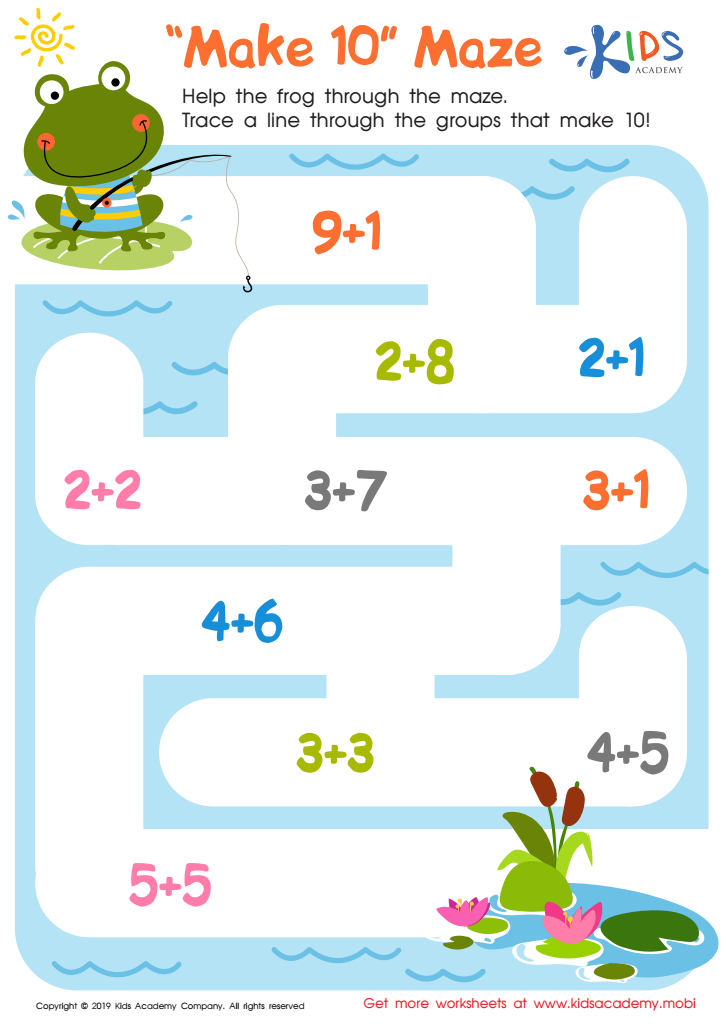
Make 10 Maze Worksheet
Help your child's frog friend make its way out of the maze! Mazes are an enjoyable way to get your kids to learn and can be a challenge. Have your kids take a look at this tracing sheet and help the frog make its way through the maze by tracing a line through the groups of equations that make 10. It’ll be a fun time for everyone!
Make 10 Maze Worksheet
Worksheet
Join Kids Academy for Free
Who is primarily going to use this learning content?








Understanding basic arithmetic is foundational for young children's overall cognitive development and future academic success. For children aged 3-4, engaging with numbers and arithmetic concepts lays the groundwork for critical thinking and problem-solving skills. At this stage, children are naturally curious and absorb information quickly; fostering their interest in math can instill a positive attitude toward learning.
Basic arithmetic introduces concepts such as counting, recognizing numbers, and understanding simple addition and subtraction. These skills go beyond math; they enhance language development as children learn the vocabulary associated with numeracy. Moreover, arithmetic provides opportunities for meaningful conversations between parents or teachers and children, building communication skills.
Early exposure to these concepts also develops spatial awareness and logical reasoning. Activities like sorting, measuring, and comparing quantities help children make sense of the world around them.
Additionally, a strong foundation in math can prevent later difficulties in the classroom. Children who grasp basic arithmetic are more likely to feel confident and competent as they progress in their education, reducing anxiety and frustration associated with math learning in older grades. Therefore, fostering basic arithmetic understanding in early childhood is crucial for their lifelong learning journey.








