
Understanding adjectives Worksheets for Ages 3-4
3 filtered results
Difficulty Level
Grade
Age
-
From - To
Subject
Activity
Standards
Explore our engaging "Understanding Adjectives Worksheets" designed specifically for ages 3-4! These fun and interactive worksheets introduce young learners to descriptive words that enhance their vocabulary and understanding of language. Through colorful activities, kids will identify and use adjectives to describe familiar objects, animals, and everyday experiences. Each worksheet encourages creativity and critical thinking while supporting early literacy skills. Perfect for home or classroom use, these resources help develop a strong foundation in language arts. Watch your little ones flourish as they learn to express themselves more vividly and make connections to the world around them!
Favorites
With answer key
Interactive
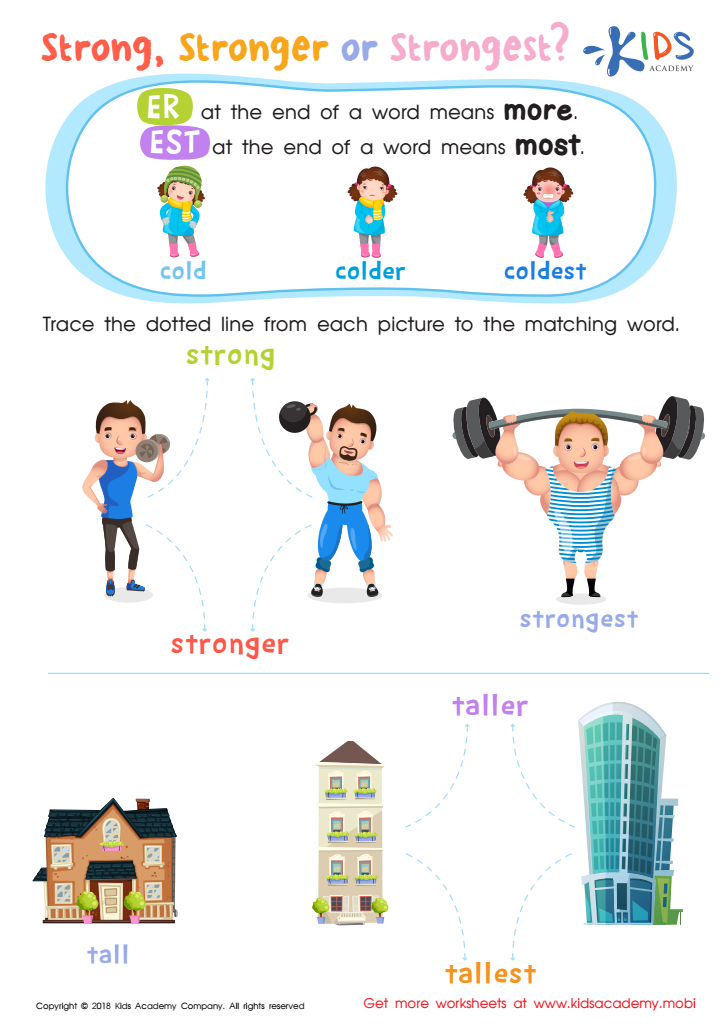
Strong or Stronger? Worksheet
Help your child understand the concept of size gradients with a fun worksheet. Explain to them that adding "-er" to words means "more" and "-est" means "most". Point to the pictures and have your little one trace the dotted line to the corresponding words to learn the concept of highest and lowest.
 Assign to My Students
Strong or Stronger? Worksheet
Worksheet
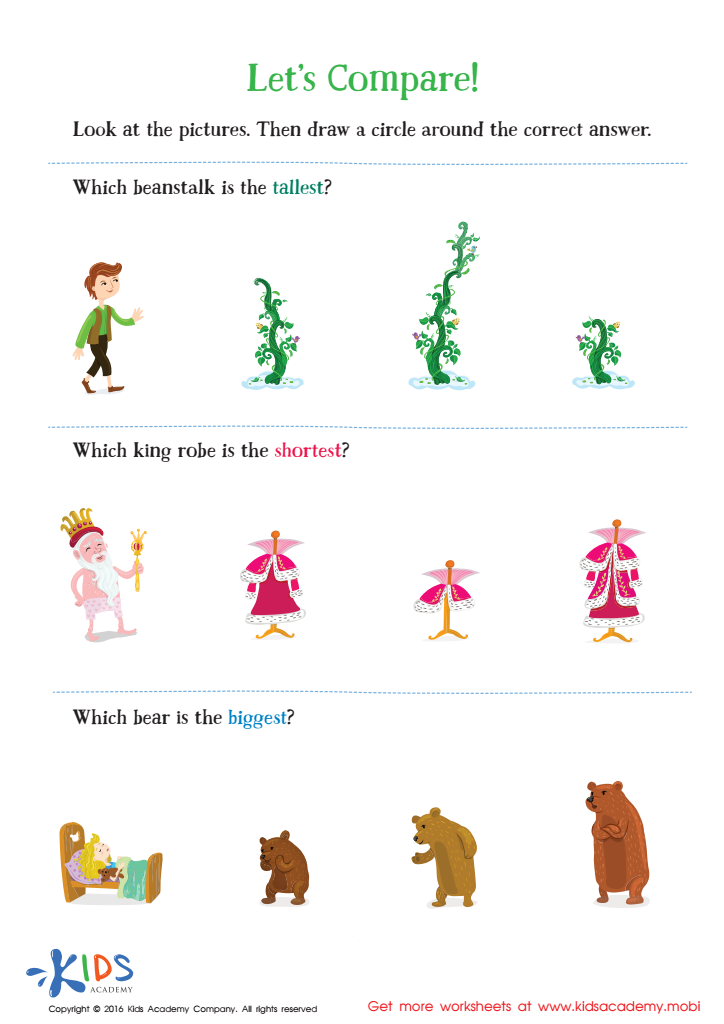
Fairy Tale Worksheet: Let's Compare
Preschoolers need to recognize different sizes of objects. This worksheet combines fun fairy tales with size practice, helping them read, problem solve, and sort through pictures. Your child will love the images and be eager to complete it. Enhance their learning by talking about the tales to build comprehension.
Fairy Tale Worksheet: Let's Compare
Worksheet
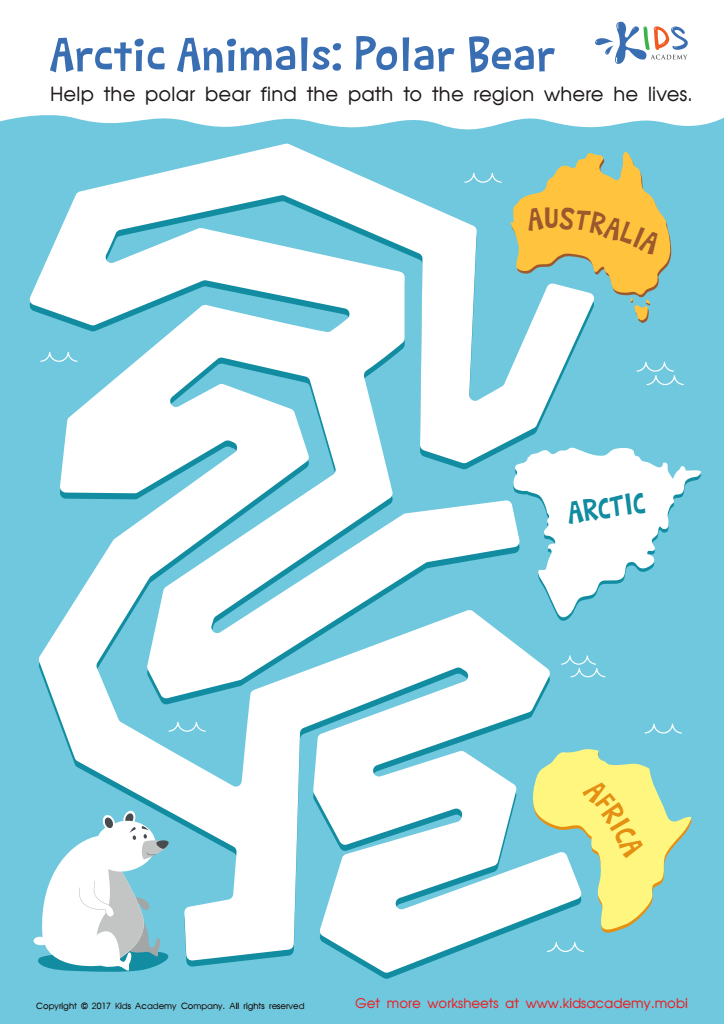
Arctic Animals: Polar Bear Worksheet
Oh no! Our polar bear friend is lost! Let's help him find his way back to the arctic with this fun worksheet. It reinforces science and social studies and kids will learn about the climate and habitats of different continents. They'll also develop logical reasoning skills! You can enrich the experience by looking up pictures of real polar bears after the worksheet is complete.
Arctic Animals: Polar Bear Worksheet
Worksheet
Join Kids Academy for Free
Who is primarily going to use this learning content?







Understanding adjectives is crucial for children aged 3 to 4 as it significantly enriches their language and cognitive development. At this stage, youngsters are eager to express themselves and make sense of their surroundings. Adjectives—words that describe nouns—play a vital role in this process by helping children articulate their thoughts and feelings more clearly.
When parents and teachers focus on introducing adjectives, they equip children with the tools to express various characteristics, such as size (big or small), color (red or blue), and emotions (happy or sad). This enhances their vocabulary and encourages them to use more descriptive language when conversing. Consequently, children become more communicative and confident.
Furthermore, understanding adjectives aids in vocabulary growth, story comprehension, and following directions. For example, grasping concepts like “tall” or “short” can help children understand height distinctions and follow instructions more accurately. Through playful activities like games, storytelling, and hands-on experiences, adults can seamlessly integrate adjectives into daily learning.
Overall, fostering an understanding of adjectives in early childhood supports cognitive skills vital for literacy, social interactions, and overall emotional development, laying a strong foundation for future learning.








