Basic counting skills Addition & Subtraction Worksheets for Ages 3-4
3 filtered results
-
From - To
Help your young learners grasp essential counting skills with our engaging Addition & Subtraction Worksheets designed for ages 3-4. These printable activities promote foundational math concepts through fun, interactive lessons that focus on basic counting, visual aids, and simple addition and subtraction problems. Perfect for early childhood development, our worksheets encourage number recognition and problem-solving in an enjoyable way. Tailored to keep little minds engaged, they can be used at home or in the classroom setting. Foster a positive attitude towards math and support your child's learning journey with these essential resources today!
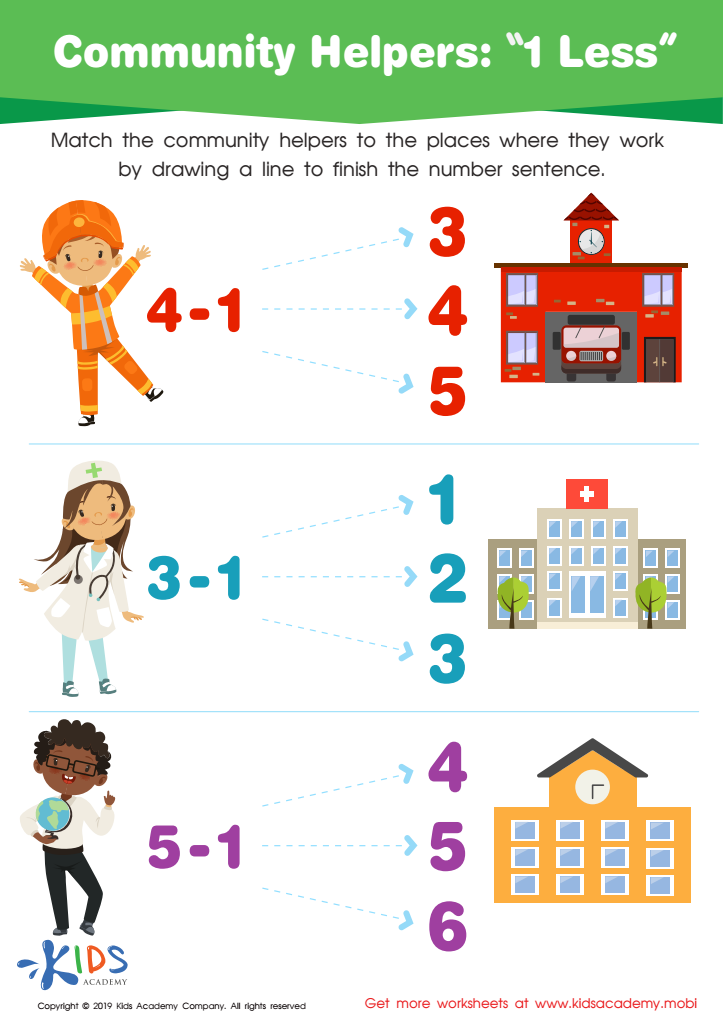
Community Helpers: 1 less Worksheet
 Assign to My Students








Basic counting skills, alongside early addition and subtraction, are fundamental building blocks for a child’s cognitive development. For ages 3-4, this foundational knowledge facilitates critical thinking and problem-solving abilities that will serve children throughout their educational journey. As they learn to count, they begin to understand quantities and establish a sense of numeracy, which is crucial for later arithmetic skills. Developing addition and subtraction concepts at this young age also lays the groundwork for more complex mathematical ideas in elementary school, such as multiplication and division.
Moreover, fostering a child's counting skills can enhance their fine motor skills through hands-on activities, such as using blocks or counting fingers. It also supports early language development, as children learn to associate numbers with their spoken counterparts. Engaging in counting and simple math encourages interaction, enhancing social skills between parents, teachers, and children.
By investing in these early numeracy skills, parents and teachers can not only boost children's confidence in mathematics but can also cultivate a lifelong love for learning. Building strong arithmetic basics at this stage helps to equip children for future academic success and inspires critical confidence when participating in everyday tasks involving math.








