
Mental math practice Worksheets for Ages 3-5
7 filtered results
Difficulty Level
Grade
Age
-
From - To
Subject
Activity
Standards
Enhance your child's cognitive development with our engaging Mental Math Practice Worksheets for Ages 3-5! Carefully crafted to suit young learners, our worksheets are designed to make early math fun and intuitive. Through playful exercises and vibrant visuals, children will build a strong foundation in mental arithmetic, helping them to add, subtract, and recognize patterns effortlessly. These activities not only boost math skills but also improve concentration, memory, and problem-solving abilities. Perfect for parents and educators seeking to support their children's educational journey, our printable worksheets are accessible and effective. Kickstart your child's math adventure today!
Favorites
With answer key
Interactive
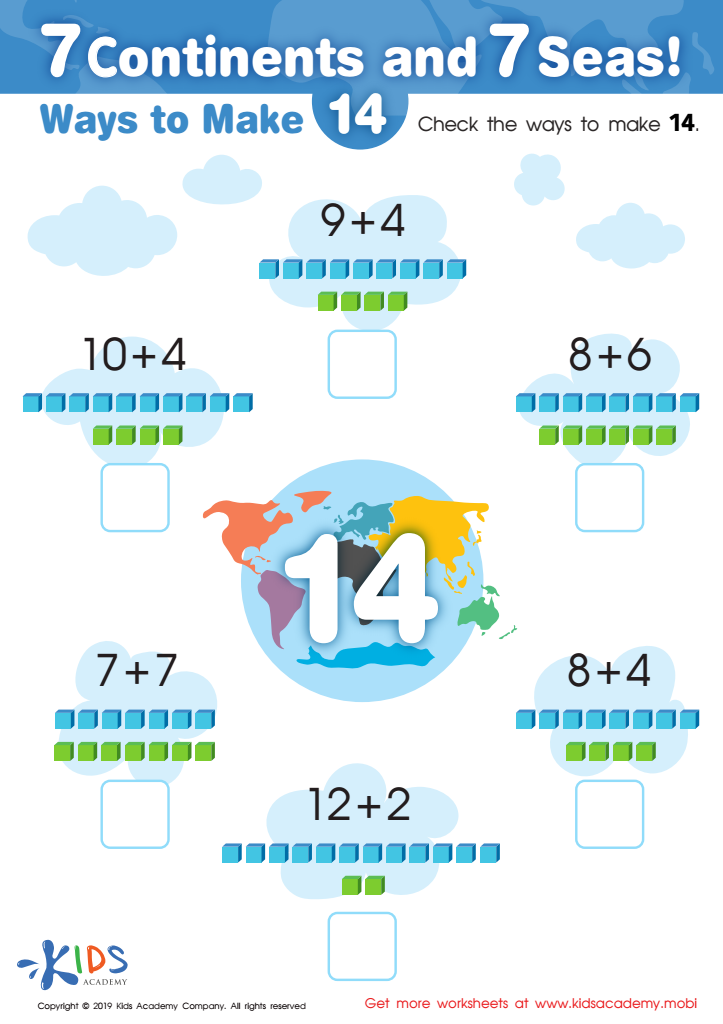
7 Continents and 7 Seas Worksheet
Remind kids of the continents and show them how different numbers can add up to the same figure. Give examples, like 2+2 =4, and 3+1 =4. Ask if they can provide other examples, then work through the simple additions in this worksheet with them. Ask them to circle all equations that make 14.
 Assign to My Students
7 Continents and 7 Seas Worksheet
Worksheet
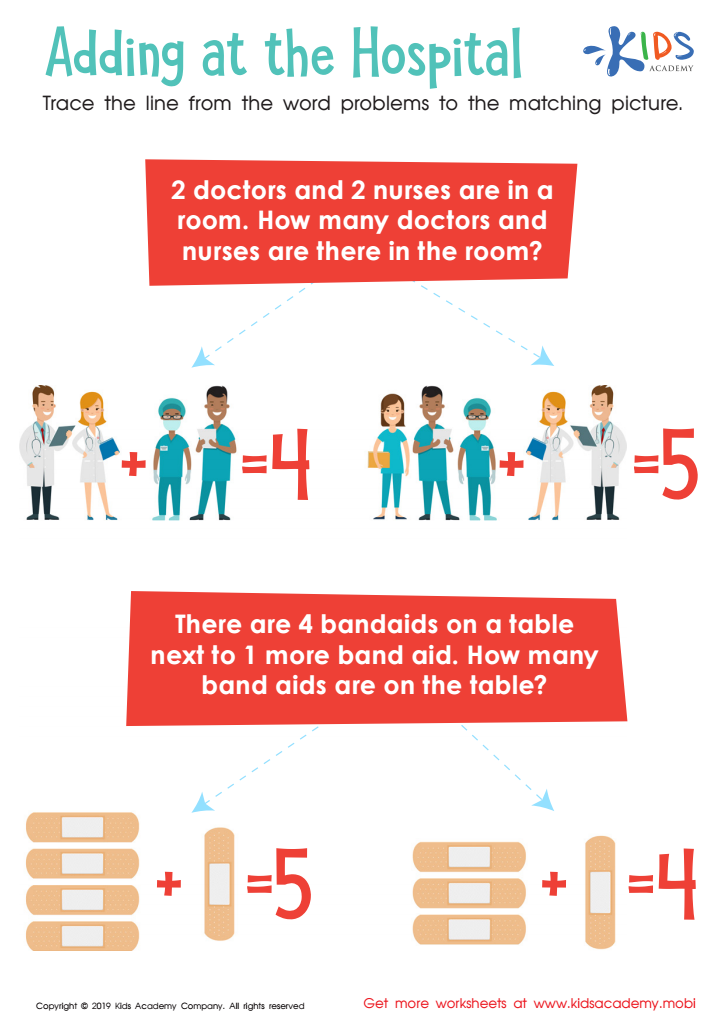
Adding at the Hospital Worksheet
A hospital visit doesn't have to be scary for kids. With this worksheet, they can count along with doctors and nurses, by reading the word problems and tracing lines to the corresponding picture. Guide them through it and you'll help them have a fun experience.
Adding at the Hospital Worksheet
Worksheet
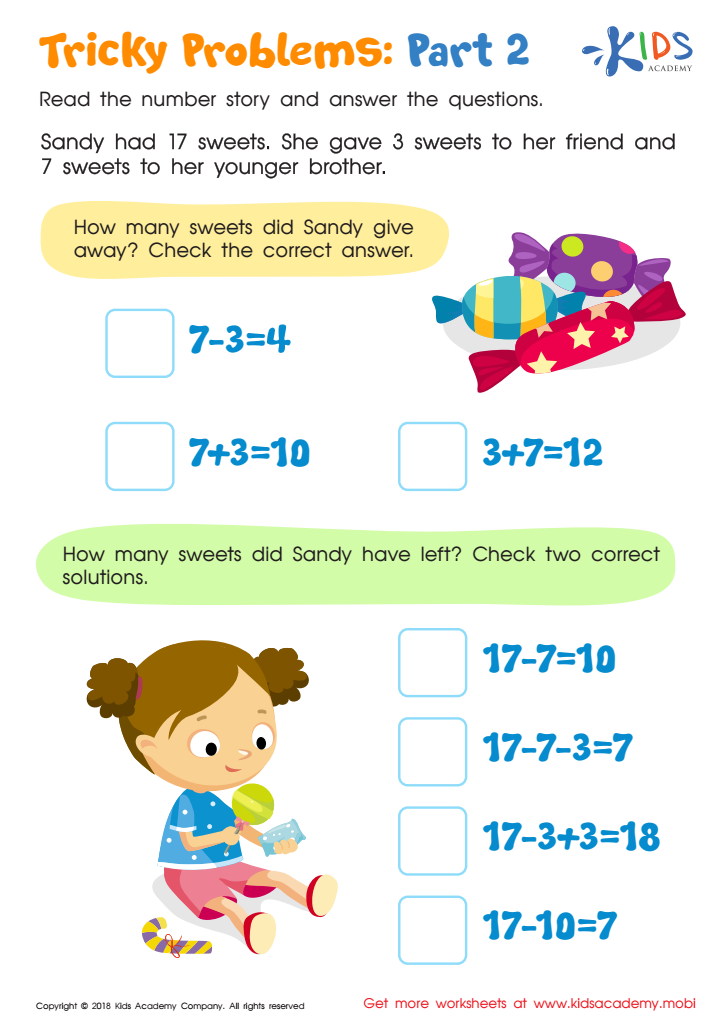
Tricky Problems Worksheet: Part 2
Help your little math learner visualize number stories with this engaging worksheet. They'll connect pictures to the story and use math facts to find the sums. After that, they'll be able to identify the correct number sentences to match. Let them practice and get better at problem solving!
Tricky Problems Worksheet: Part 2
Worksheet
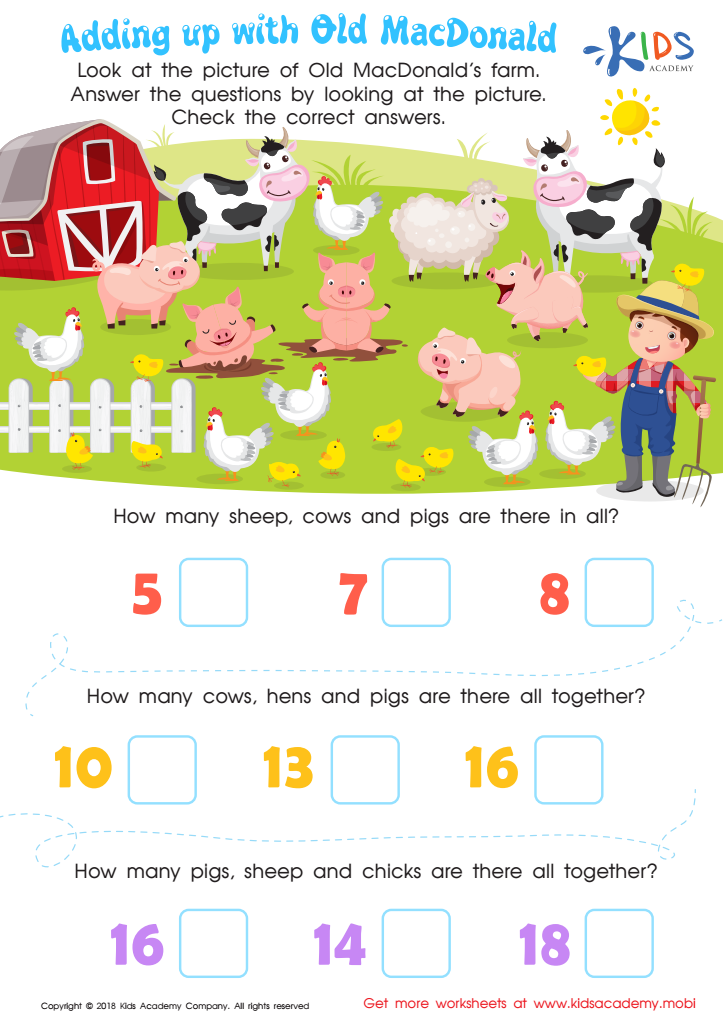
Adding Up with Old MacDonald Worksheet
Old MacDonald needs help counting his animals! Give your little math whiz a fun challenge with a free PDF worksheet. They'll love counting the animals and doing basic addition with two or three addends. Who knew math could be so much fun on the farm?
Adding Up with Old MacDonald Worksheet
Worksheet
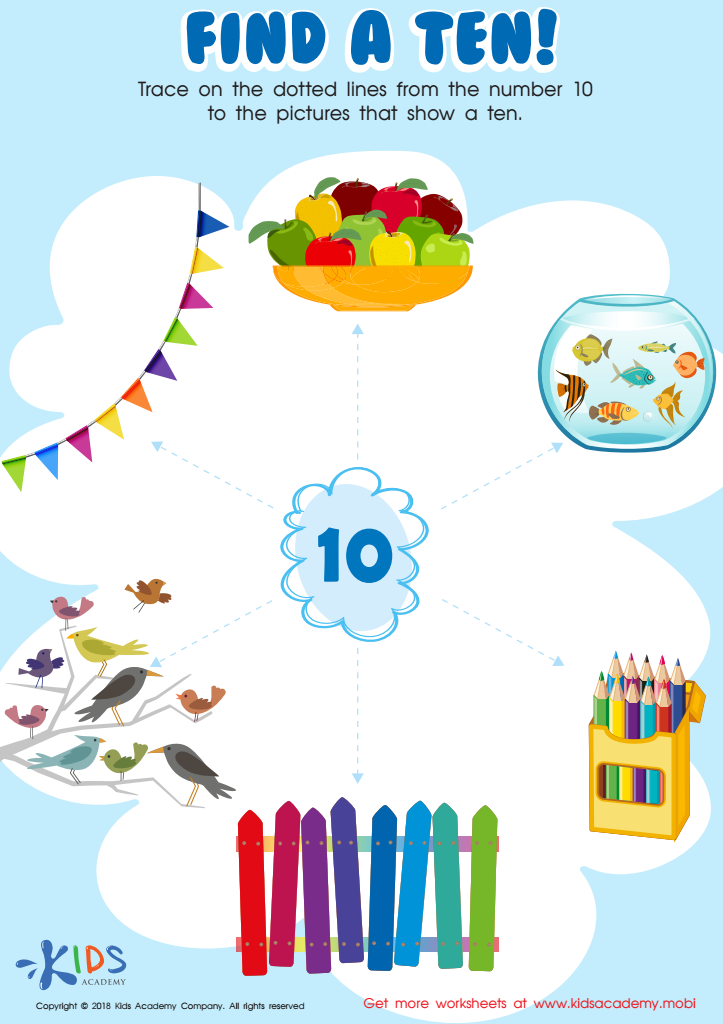
Kindergarten Math Worksheet: Find a Ten
Help your child learn to count to 10 joyfully with this kindergarten math worksheet: Find a Ten! It's full of vivid images to make counting easier. Just count the items in each picture and trace the dotted lines for the correct answer.
Kindergarten Math Worksheet: Find a Ten
Worksheet
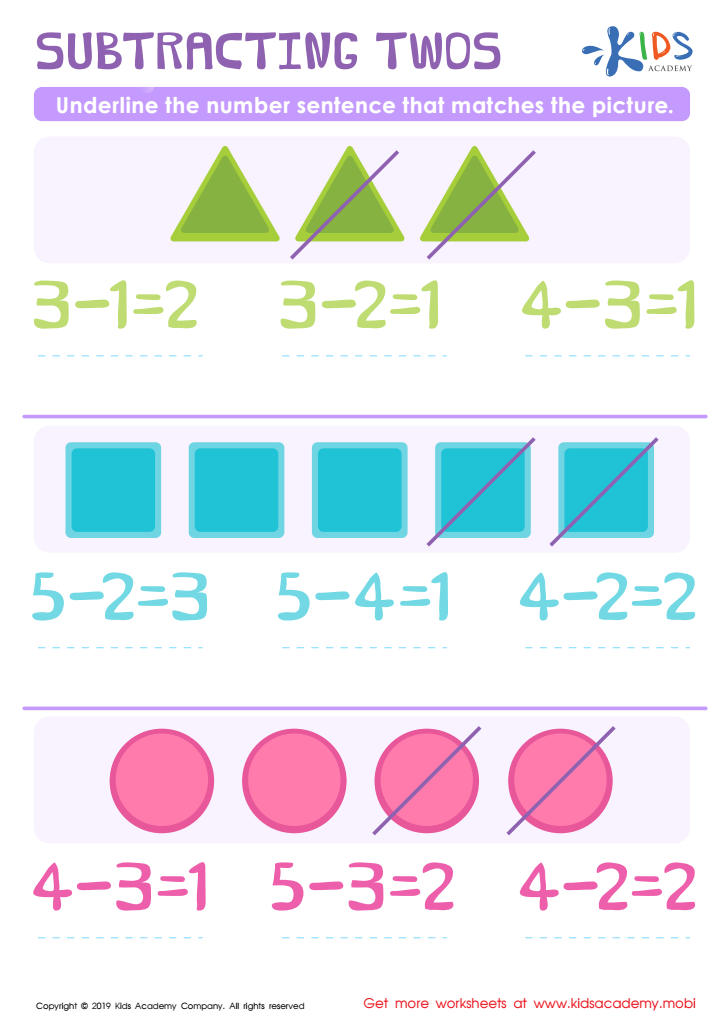
Subtracting Twos Worksheet
Help your children learn the basics of math with this worksheet. It has three number sentences they can match up with the pictures. Start by making math an enjoyable subject and help your kids underline the equation that matches up. This will give them a strong foundation to build on for the rest of their math journey.
Subtracting Twos Worksheet
Worksheet
Join Kids Academy for Free
Who is primarily going to use this learning content?








Parents and teachers should care about incorporating mental math practice for children aged 3-5 because it lays a strong foundation for future mathematical understanding and cognitive development. During these early years, children's brains are highly adaptable and open to forming new neural connections. Mental math exercises stimulate critical thinking, enhance memory, and help develop problem-solving skills.
At this formative stage, young children can learn to recognize numbers, simple counting, basic addition and subtraction through playful activities. Introducing mental math concepts in a fun, engaging manner helps them grasp abstract concepts more concretely. Furthermore, early success and enjoyment in mental math foster a positive attitude towards mathematics, which is crucial for their confidence in the subject as they progress in school.
Mental math practice also encourages concentration and focus, skills beneficial in all areas of learning. It can help develop fine motor skills when combined with physical activities, like counting toys or manipulating objects. Parents and teachers who integrate mental math games into daily routines provide children with essential tools for academic success, establishing a lifelong appreciation for numbers and problem-solving. Overall, prioritizing mental math from ages 3 to 5 equips children with the critical thinking skills necessary for navigating future academic and real-life challenges.








