
Money identification Worksheets for Ages 3-5
3 filtered results
Difficulty Level
Grade
Age
-
From - To
Subject
Activity
Standards
Help your little ones discover the fundamentals of money with our engaging Money Identification Worksheets, designed especially for ages 3-5. These colorful and interactive worksheets introduce children to various coins and bills, enhancing their visual recognition skills and financial literacy. Each activity encourages hands-on learning through fun exercises such as matching, counting, and identifying different denominations. As young learners grasp the concepts of money, they build confidence and prepare for future financial concepts in a playful, supportive environment. Download our worksheets and watch as your child embarks on an exciting journey into the world of money! Perfect for home or classroom use.
Favorites
With answer key
Interactive
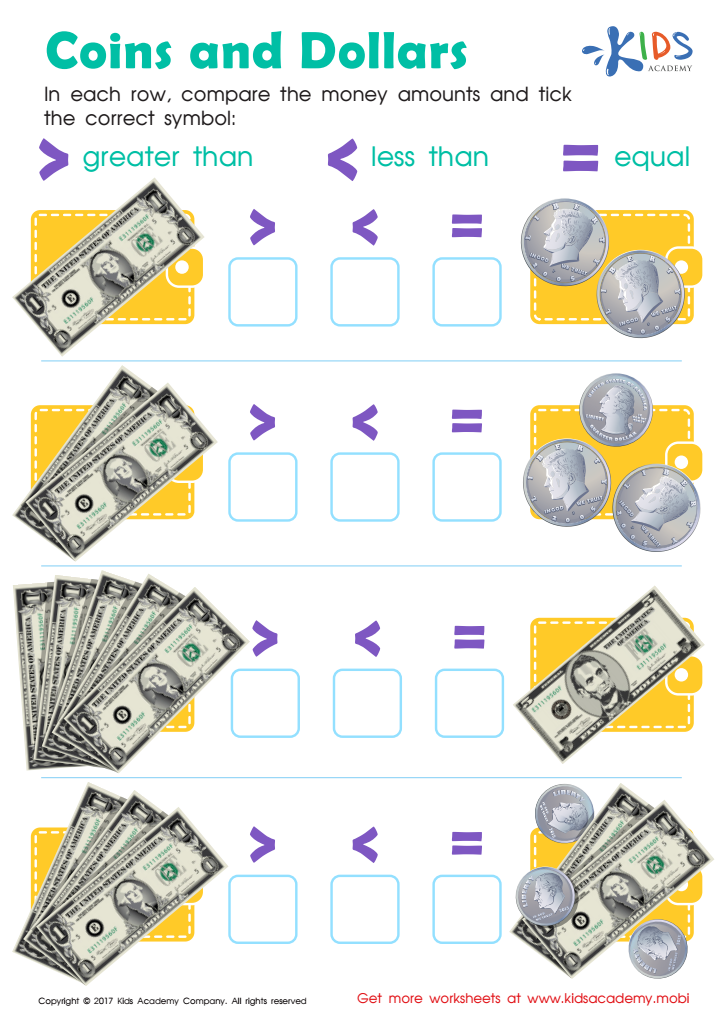
Money: Coins Dollars Printable
Motivate your kid to learn and practise essential math skills, like 'greater than' and 'less than', by introducing the importance of money! The money worksheet "Coins and Dollars" will give them a hands-on experience of counting coins and dollars, making math symbols more memorable.
 Assign to My Students
Money: Coins Dollars Printable
Worksheet
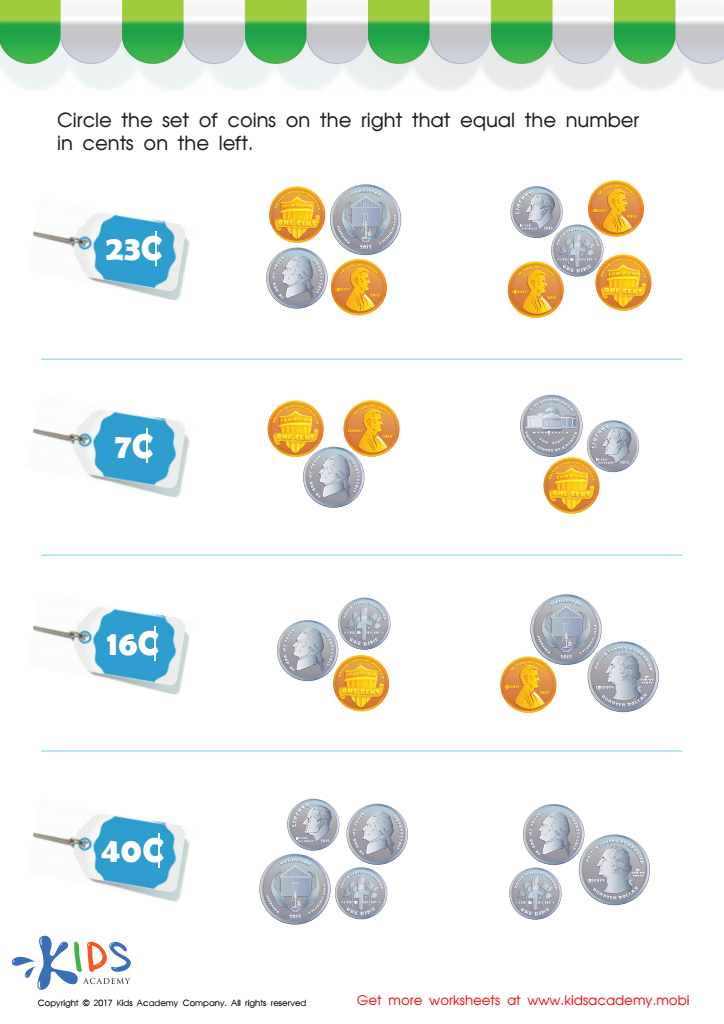
Picking the Coins You Need Money Worksheet
Let's learn to count money with Parents and Kids Academy! Investigate a real shop together: buy a globe, pencils, books, and a school bag using coins. Then, circle the coins you'll need. Visit our website for more free and fun money games for kids!
Picking the Coins You Need Money Worksheet
Worksheet
Join Kids Academy for Free
Who is primarily going to use this learning content?








Money identification is a crucial developmental skill for children aged 3 to 5, laying the groundwork for financial literacy as they grow. At this early age, children are naturally curious and eager to engage with the world around them. Introducing money concepts helps them to understand the value of exchange, which is fundamental to their everyday experiences, such as shopping or saving.
By learning to identify coins and bills, children enhance their cognitive skills through sorting, matching, and counting exercises. Engaging in hands-on activities that involve money can also promote language development, as they learn the terminology associated with values and transactions.
Parents and teachers play a vital role in supporting this learning. Parents can create positive associations with money through interactive play, such as using a toy cash register, role-playing store scenarios, or incorporating money into everyday activities like grocery shopping. Teachers can integrate money through engaging classroom activities, thus reinforcing lessons in an enjoyable manner.
Understanding money identification aids in the development of critical thinking and problem-solving skills, fostering independence and responsible decision-making. In essence, nurturing these foundational skills equips children for future financial health and confidence, forming a base for lifelong financial education.








