Filters

7 filtered results

Clear all filters
Favorites
With answer key
Interactive

7 filtered results

Difficulty Level

Grade


Our "Problem-Solving Skills Addition Facts Worksheets for Ages 3-5" make learning fun and engaging for young learners. Designed to develop foundational math skills, these worksheets incorporate colorful visuals and practical exercises to help children grasp basic addition concepts. Perfect for preschool and early kindergarten students, the activities encourage critical thinking, enhance problem-solving abilities, and boost number recognition. By focusing on interactive and hands-on learning, these worksheets facilitate a deeper understanding of addition, laying a strong foundation for future math success. Ideal for parents and educators aiming to support early math development at home or in the classroom.

Check out this FREE Trial Lesson on Addition Facts for age 3-5!

More Word Problems

Favorites
With answer key
Interactive
  • 3-5
  • Problem-Solving Skills
  • Addition Facts
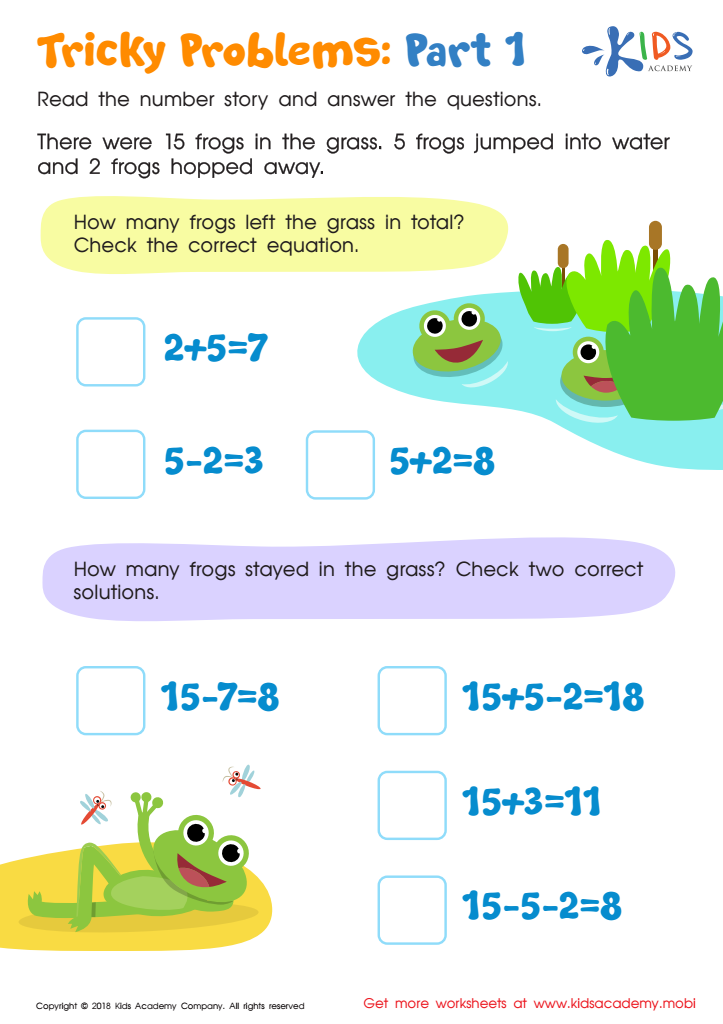
Tricky Problems Worksheet: Part 1

Tricky Problems Worksheet: Part 1

Visualizing word problems can help students solve them. This fun PDF worksheet encourages students to create mental images using math facts, then check boxes to match the equations for basic addition problems. It's a great way to build confidence in solving math.
Tricky Problems Worksheet: Part 1
Worksheet
7 Continents and 7 Seas Worksheet

7 Continents and 7 Seas Worksheet

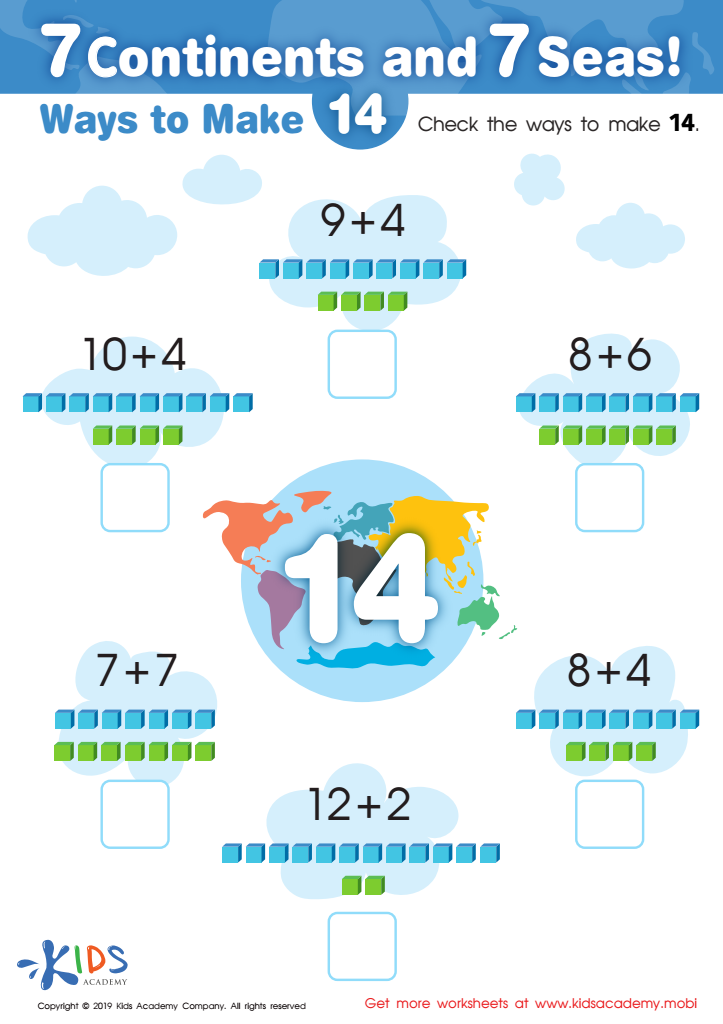
Remind kids of the continents and show them how different numbers can add up to the same figure. Give examples, like 2+2 =4, and 3+1 =4. Ask if they can provide other examples, then work through the simple additions in this worksheet with them. Ask them to circle all equations that make 14.
7 Continents and 7 Seas Worksheet
Worksheet
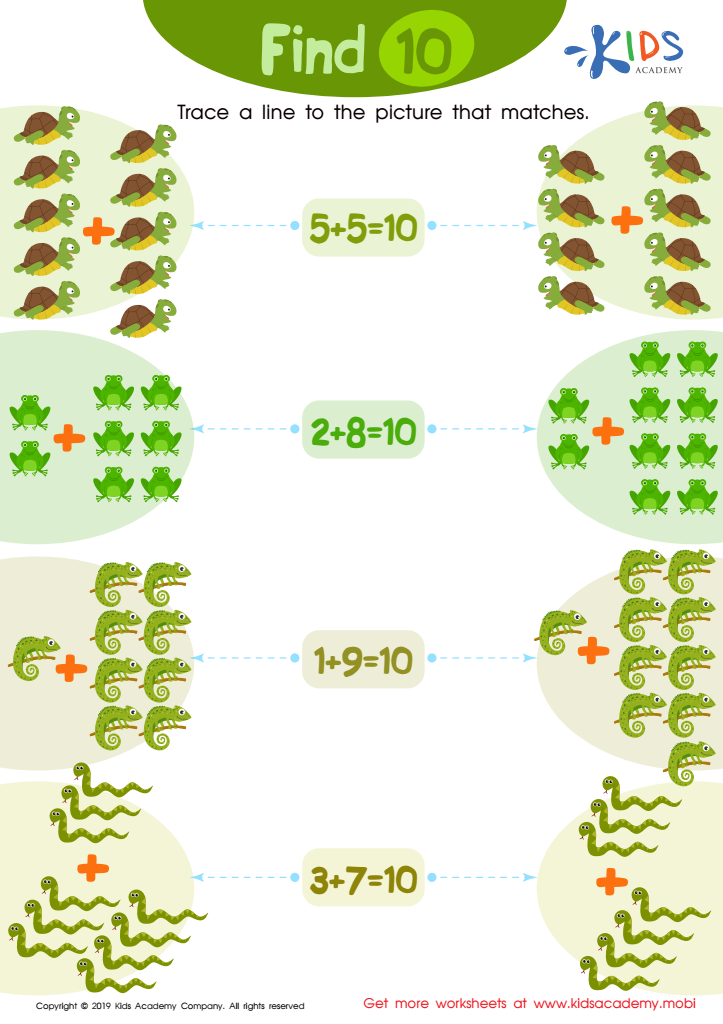
Find 10 Worksheet
Find 10 Worksheet

Find 10 Worksheet

Counting can be tricky, but your kids can master it with regular practice. Here's a fun activity to help: count the animals, then trace a line to the pictures that matches. With these tips, math will be an easy walk in the park.
Find 10 Worksheet
Worksheet
Equations Matching Word Problems Worksheet

Equations Matching Word Problems Worksheet

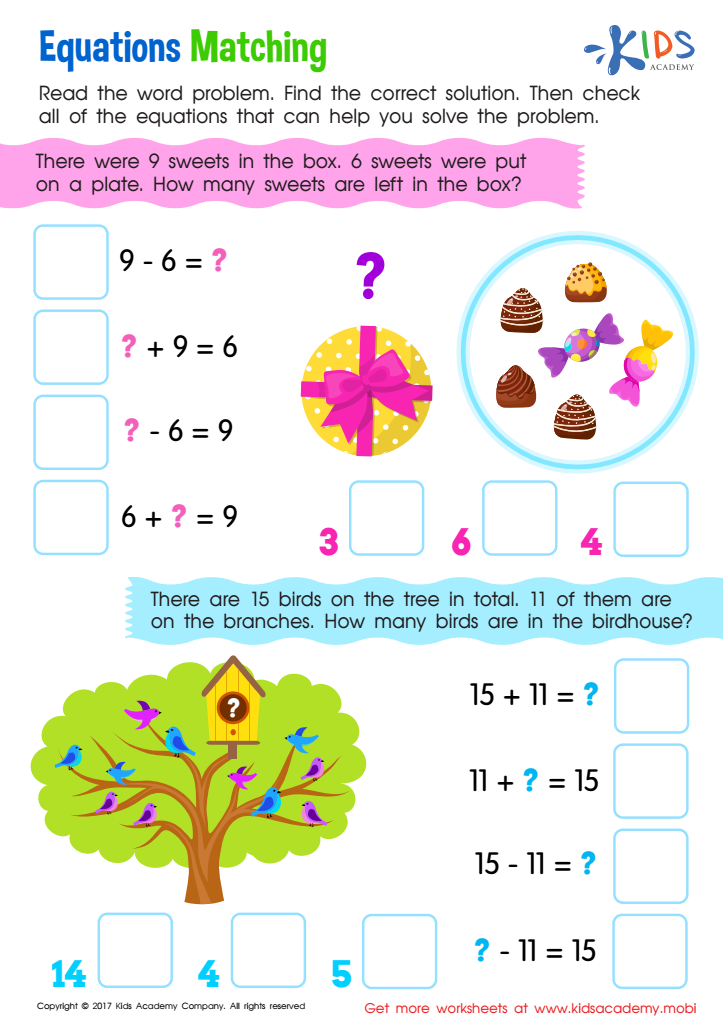
Download this worksheet and give your young mathematician practice in solving equations using matching numbers and number family facts. They'll solve word problems, develop critical thinking and algebraic reasoning, and gain success with addition and subtraction.
Equations Matching Word Problems Worksheet
Worksheet
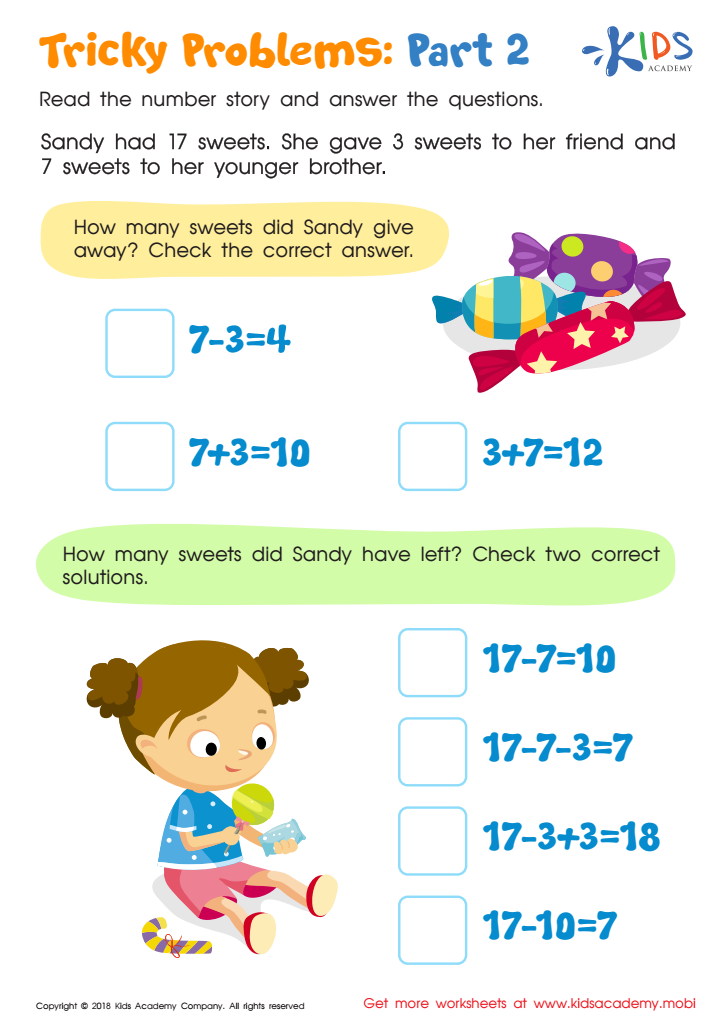
Tricky Problems Worksheet: Part 2

Tricky Problems Worksheet: Part 2

Help your little math learner visualize number stories with this engaging worksheet. They'll connect pictures to the story and use math facts to find the sums. After that, they'll be able to identify the correct number sentences to match. Let them practice and get better at problem solving!
Tricky Problems Worksheet: Part 2
Worksheet
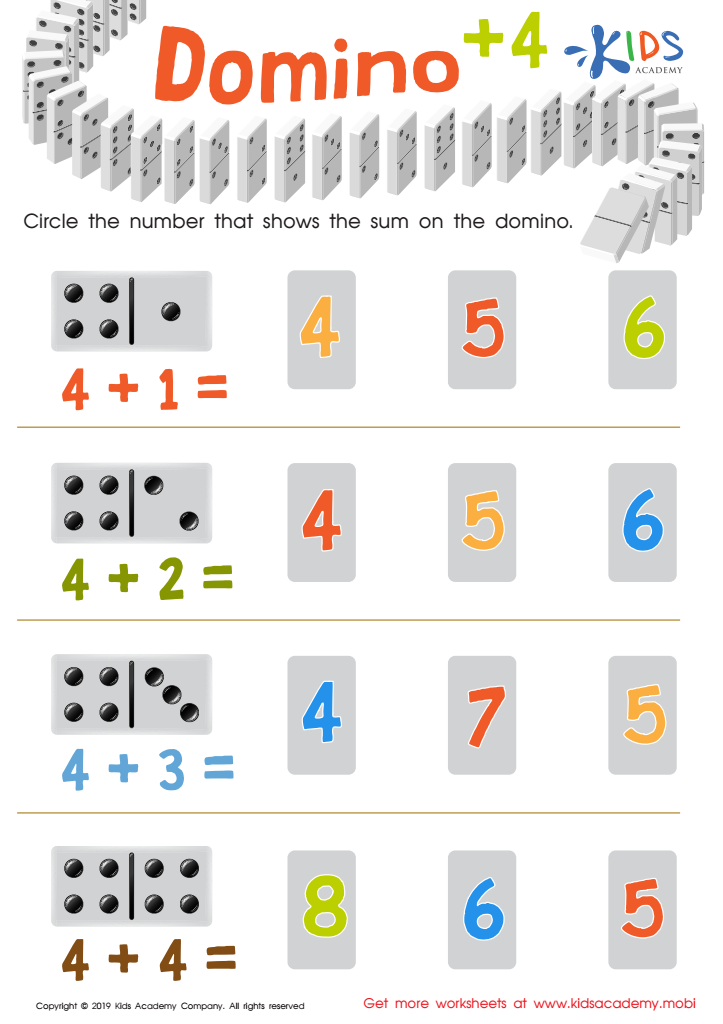
Domino +4 Worksheet
Domino +4 Worksheet

Domino +4 Worksheet

Ask your kids if they know what a domino is. Explain, then move on to solving the four simple equations on this printout, adding a number to 4. Help them find the sum and circle the number.
Domino +4 Worksheet
Worksheet
Flags and Fours Worksheet


Flags and Fours Worksheet

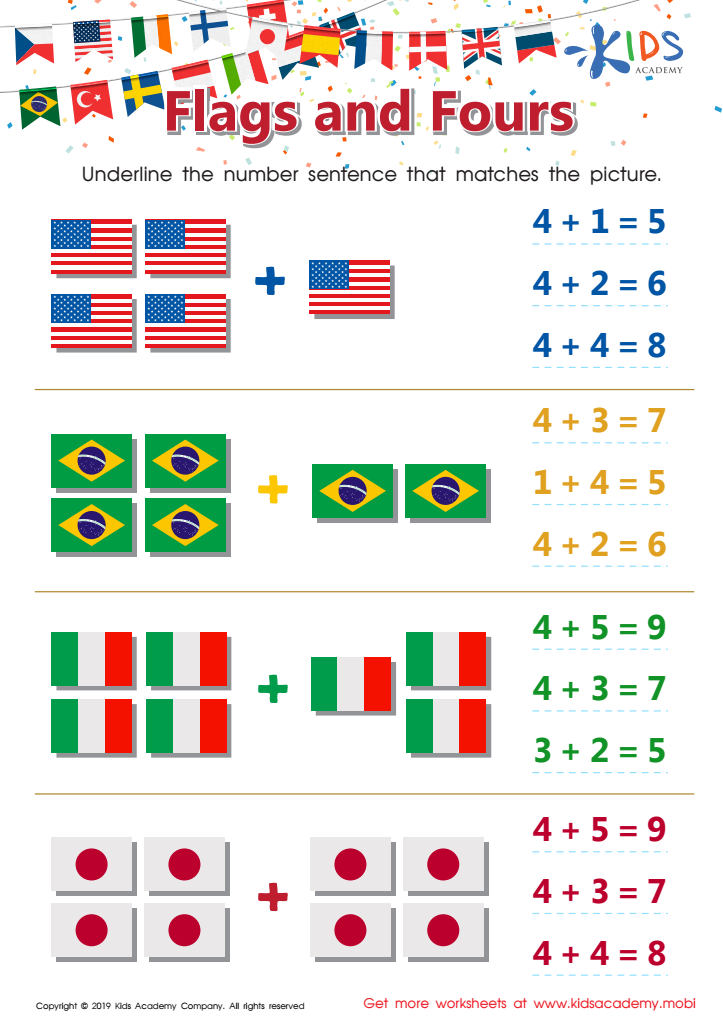
Have your kids identify country flags from this colorful printout. Then, ask them to underline the number sentence that goes with each flag. Combining math with national flag recognition strengthens kids' knowledge of both, promoting an understanding of identity and numbers.
Flags and Fours Worksheet
Worksheet


Problem-solving skills in addition facts for ages 3-5 form a crucial foundation for a child's future learning and cognitive development. At this tender age, children's brains are exceptionally receptive and developing rapidly. Introducing problem-solving through addition not only fosters mathematical understanding but also enhances critical thinking. When parents and teachers focus on addition for young learners, they help build essential cognitive skills like memory, attention, and logical reasoning.

Understanding addition prepares children to grasp more advanced mathematical concepts later. It's akin to laying the first bricks of a sturdy building. Furthermore, these skills aren't just limited to math; they are transferrable and applicable in everyday activities, helping children understand patterns, make decisions, and solve real-world problems.

Moreover, learning addition through problem-solving activates curiosity and fosters a love for learning. Children who find joy in solving problems are more likely to maintain a positive attitude toward education. Engaging activities that teach addition in contexts they can relate to make learning fun and meaningful. This holistic approach also boosts their confidence, speech, and social interactions when they discuss and explain solutions.

In summary, focusing on problem-solving skills in addition at ages 3-5 equips children with essential tools for academic success and life-long intellectual development. Parents and teachers play a pivotal role in this transformative process.