
Fine motor development Addition & Subtraction Worksheets for Ages 3-5
3 filtered results
Difficulty Level
Grade
Age
-
From - To
Subject
Activity
Standards
Enhance your child’s early math skills and fine motor development with our engaging addition and subtraction worksheets designed specifically for ages 3-5. These worksheets combine playful activities that make learning math fun and interactive. As children solve simple math problems, they'll also practice vital fine motor skills by cutting, pasting, and coloring. Each worksheet is crafted to be visually appealing and encourage hands-on learning, making it easier for little ones to grasp fundamental math concepts. Perfect for home or classroom use, our resources support your child's cognitive growth while promoting essential motor coordination. Start your learning journey today!
Favorites
With answer key
Interactive
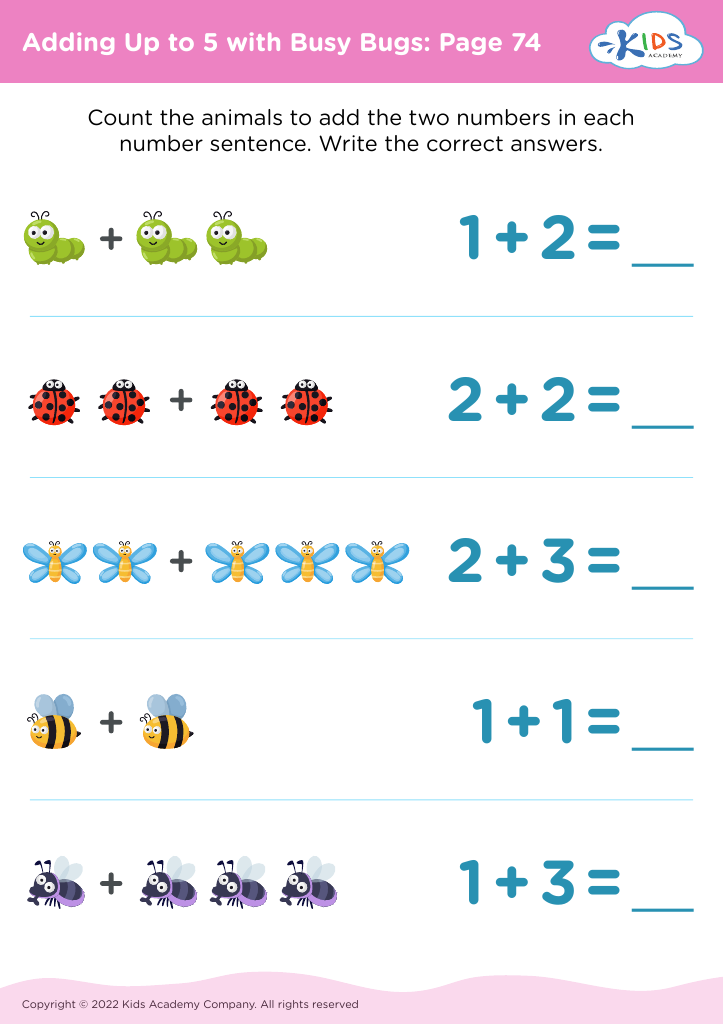
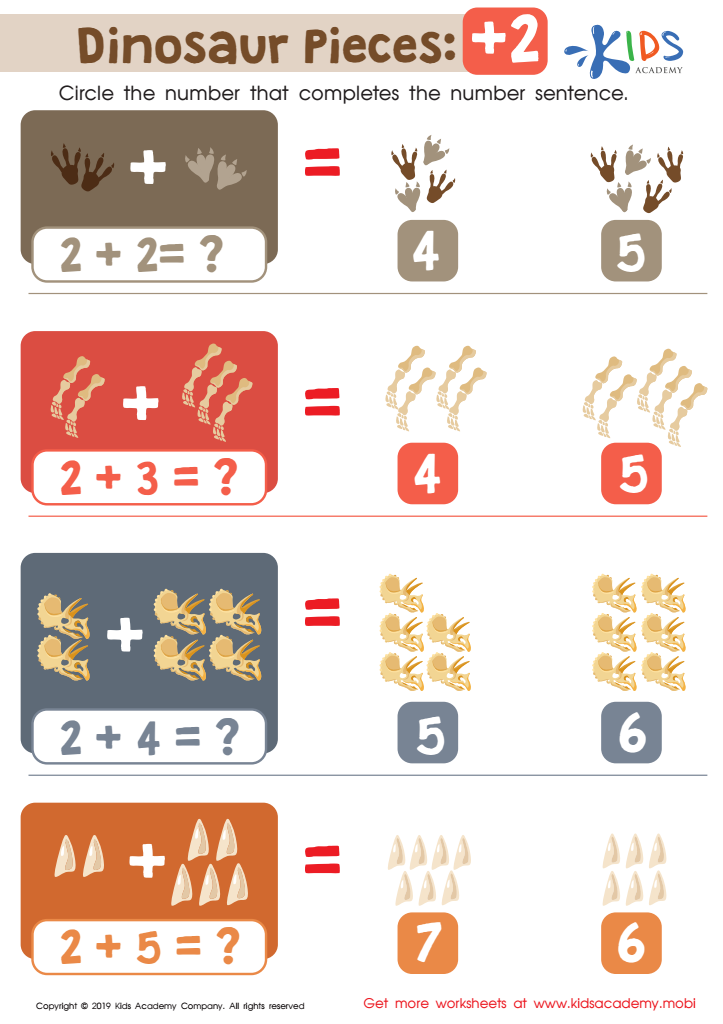
Dinosaur Pieces: +2 Worksheet
Kids love dinosaurs! See if your kids can solve these three equations featuring the mysterious creatures. Download the PDF and have them circle the number that completes each equation. Dinosaurs are extinct, not seen for thousands of years, but they can still help kids work on their math skills!
 Assign to My Students
Dinosaur Pieces: +2 Worksheet
Worksheet
Join Kids Academy for Free
Who is primarily going to use this learning content?








Fine motor development is crucial for children aged 3-5 as it lays the foundation for essential life skills and academic success. During this developmental stage, children refine their hand-eye coordination, dexterity, and control over small muscle movements, all of which are necessary for engaging in activities like writing, drawing, and manipulating objects. This is particularly important in mastering early math concepts such as addition and subtraction.
When children develop fine motor skills, they become more adept at using tools like pencils or scissors, which enhances their ability to express mathematical concepts visually. Activities that integrate fine motor tasks—such as using manipulatives for counting or drawing to represent addition and subtraction problems—can significantly reinforce their understanding of these mathematical operations.
Moreover, involving parents and teachers in promoting fine motor activities creates a collaborative environment that supports a child's learning. Simple tasks, like threading beads or building blocks, can enhance both fine motor skills and basic math competencies. By nurturing this development, we help shape confident learners who not only enjoy math but also gain the skills necessary for success in school and beyond. In essence, fine motor development is a pathway to cognitive, social, and emotional growth for young learners.








