
Fine motor development Addition Worksheets for Ages 3-5
3 filtered results
Difficulty Level
Grade
Age
-
From - To
Subject
Activity
Standards
Enhance your child’s fine motor skills while introducing them to the concept of addition with our engaging worksheets designed for ages 3-5. These fun, interactive activities not only help young learners practice counting and number recognition but also encourage the development of essential hand-eye coordination and dexterity. Filled with colorful illustrations and age-appropriate exercises, our fine motor development addition worksheets offer a balanced mix of educational content and playful design. Perfect for home or classroom use, these worksheets support early numeracy skills while fostering creativity and engagement. Start your child's learning journey today and watch their confidence grow!
Favorites
With answer key
Interactive
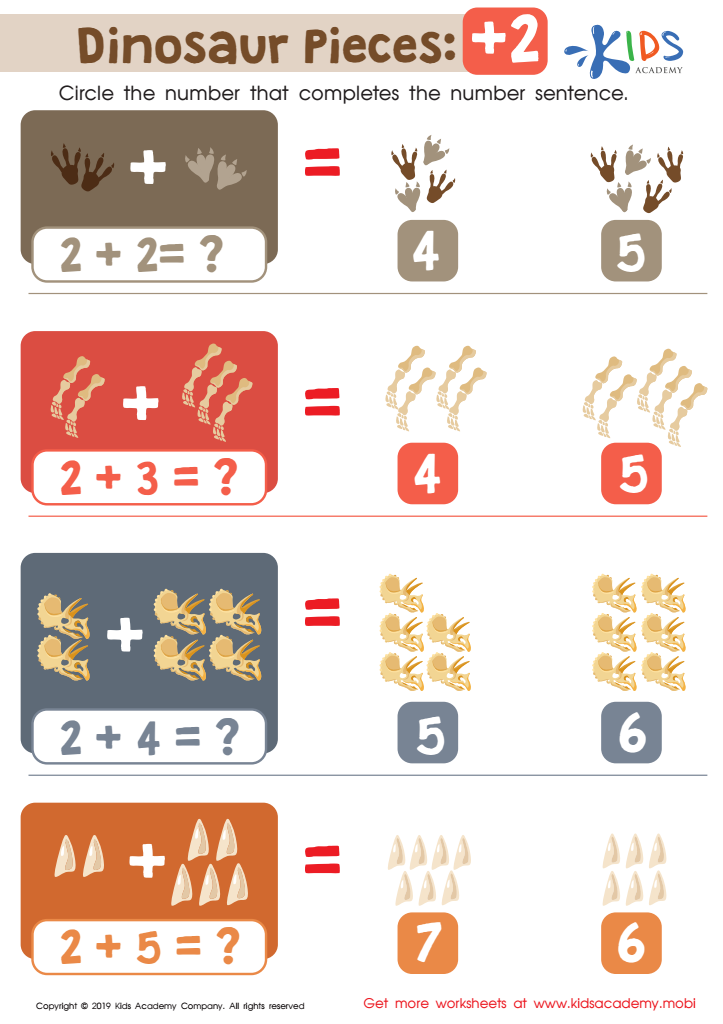
Dinosaur Pieces: +2 Worksheet
Kids love dinosaurs! See if your kids can solve these three equations featuring the mysterious creatures. Download the PDF and have them circle the number that completes each equation. Dinosaurs are extinct, not seen for thousands of years, but they can still help kids work on their math skills!
 Assign to My Students
Dinosaur Pieces: +2 Worksheet
Worksheet
Join Kids Academy for Free
Who is primarily going to use this learning content?








Fine motor development is crucial for children aged 3-5 as it lays the foundation for essential skills they will use throughout their lives. During this stage, children refine their hand-eye coordination and dexterity, enabling them to perform tasks like holding a pencil, cutting with scissors, and manipulating small objects. These abilities are not only vital for academic success but also for everyday activities such as tying shoelaces, buttoning shirts, and eating independently.
Parents and teachers should care about fine motor development as it directly impacts a child's confidence and independence. Activities that promote dexterity—like drawing, coloring, playing with clay, or building with blocks—enhance neural connectivity, encourage creativity, and bolster cognitive skills. Furthermore, fine motor skills are closely linked to literacy and math development; children who struggle with these skills may find writing and manipulating numbers challenging.
Also, fostering fine motor skills can provide children with a sense of accomplishment, which boosts self-esteem and motivation in learning. By being attuned to the importance of this developmental area, parents and teachers can create a supportive environment that nurtures children's growth, ensuring they are well-prepared for the academic challenges ahead. Active engagement in fine motor activities is essential for holistic childhood development.








