
Understanding prepositions Geometry Worksheets for Ages 3-5
4 filtered results
Difficulty Level
Grade
Age
-
From - To
Subject
Activity
Standards
Our "Understanding Prepositions Geometry Worksheets" for ages 3-5 offer an exciting and engaging way for young learners to develop essential geometry skills. Through colorful and interactive activities, children will learn to recognize and use prepositions like above, below, next to, and more, all while enhancing their spatial awareness. Perfect for early educational settings or home practice, these worksheets will keep kids captivated and motivated. Start building a strong foundation in geometry and language skills today with our specially designed resources that support Cognitive Development and align with early learning standards. Embark on a fun-filled learning adventure with us!
Favorites
With answer key
Interactive
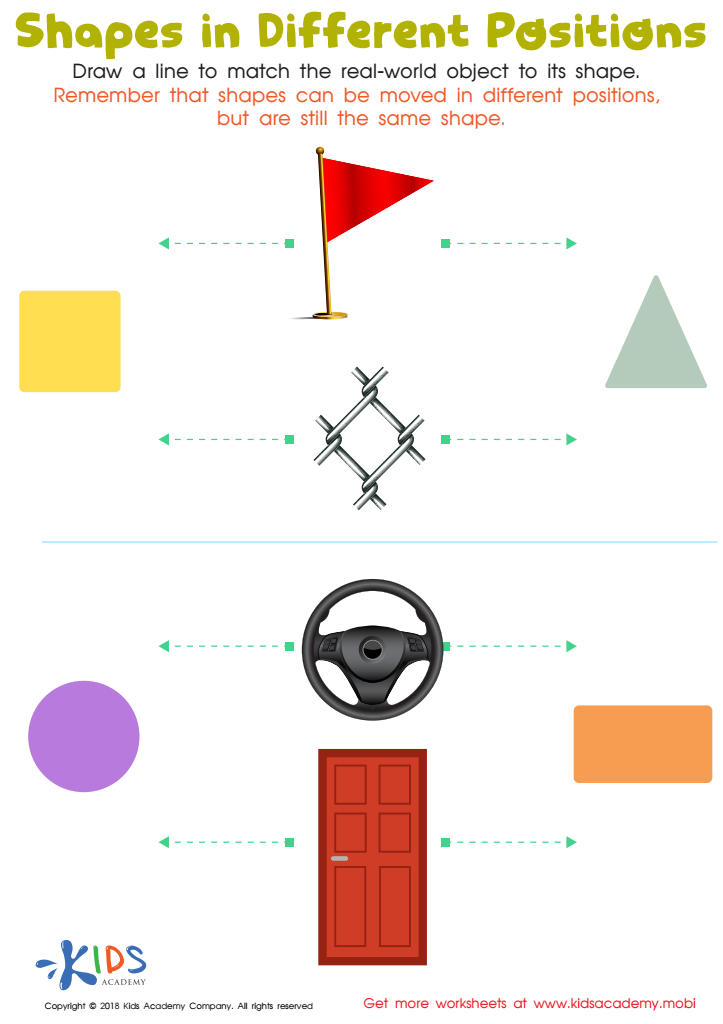
Shapes in Different Positions Worksheet
Children can practice and strengthen their visual-discernment, hand-eye coordination and neural connections by manipulating shapes in their minds and matching them with the right answer. This PDF with bright colors gives your kids the opportunity to do so.
 Assign to My Students
Shapes in Different Positions Worksheet
Worksheet











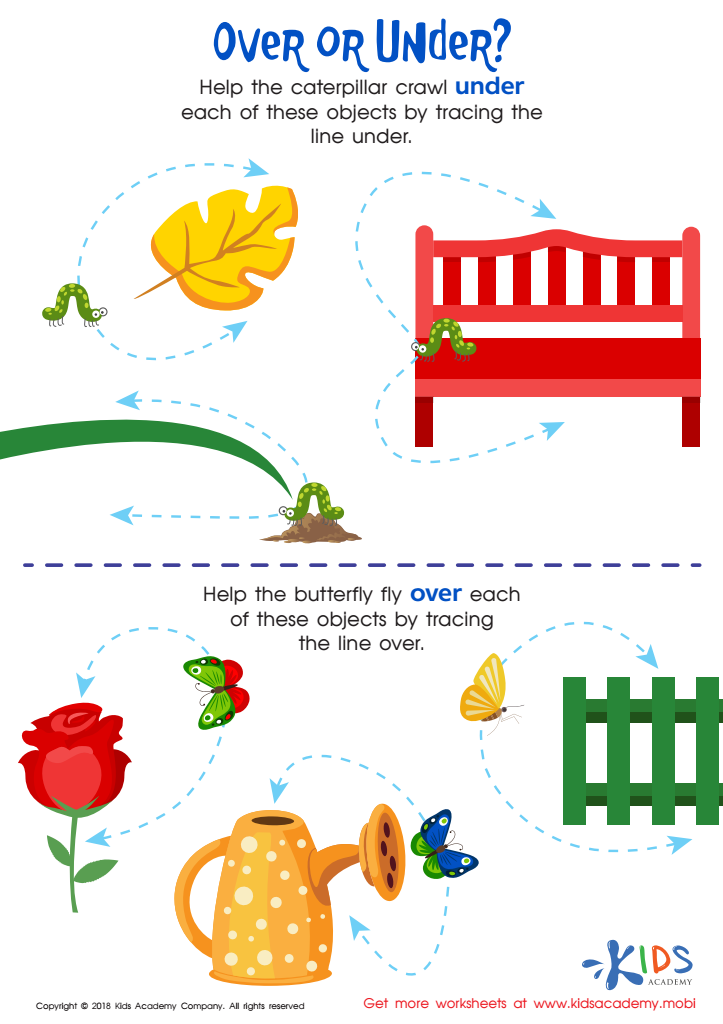
Over or Under? Worksheet
Math for young kids isn't just about numbers and counting, but also spatial concepts like geometry. This worksheet helps students learn "over" and "under" by tracing the movement of caterpillars and butterflies. Downloadable for free, it's an effective teaching tool for early learners.
Over or Under? Worksheet
Worksheet
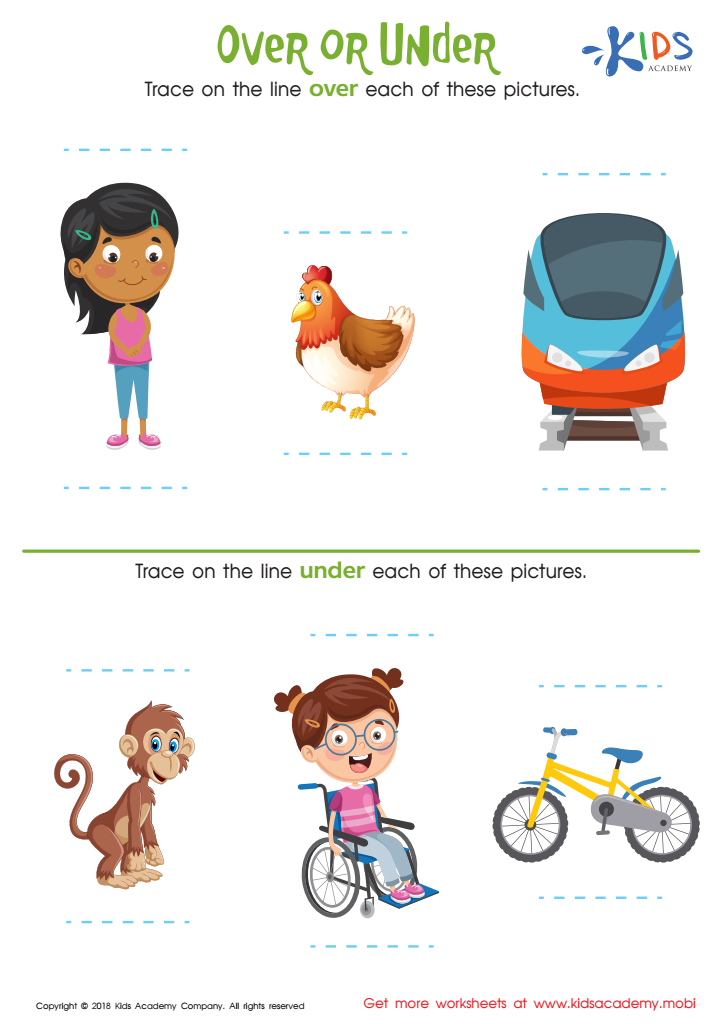
Over or Under Worksheet
Help your toddler grasp prepositions like "over" and "under" with this fun worksheet. Have them trace lines over the pictures on one half and under the pictures on the other, thus practicing basic communication and math concepts. Strengthen your child's understanding and communication skills with this activity.
Over or Under Worksheet
Worksheet
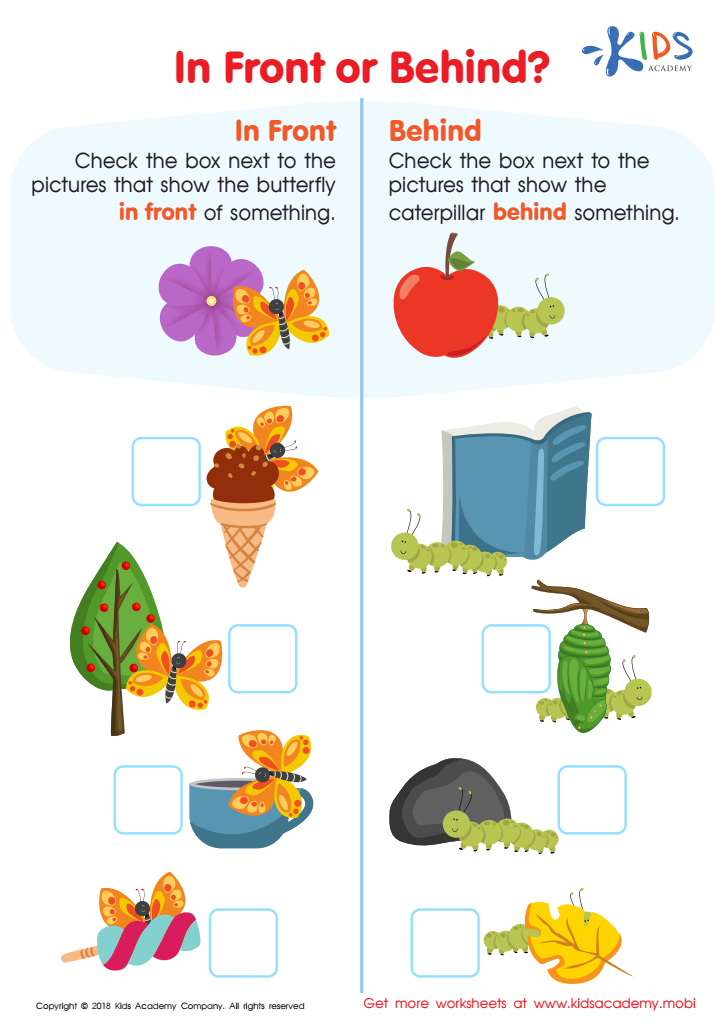
In Front or Behind Worksheet
Hone your child's spatial skills with 'in front' and 'behind'! This knowledge is essential for communication and study. Get them started with this free PDF worksheet - check off the pictures that show the butterfly in front and caterpillar behind!
In Front or Behind Worksheet
Worksheet
Join Kids Academy for Free
Who is primarily going to use this learning content?








Understanding prepositions in the context of geometry is crucial for children between the ages of 3 to 5 because it forms the foundation for both language and spatial awareness. Prepositions like "above," "below," "beside," "behind," and "in front" are fundamental in describing the relationships between objects in space. Mastering these concepts can significantly aid in vocabulary expansion and enhance communication skills.
In terms of cognitive development, grasping spatial relationships is essential. It helps young children make sense of the world around them and aids in everyday problem-solving tasks, such as navigating spaces or even understanding location-based instructions. For instance, knowing the difference between “under the table” and "on the table" is essential for following directions in daily activities.
Moreover, early exposure to spatial language can boost mathematical thinking. Prepositional geometry helps lay the groundwork for more advanced mathematics and sciences. Recognizing shapes and their positions improves a child's ability to engage with more complex geometric concepts later in school.
Parents and teachers play a crucial role by incorporating simple activities like story-telling using spatial terms, interactive play, and guided explorations of surroundings. Such enriching experiences foster both linguistic and cognitive growth, ensuring a smoother transition to formal education. Understanding these basics invites children into a world of learning that extends far beyond the early years.








