
Develop problem-solving skills Math Worksheets for Ages 3-5
3 filtered results
Difficulty Level
Grade
Age
-
From - To
Subject
Activity
Standards
Welcome to our "Develop Problem-Solving Skills Math Worksheets" designed specifically for children aged 3-5! These engaging and fun-filled worksheets encourage young learners to think critically and tackle mathematical challenges with confidence. Each worksheet focuses on essential skills, such as pattern recognition, basic counting, and logic puzzles, fostering a strong foundation for future math success. By using colorful visuals and interactive activities, our resources help children develop their problem-solving abilities in a playful way. Perfect for parents and educators looking to enhance early math learning, these worksheets motivate children to explore, think independently, and enjoy the delights of solving math problems.
Favorites
With answer key
Interactive
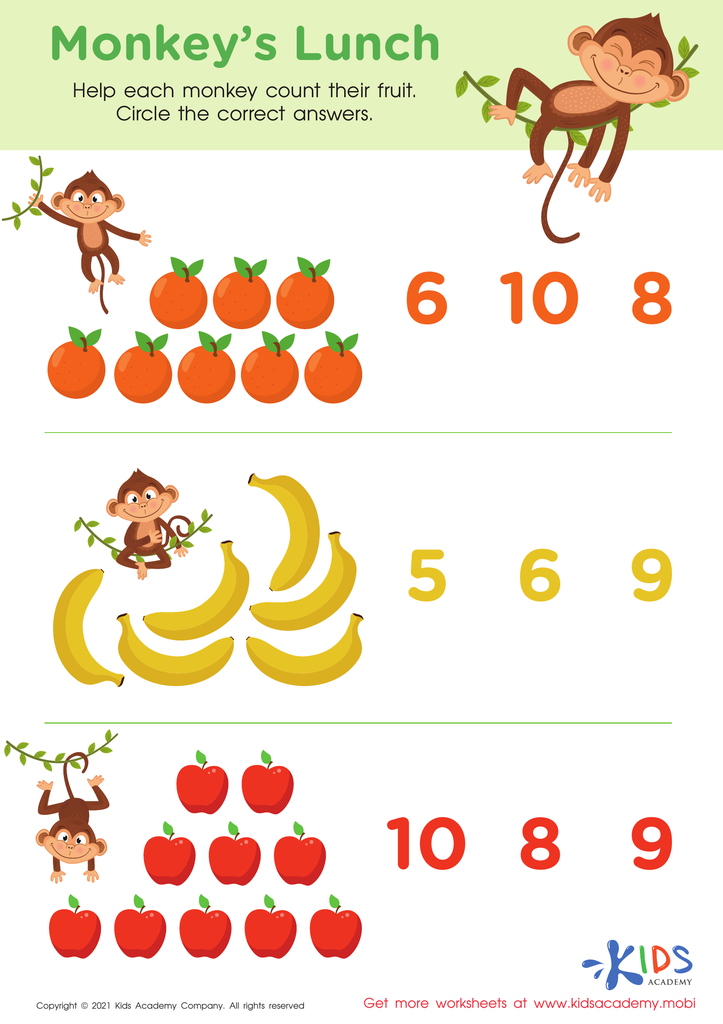
Monkey’s Lunch Worksheet
Download this free worksheet to help your kindergartner perfect their counting skills! Have your child circle the correct answers and count the fruits for the monkeys. It'll seem like fun, but your child is really learning how to count, group objects, and identify numbers.
Monkey’s Lunch Worksheet
Worksheet
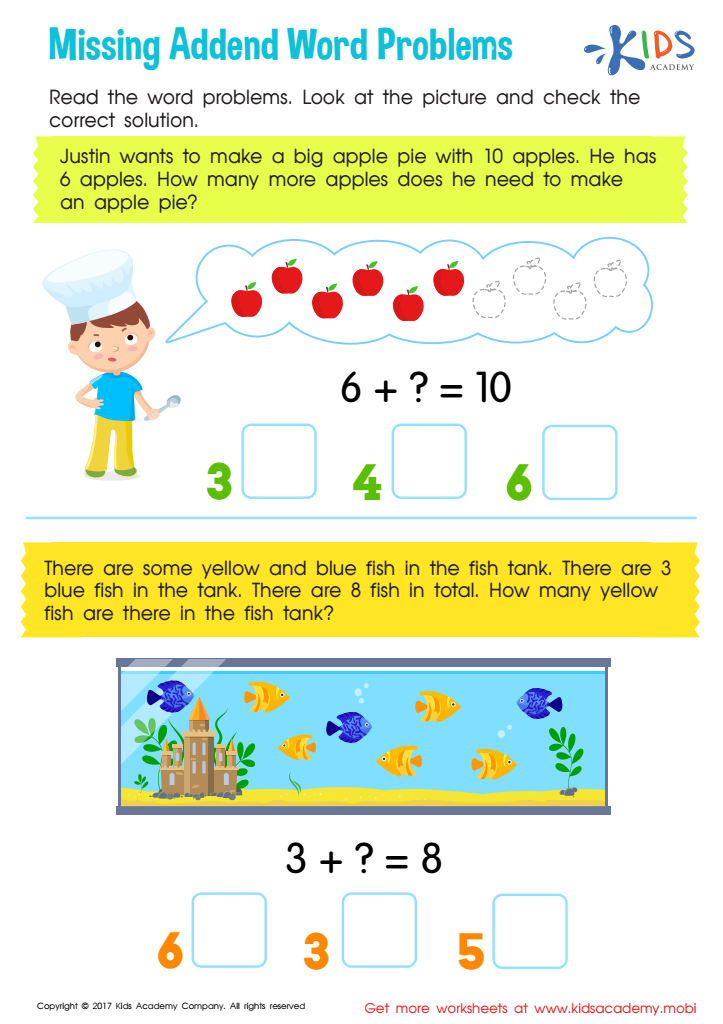
Missing Addend Word Problems Worksheet
Doing many addition and subtraction problems is key for fluency and mastery. Word problems can help kids understand how math works in everyday life. Our math worksheet uses fun scenarios and pictures to teach how to find the missing addend. It's the perfect tool to help kids understand math better!
 Assign to My Students
Missing Addend Word Problems Worksheet
Worksheet
Join Kids Academy for Free
Who is primarily going to use this learning content?






.jpg)

Developing problem-solving skills through math in early childhood (ages 3-5) is crucial for several reasons. First, these skills lay the foundation for future academic success. Children who engage in mathematical problem solving develop logical reasoning and analytical thinking, which are essential not just in math, but across all subjects. Early exposure fosters a positive attitude towards learning and builds confidence in their abilities to tackle challenges.
Second, problem-solving activities enhance critical thinking. Through hands-on experiences, such as sorting objects or counting toys, children learn to approach problems systematically and explore various solutions. This adaptability is vital for success in our increasingly complex world.
Moreover, math in early childhood is not solely about numbers; it encompasses patterns, measurements, and spatial awareness, essential for daily living and future learning experiences. Engaging in these activities encourages curiosity and creativity, allowing children to connect their mathematical understandings to real-life scenarios.
Finally, children who develop strong problem-solving skills become resilient learners. They learn that failure is part of the learning process, which nurtures perseverance. For these reasons, parents and teachers play a pivotal role in creating environments where problem-solving through math is encouraged, ensuring children build these foundational skills early on.








