Spatial understanding Geometry Worksheets for Ages 3-6
3 filtered results
-
From - To
Unlock your child's potential with our Spatial Understanding Geometry Worksheets, designed specifically for ages 3-6. These engaging worksheets encourage early learners to explore shapes, patterns, and spatial relationships in a fun, interactive way. Our age-appropriate activities help build foundational geometry skills that are crucial for later academic success. By navigating through mazes, completing shape puzzles, and assembling objects, kids will improve their problem-solving abilities and spatial awareness. Perfect for use at home or in the classroom, our worksheets offer an enjoyable educational experience that sparks curiosity and fosters a love for math from an early age.
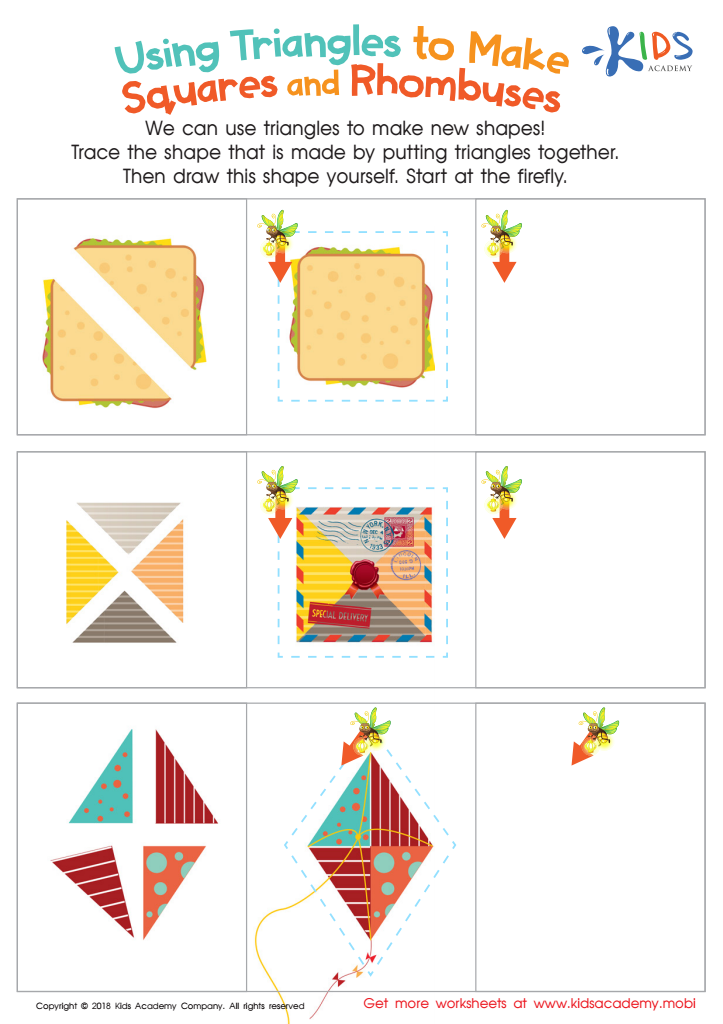
Using Triangles to Make Squares and Rhombuses Worksheet
 Assign to My Students











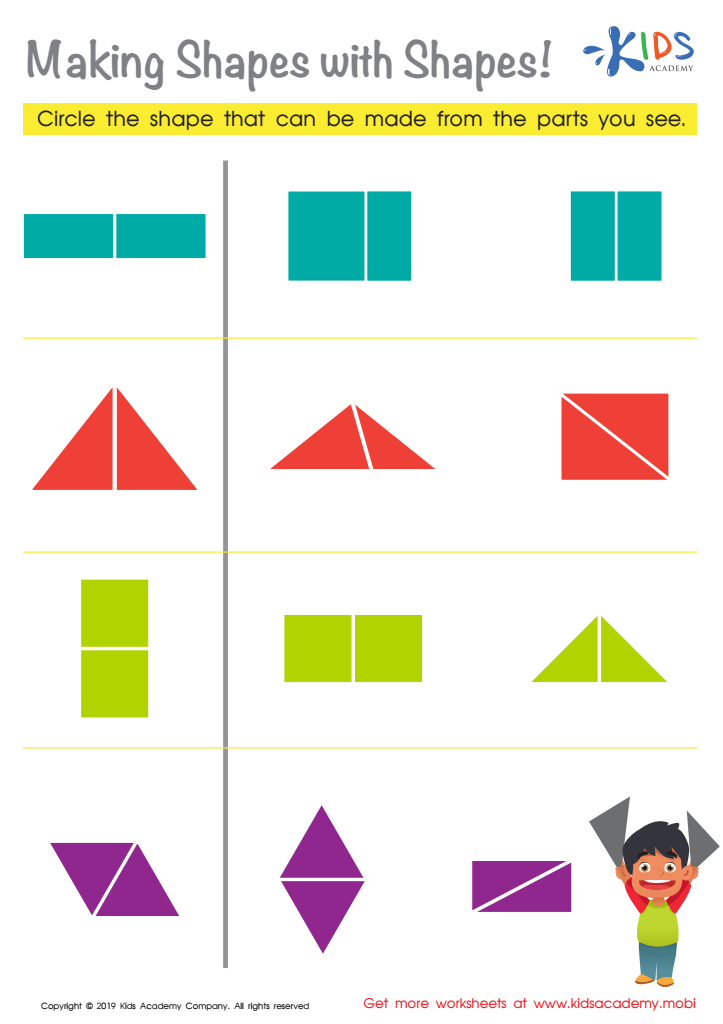
Making Shapes with Shapes Worksheet
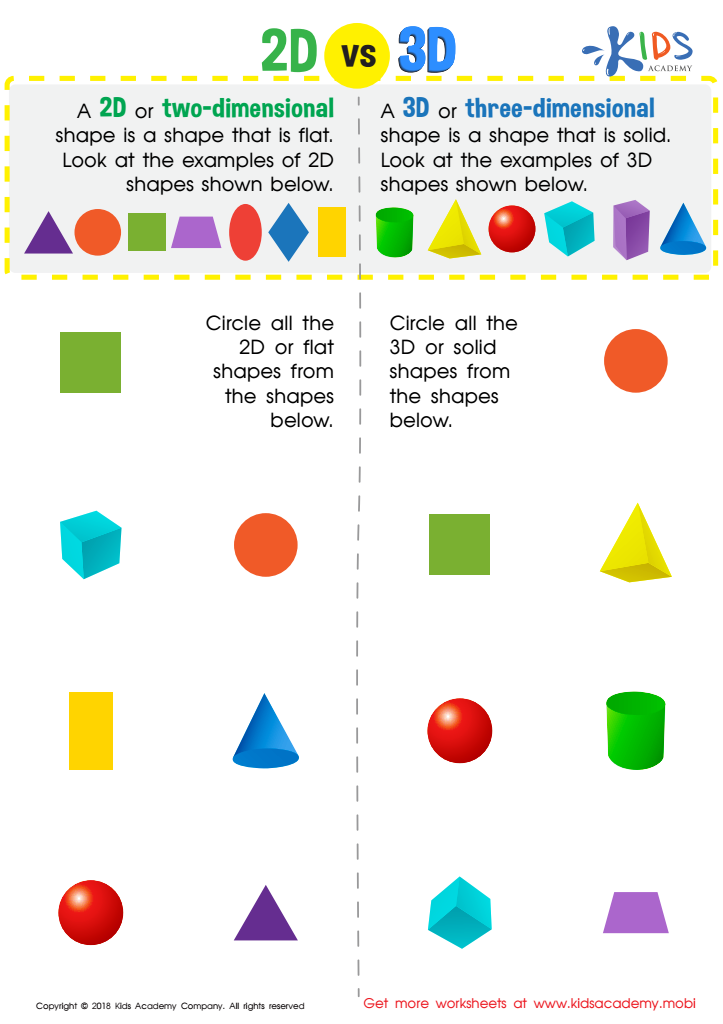
2D vs 3D Shapes Worksheet








Parents and teachers should prioritize developing spatial understanding and geometry skills in children ages 3-6 for several significant reasons. During these early years, children's brains are exceptionally receptive to learning foundational concepts that will support their future academic achievements. Spatial understanding involves the ability to comprehend and manipulate shapes and spaces, which forms the basis for more complex mathematical thinking.
First, enhancing spatial awareness aids in the development of problem-solving skills. As children engage with puzzles, building blocks, and pattern recognition activities, they learn how to approach challenges logically and develop persistence. These are crucial life skills that will benefit them beyond the classroom.
Second, early geometric learning can improve language skills. Discussing shapes, sizes, and spatial relationships enriches a child’s vocabulary, allowing them to articulate ideas more clearly. When they learn to describe the positioning of objects—such as "above," "below," "next to"— they are also refining their ability to communicate effectively.
Lastly, spatial skills are instrumental in STEM (Science, Technology, Engineering, and Math) fields. Early exposure lays the groundwork for success in subjects like science and engineering, where visualizing and manipulating objects are key components.
Incorporating spatial and geometry activities into a child's daily routine can provide a strong educational foundation, stimulate cognitive growth, and inspire a lifelong interest in learning and inquiry.








