
Mental math skills Numbers Worksheets for Ages 3-6
4 filtered results
Difficulty Level
Grade
Age
-
From - To
Subject
Activity
Standards
Boost your child's confidence in numbers with our engaging Mental Math Skills Worksheets designed for ages 3-6! These worksheets promote early math proficiency by encouraging children to practice essential skills like counting, addition, and subtraction in a fun, interactive way. Each activity is tailored to fit the developmental needs of young learners, fostering a love for math while strengthening their problem-solving abilities. Our thoughtfully crafted activities not only support kindergarten readiness but also enhance critical thinking and cognitive skills. Discover the joy of learning numbers with our comprehensive, educational materials that make math exciting for every little learner!
Favorites
With answer key
Interactive
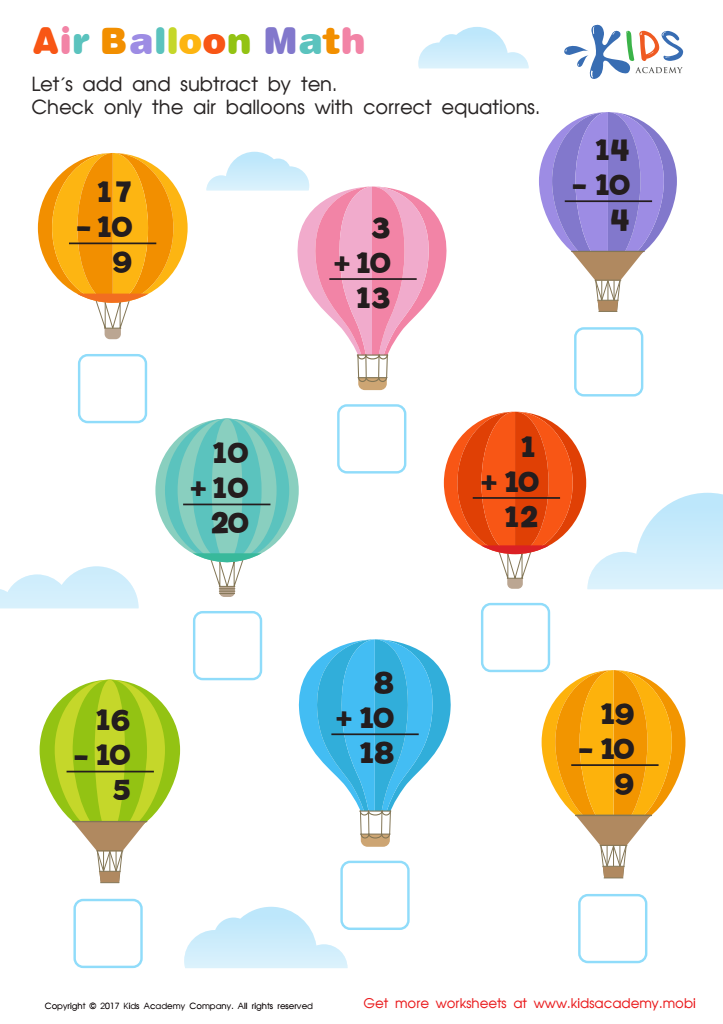
Air Balloon Math Worksheet
Revised:
Review your child's addition and subtraction skills with this fun worksheet. Featuring hot air balloons filled with math equations, help your child add or subtract by ten before ticking the boxes with the right answers. Working through the equations one-by-one is a great way to make math practice enjoyable!
 Assign to My Students
Air Balloon Math Worksheet
Worksheet
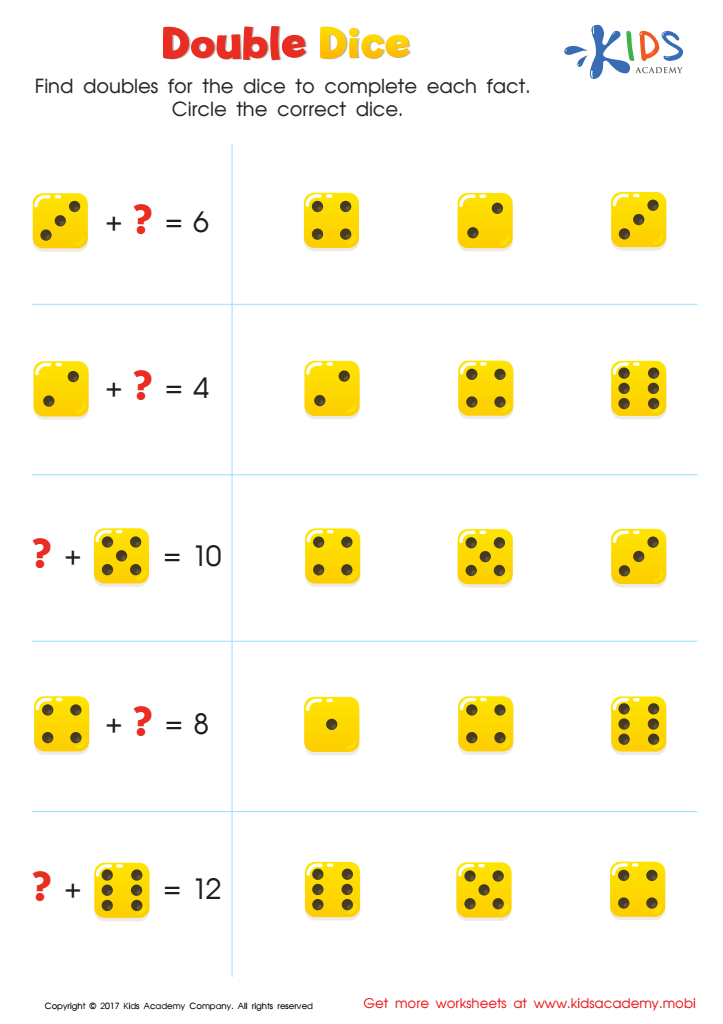
Addition Facts: Double Dice Worksheet
Are you looking for ways to make maths more engaging for kids? Maths can be a bore, but by teaching kids from an early age that it can be fun, they won't struggle with it. This worksheet is a great way to start: your child needs to identify the number on the left dice and find its double on the right. The sum of the two dice is also given.
Addition Facts: Double Dice Worksheet
Worksheet
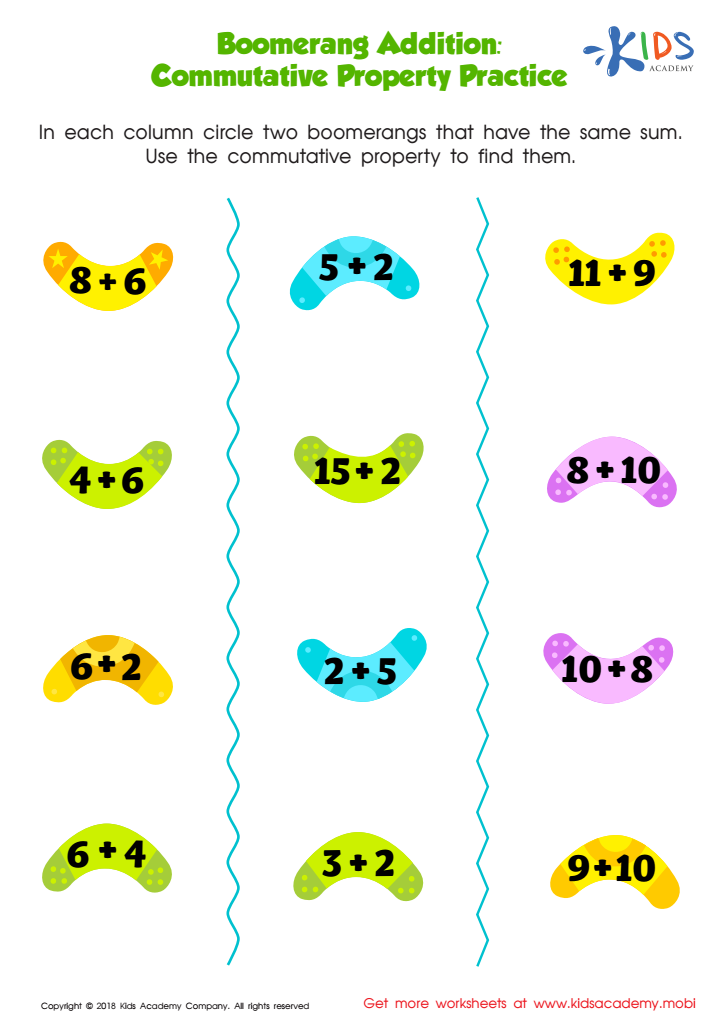
Boomerang Addition Worksheet
Kids know that when a boomerang is thrown, it reverses its path back. The same goes for addition: numbers can be rearranged and the sum will remain the same. Use this worksheet to find matching pairs of colorful boomerangs and equations. Look through each column and use the commutative property to find the pairs with the same sum.
Boomerang Addition Worksheet
Worksheet
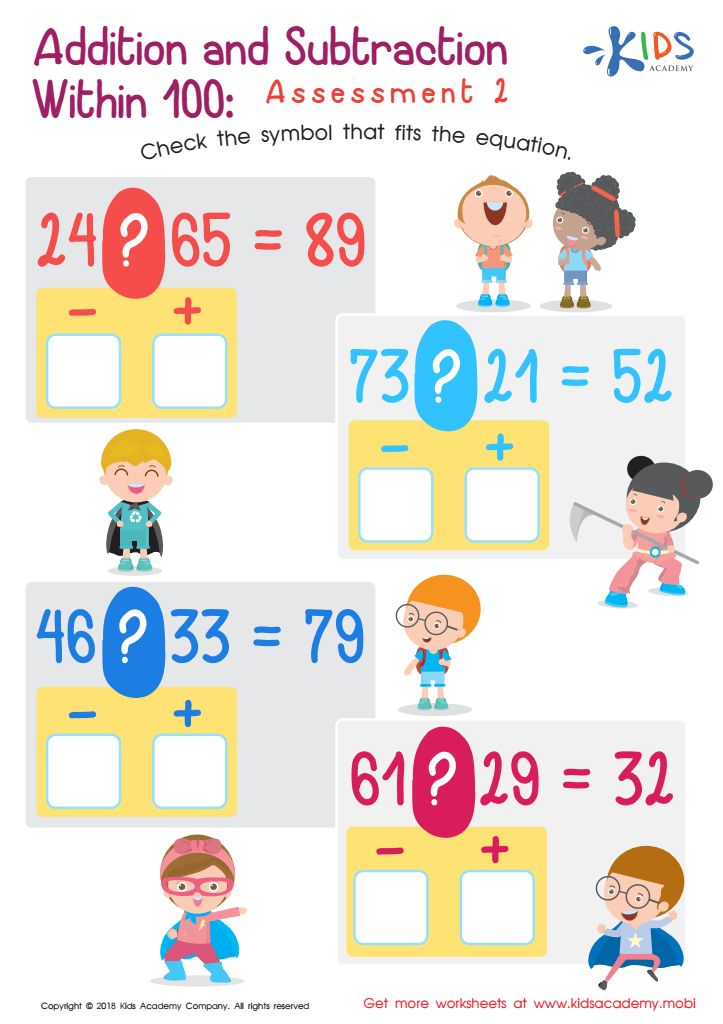
Addition and Subtraction Within 1: Assessment 2 Worksheet
This worksheet is a great tool to help your students learn addition and subtraction. It contains four equations in a printable pdf. Ask your students to review the equation and determine if the symbol between them is a '+' or '-'. Guide them in selecting the correct symbols for each equation.
Addition and Subtraction Within 1: Assessment 2 Worksheet
Worksheet
Join Kids Academy for Free
Who is primarily going to use this learning content?








Mental math skills are crucial for children aged 3-6 as they lay the foundation for a child's mathematical understanding and overall cognitive development. During these formative years, children are naturally curious and eager to explore concepts like numbers, patterns, and relationships. By nurturing mental math skills, parents and teachers can enhance children's problem-solving abilities, boost their confidence, and encourage a positive attitude towards mathematics.
Mental math promotes number sense, which helps children understand quantities and how numbers work together. Engaging activities—such as counting objects, simple arithmetic games, and pattern recognition—help young learners develop these skills in a fun and interactive manner. Moreover, mental math encourages flexibility in thinking; children learn to approach mathematical challenges from different angles and can find solutions without relying on calculators or other tools.
Additionally, strong mental math skills facilitate later academic performance, as children with a strong foundational understanding of numbers tend to do better in more complex mathematical tasks. By focusing on mental math early on, parents and teachers pave the way for a successful learning experience, empowering children with essential skills that extend beyond the classroom, fostering lifelong learners who are comfortable with numbers.








