Our "Addition Skills Word Problems Worksheets for Ages 3-6" offer fun, engaging activities designed to introduce young learners to basic addition concepts through real-life scenarios. These printable resources help children develop critical thinking skills and enhance their ability to solve problems independently. Each worksheet employs vivid illustrations and simple stories that capture kid's interest while nurturing a love for math. Perfect for preschoolers and kindergarteners, our exercises provide a foundational understanding of addition, paving the way for future math success. Join this exciting learning journey that combines education and entertainment harmoniously!

Check out this FREE Trial Lesson on Word Problems for age 3-6!

Solve Tricky Number Situations by Drawing (3 numbers) - Part 1

Favorites
With answer key
Interactive
  • 3-6
  • Addition skills
  • Word Problems
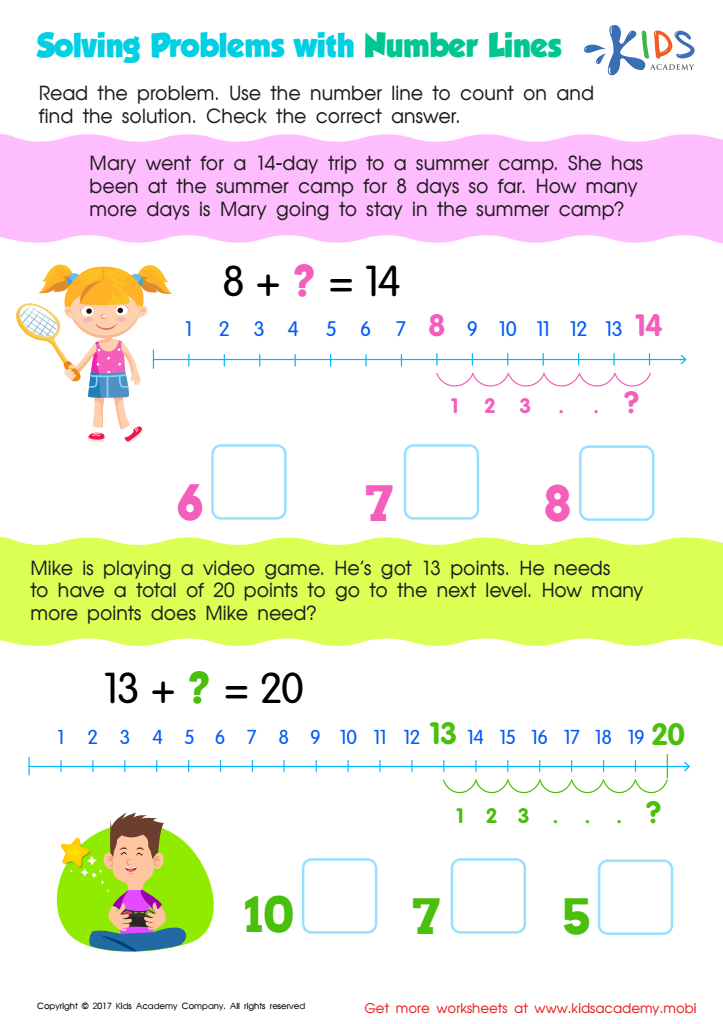
Solving Problems: Number Lines Worksheet

Solving Problems: Number Lines Worksheet

Number lines are fun and help build number sense and reasoning. This worksheet uses them to help students count on to find a solution to an equation. They'll have fun counting with familiar numbers and 10-bases, while also working on algebraic reasoning.
Solving Problems: Number Lines Worksheet
Worksheet
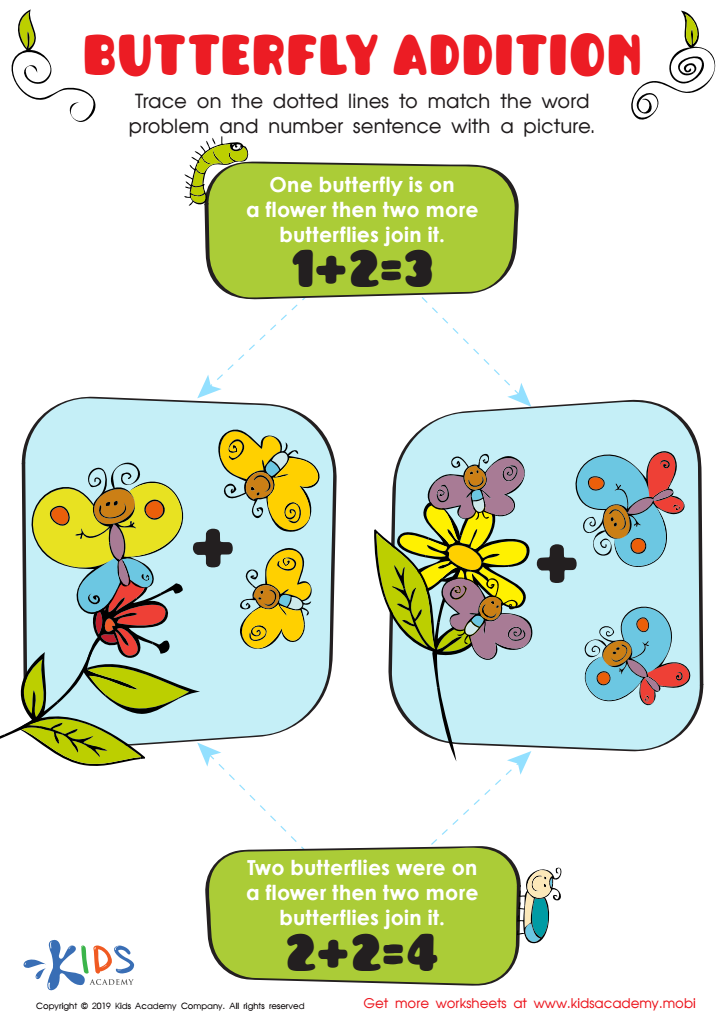
Butterfly Addition Worksheet

Butterfly Addition Worksheet

This tracing sheet is great for kids to work on math skills and have fun too. Read the word problems to them, then help them trace the dotted lines to match the problem and number sentence to a picture. Not only is it educational, it's beautiful too - your kids will love learning about butterflies!
Butterfly Addition Worksheet
Worksheet
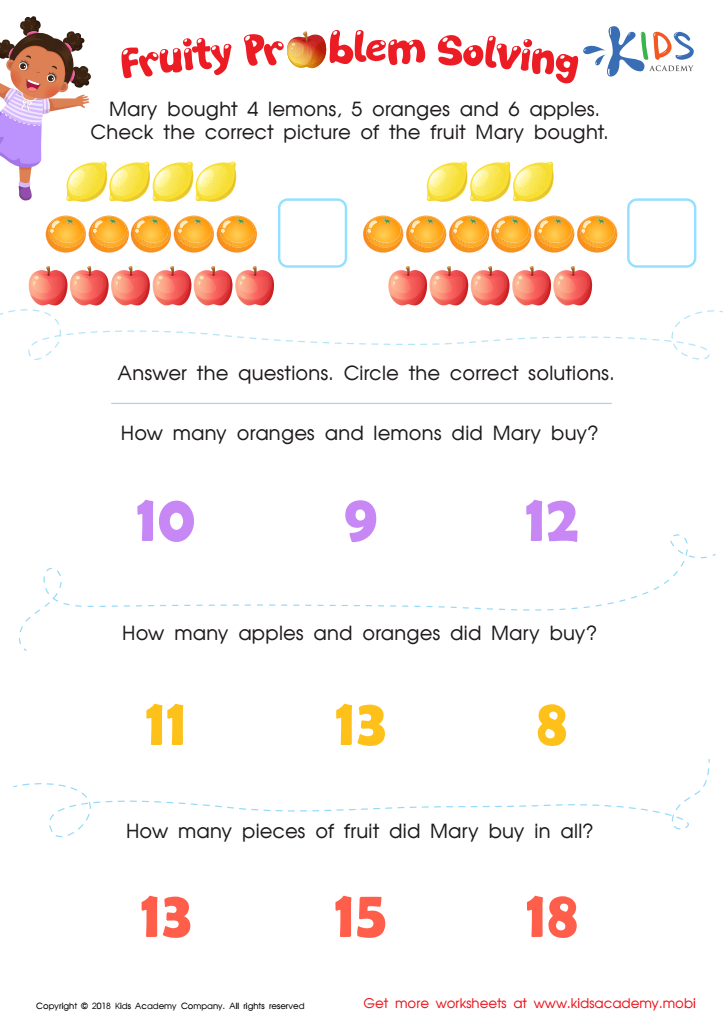
Fruity Problem Solving Worksheet

Fruity Problem Solving Worksheet

Practice addition word problems with young mathematicians using this PDF worksheet featuring fruit. As they read each problem carefully and circle the correct sums, they'll reinforce attention to detail and fine motor skills. Tangible representations are key to helping them with basic addition.
Fruity Problem Solving Worksheet
Worksheet
Adding Flower Petals Worksheet

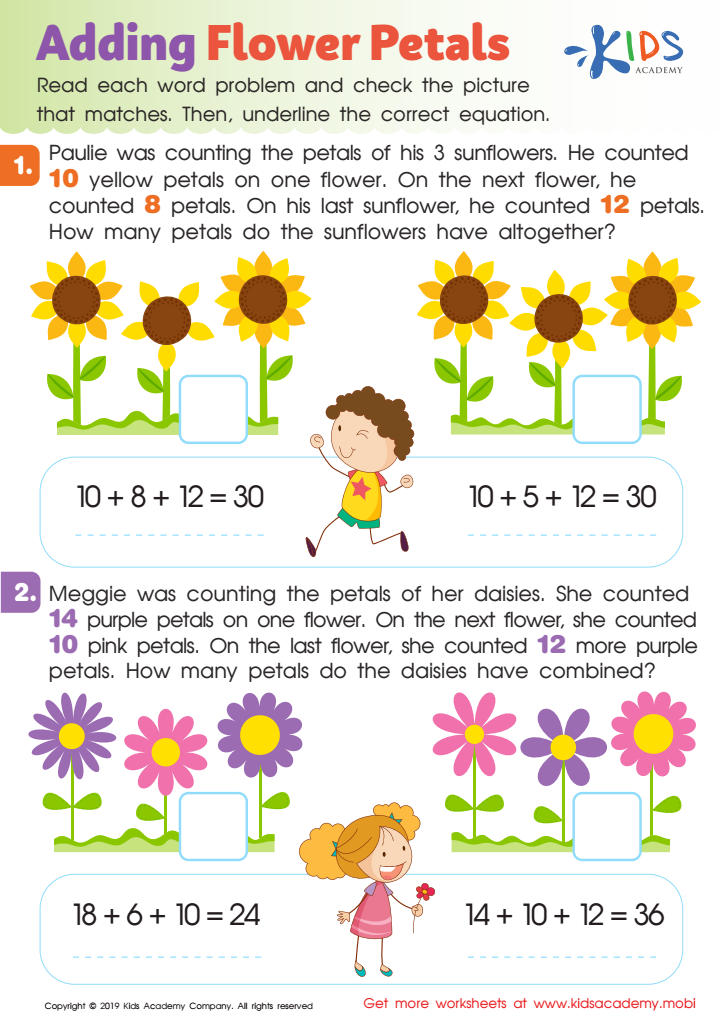
Adding Flower Petals Worksheet

This free worksheet helps little mathematicians learn to understand word problems. They'll read each one and match it to the corresponding picture. Important info is highlighted, teaching kids to look for key info when solving problems. Then they'll underline the correct number equation that matches the picture. A great way to practice problem-solving skills!
Adding Flower Petals Worksheet
Worksheet
Adding at the Hospital Worksheet

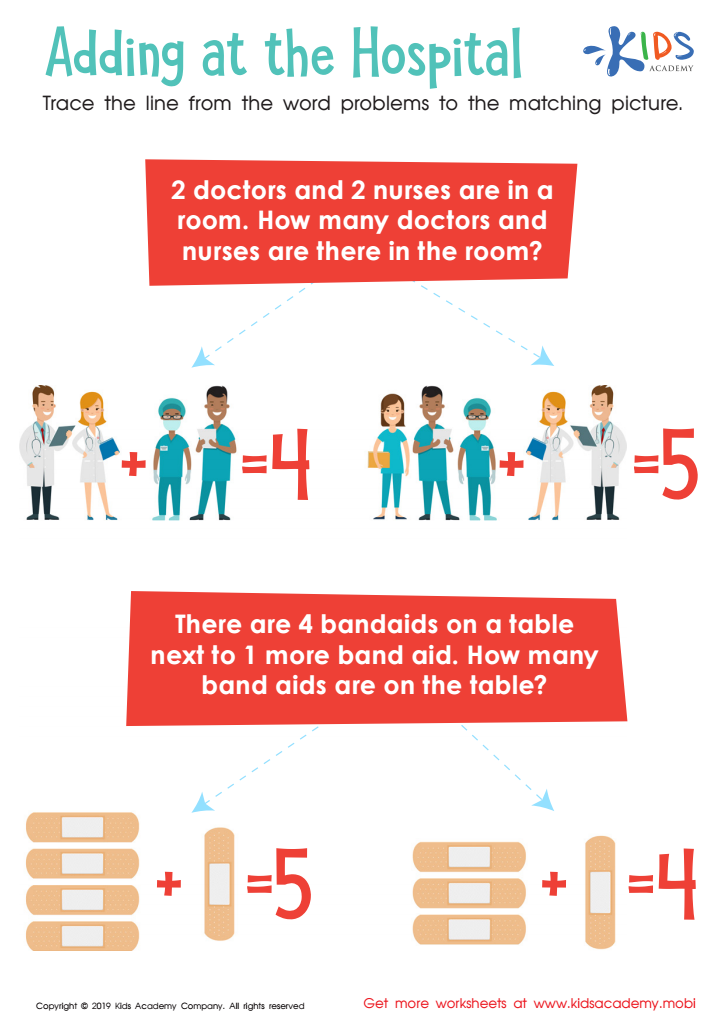
Adding at the Hospital Worksheet

A hospital visit doesn't have to be scary for kids. With this worksheet, they can count along with doctors and nurses, by reading the word problems and tracing lines to the corresponding picture. Guide them through it and you'll help them have a fun experience.
Adding at the Hospital Worksheet
Worksheet
Sums and Differences Within 1 - Assessment 2 Worksheet

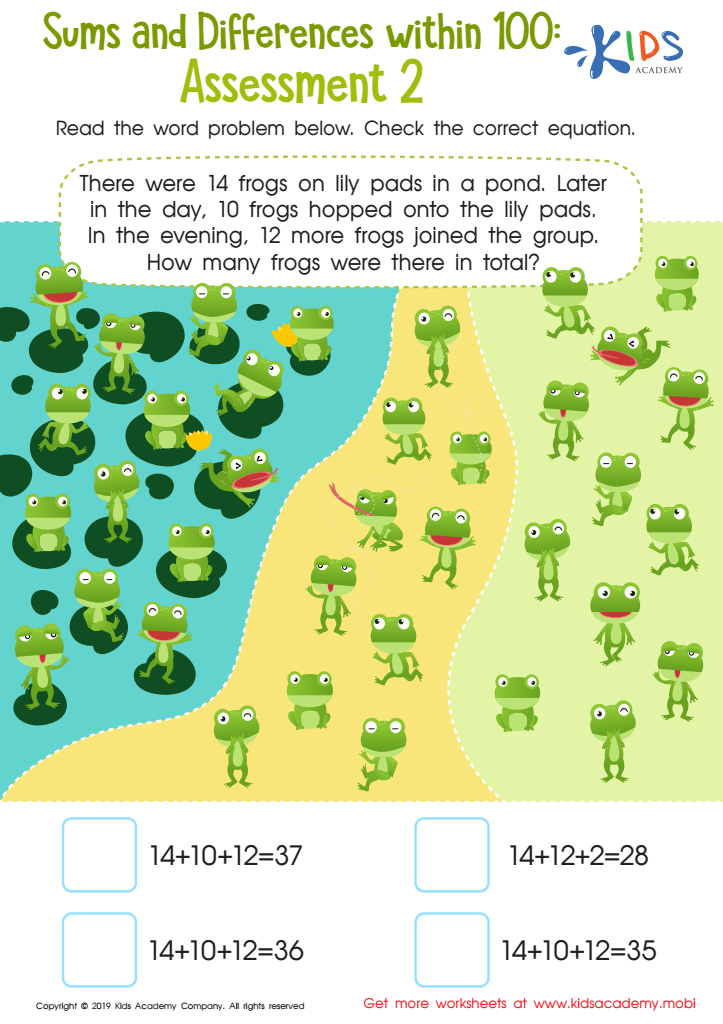
Sums and Differences Within 1 - Assessment 2 Worksheet

Help your kids practice math with these simple word problems. Read the question, discuss with them to form the equation and then check the answer. Give them a chance to sharpen their math skills!
Sums and Differences Within 1 - Assessment 2 Worksheet
Worksheet
Adding Up with Old MacDonald Worksheet

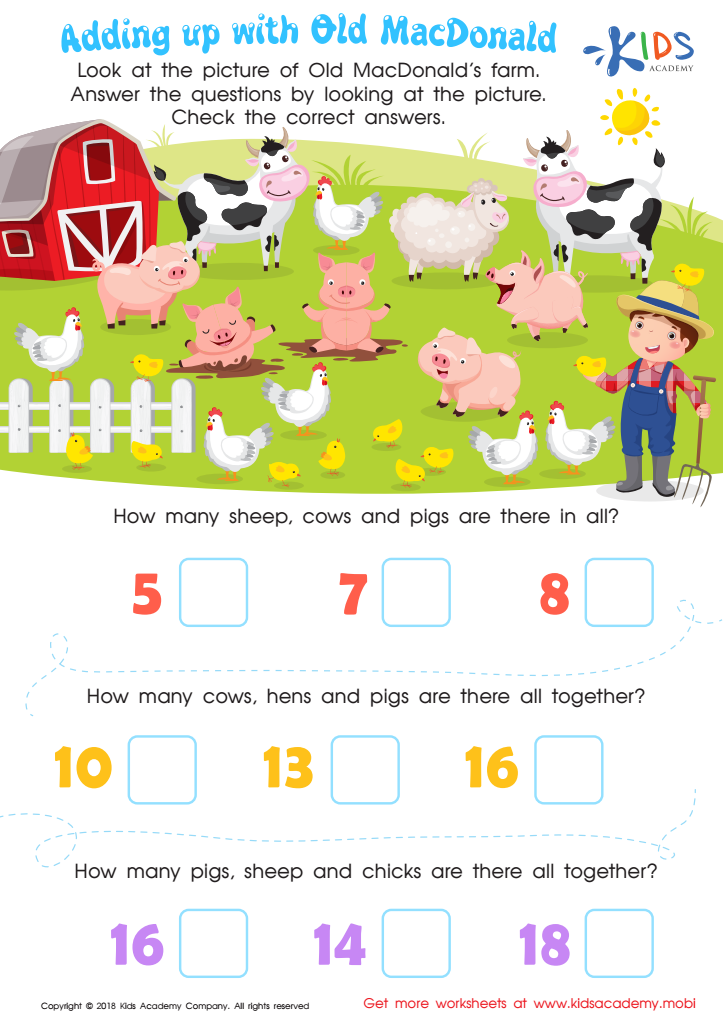
Adding Up with Old MacDonald Worksheet

Old MacDonald needs help counting his animals! Give your little math whiz a fun challenge with a free PDF worksheet. They'll love counting the animals and doing basic addition with two or three addends. Who knew math could be so much fun on the farm?
Adding Up with Old MacDonald Worksheet
Worksheet
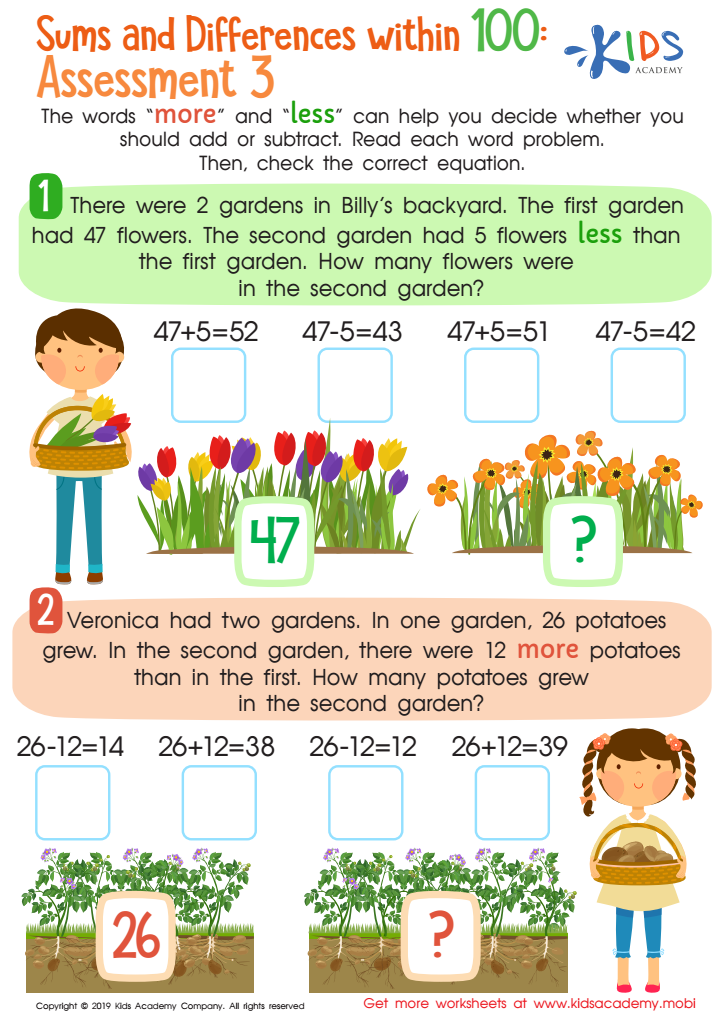
Sums and Differences Within 1 - Assessment 3 Worksheet

Sums and Differences Within 1 - Assessment 3 Worksheet

When we see 'more' or 'less', they usually refer to quantity. In Math, they indicate addition or subtraction. Help kids read aloud two simple word problems and figure out the correct equations for each. Check the correct equation afterwards.
Sums and Differences Within 1 - Assessment 3 Worksheet
Worksheet
Make it Easy Strategies: Assessment 2 Worksheet

Make it Easy Strategies: Assessment 2 Worksheet

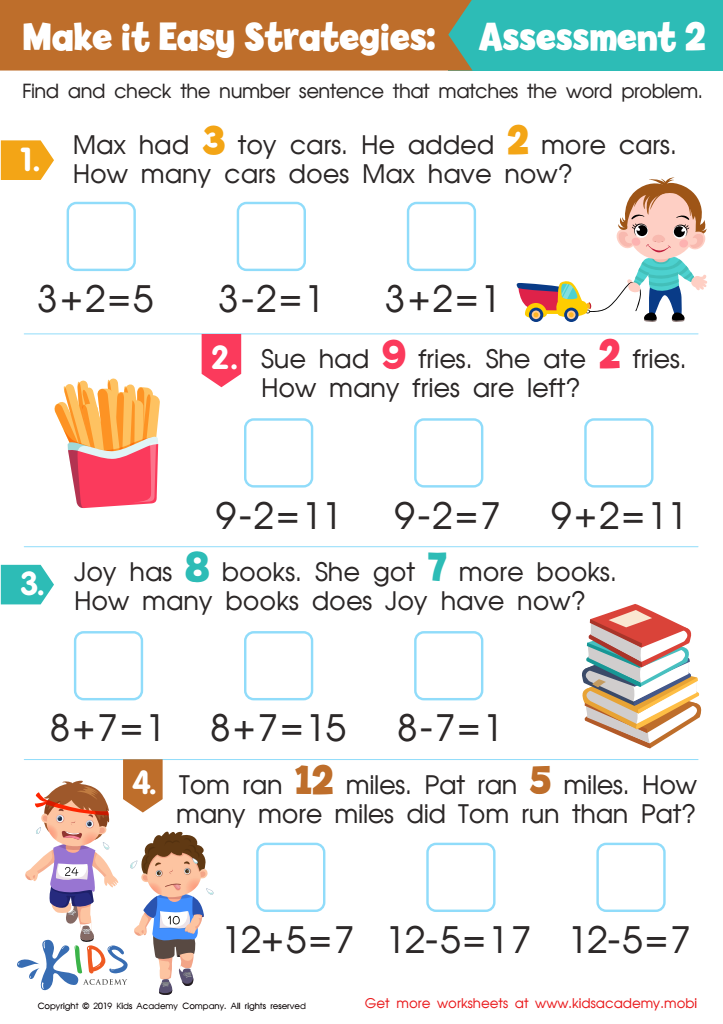
Utilize images and objects your students know to facilitate learning. Simple math problems should be a cinch for kindergartners who can count to 30. Ask them to identify the picture's subject. Then read word problems and help them find the right number sentences to match.
Make it Easy Strategies: Assessment 2 Worksheet
Worksheet
Supermarket Math Worksheet

Supermarket Math Worksheet

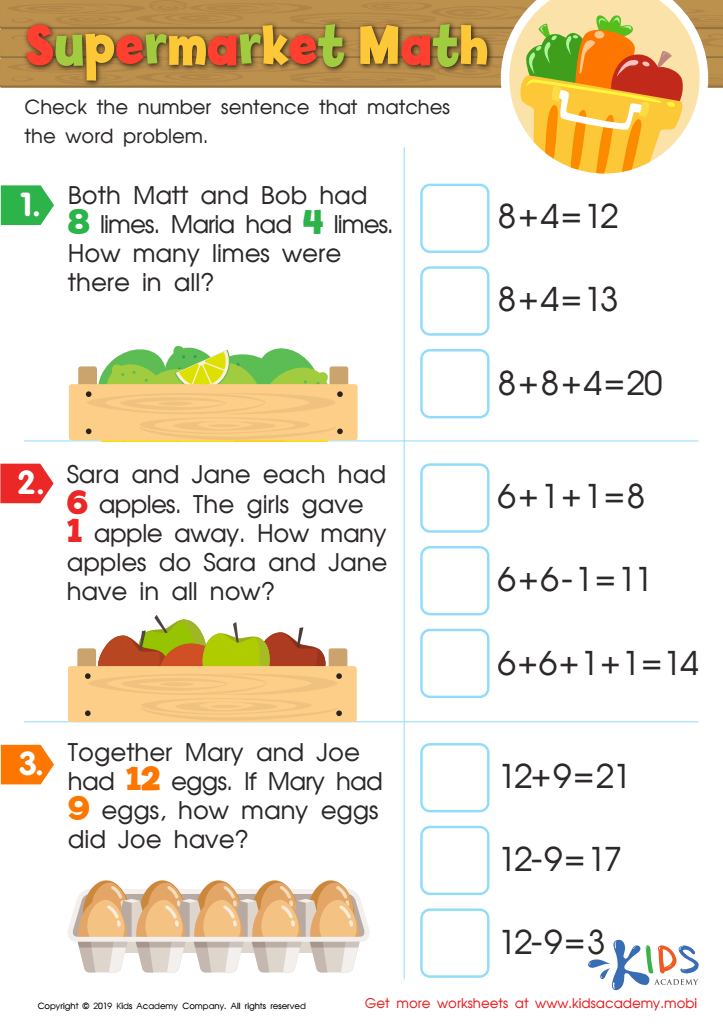
Take your kids to the supermarket and ask what they're looking forward to buying. Help them solve the three questions in the worksheet by interpreting each one into an equation, then choose the right answer.
Supermarket Math Worksheet
Worksheet
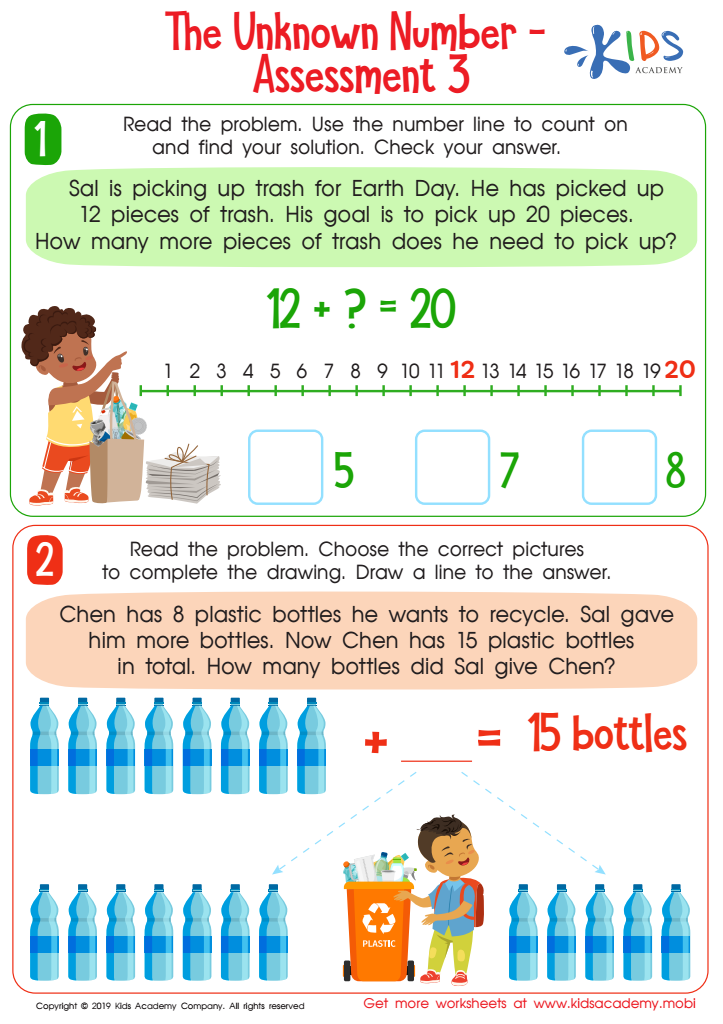
The Unknown Number - Assessment 3 Worksheet


The Unknown Number - Assessment 3 Worksheet

Read the Earth Day-themed word problem aloud to your kids, pointing to the pictures as you go. Use the number line to help them count on and find the answer. Then check it together. Doing this can help them learn more about Earth Day and meet other children who are doing their part to keep it clean.
The Unknown Number - Assessment 3 Worksheet

Worksheet


Addition skills word problems for ages 3-6 play a crucial role in early childhood development. First and foremost, they enhance basic math skills, a foundational aspect that future academic achievements build upon. Children who understand addition find it easier to grasp more complex math concepts as they grow older.

Furthermore, word problems promote critical thinking. They encourage children to analyze situations, identify relevant information, and apply the appropriate mathematical operations. This process boosts cognitive skills, such as logical reasoning and problem-solving, which are valuable for everyday life and future learning.

In addition to cognitive benefits, solving word problems increases comprehension and language skills. Since these problems are often presented in a story format, children learn to read carefully, follow instructions, and understand context. This reinforces language development and literacy, making it a multifaceted learning tool.

Emotionally, successfully solving math problems fosters a sense of achievement and builds confidence. Children become more willing to tackle challenges, fostering a positive attitude towards learning.

Socially, working in groups or with an adult can improve communication skills and teamwork. Discussing and reasoning out loud together provides opportunities for bonding and cooperative learning.

In summary, parents and teachers should prioritize addition skills word problems for ages 3-6 because they develop essential life skills, cognitive abilities, and positive learning attitudes in children.