Fine Motor Skills History Worksheets for Ages 3-6
3 filtered results
Difficulty Level
Grade
Age
-
From - To
Subject
Activity
Standards
Explore the "Fine Motor Skills History Worksheets for Ages 3-6" designed to enhance young learners' dexterity matched perfectly with their developmental stage. These engaging worksheets from Kids Academy not only improve fine motor skills but also introduce captivating historical concepts. Tailored specifically for preschool to early elementary students, they facilitate the practice of tracing, drawing, and organizing valuable motor skills. Usable both at home and in education settings, they seamlessly integrate learning with play. Start your child’s journey today, nurturing both their manual precision and curiosity about history in an interactive manner.
Favorites
With answer key
Interactive

Happy Diwali Printable
Explore India this Diwali! Learn about India's most significant holiday, Diwali, with this fun-filled printable activity for kids. Your child can gain an appreciation for Indian culture with this Diwali dot to dot worksheet.
 Assign to My Students
Happy Diwali Printable
Worksheet

Easter Holiday Printable
This printable Easter worksheet helps your child identify symbols associated with the holiday. Pick out the pictures that usually signify Easter and your little one will gain an understanding of the holiday's meaning. With this free activity, springtime just got more exciting!
Easter Holiday Printable
Worksheet
Pilgrim Maze Worksheet
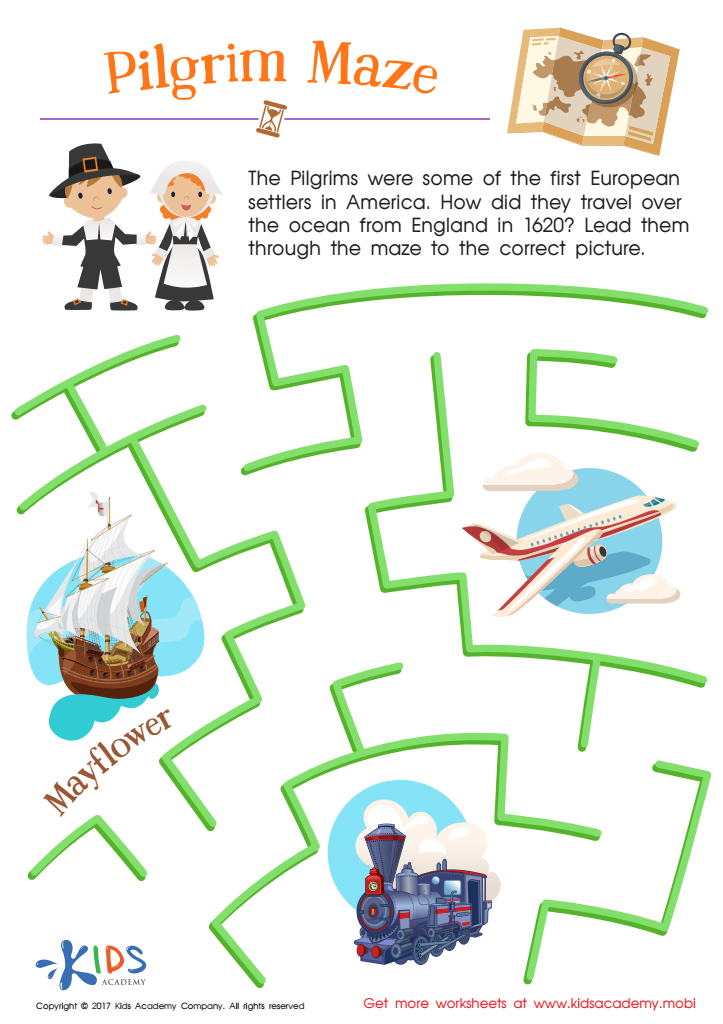
This worksheet is perfect for teaching kids about an important moment in American History! Your child will have a blast solving the maze to recall that the Mayflower brought the pilgrims to the New World in 1620. It reinforces American history facts and develops visual motor and problem solving skills. It also uses modern pictures to make kids think about the right answer. Get this challenging pilgrim printable maze or a full collection of history worksheets for your little learner!
Pilgrim Maze Worksheet
Worksheet
Join Kids Academy for Free
Who is primarily going to use this learning content?








Caring about the history of fine motor skills development in children aged 3-6 is crucial for parents and teachers because these foundational years set the stage for lifelong abilities. Fine motor skills involve the coordination of small muscles in areas like the hands and fingers, which are essential for tasks such as writing, buttoning clothes, and handling utensils. Understanding the developmental milestones within this age range can help parents and teachers identify any delays or issues early, allowing for timely interventions and support.
During ages 3-6, children typically progress from basic scribbling to more controlled, purposeful drawing and cutting. By age 3, they may stack blocks and begin using puzzles. By ages 4-5, they can often draw shapes and, with guidance, start using scissors. By age 6, many children can write simple words and tie their shoelaces. Being aware of these stages helps caregivers provide age-appropriate activities that strengthen these skills, like playing with clay, using tweezers to pick up small items, or encouraging drawing and cutting crafts.
Proper development of fine motor skills is not just about academic readiness but also about fostering independence and self-confidence. Therefore, an awareness of fine motor skills development history enables parents and teachers to create enriching environments tailored to the child’s growth.