
Understanding plurals Writing Worksheets for Ages 3-6
4 filtered results
Difficulty Level
Grade
Age
-
From - To
Subject
Activity
Standards
Introducing our "Understanding Plurals Writing Worksheets for Ages 3-6," an engaging and educational resource designed to help young learners grasp the concept of plurals. Packed with vibrant illustrations and age-appropriate exercises, these worksheets make learning fun and interactive. Children will enhance their writing skills as they practice adding 's' or 'es' to form plurals, recognize plural nouns, and differentiate between singular and plural forms. Perfect for preschool to kindergarten students, our worksheets support early literacy and language development, making them an essential tool for any young learner's educational journey. Get started on building foundational grammar skills today!
Favorites
With answer key
Interactive
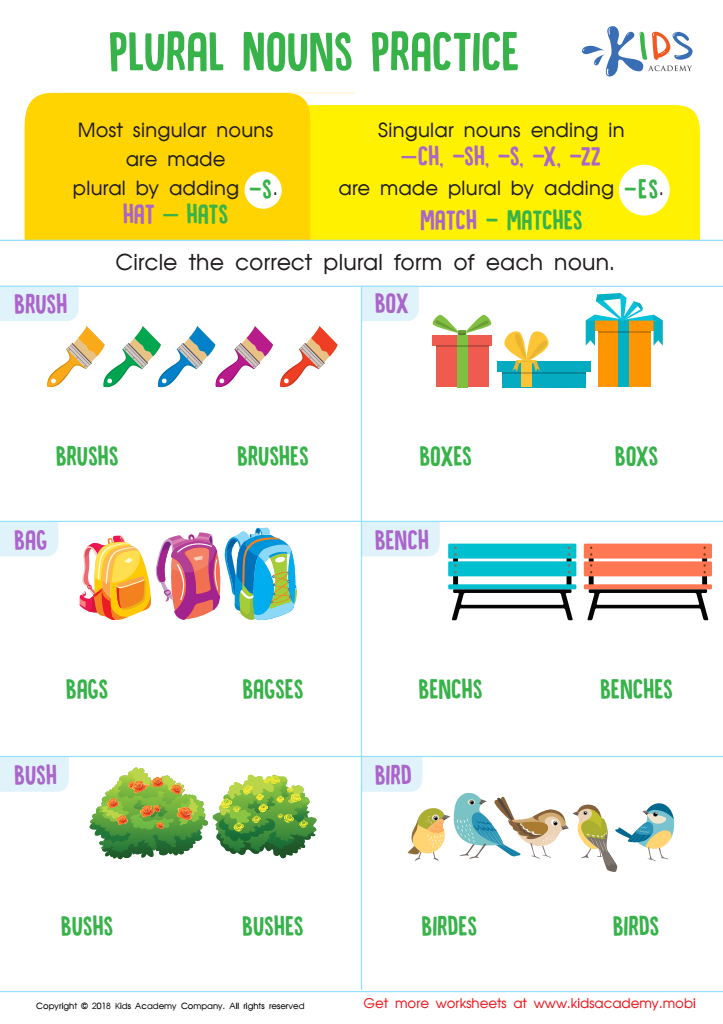
Plural Nouns Practice Worksheet
Explain to your child that most singular nouns become plural by adding "-s". E.g. "cat"->"cats". For words ending in "-ch", "-sh", "-s", "-x", or "-zz", add "-es". E.g. "buzz"->"buzzes". Then, get them to circle the right plural form of each noun on the worksheet.
 Assign to My Students
Plural Nouns Practice Worksheet
Worksheet
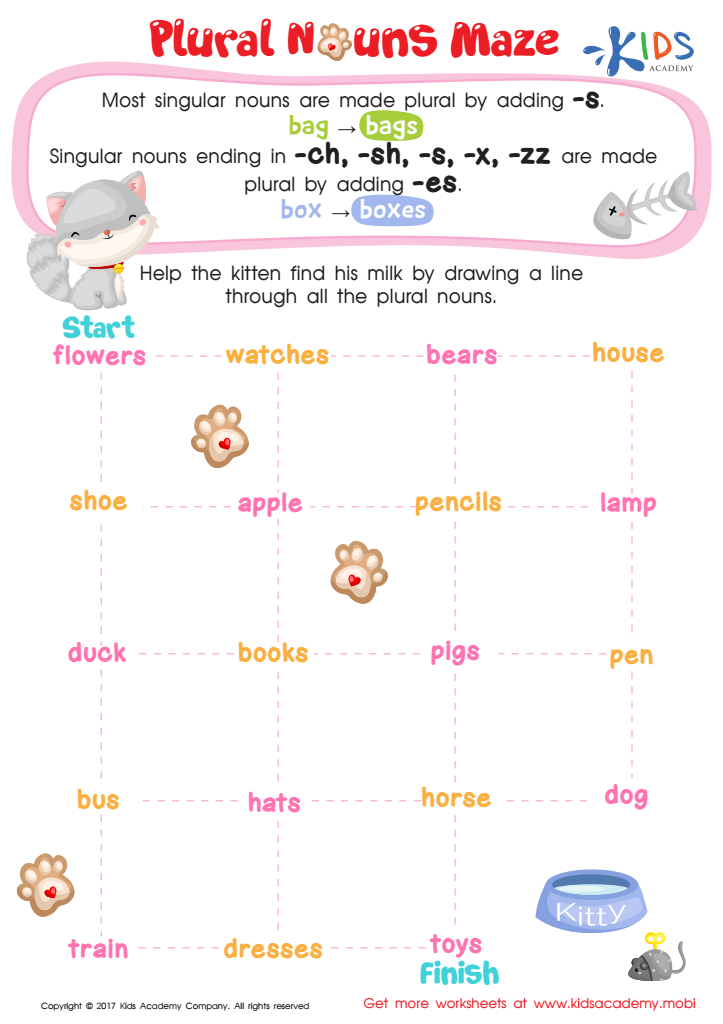
Plural Nouns Maze Worksheet
Oh no, the kitty needs her milk! Help your learner navigate the maze by drawing a line through the plural words. Review the grammar rules on -s and -es endings, then get to work to guide the kitten to her bowl! Download this PDF worksheet to start.
Plural Nouns Maze Worksheet
Worksheet
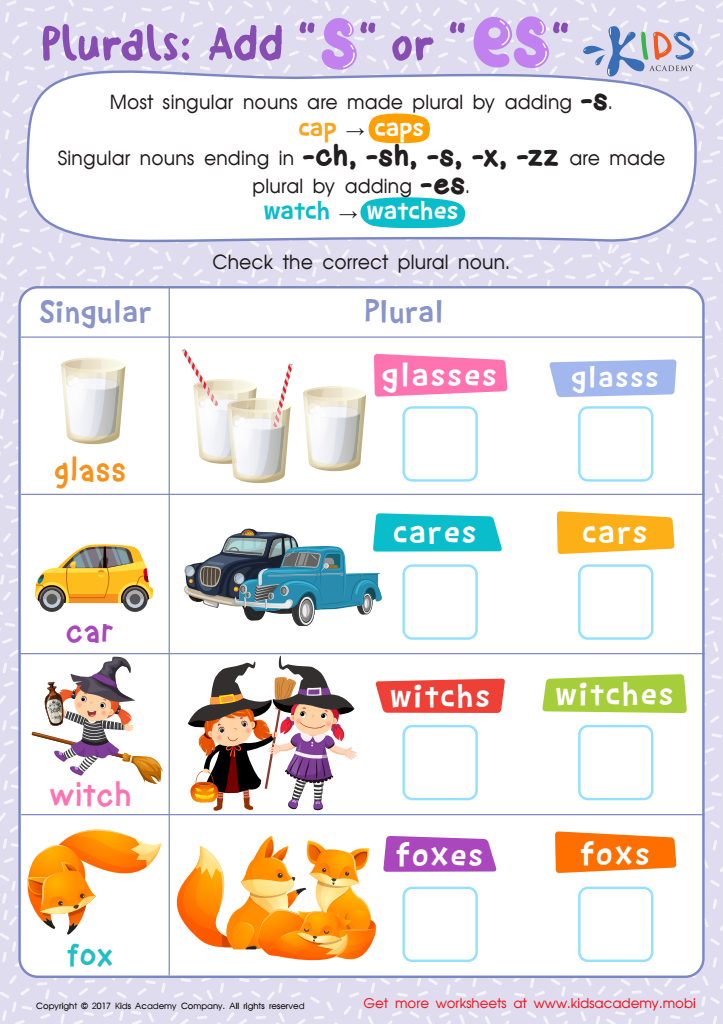
Plurals: "–es" or "–es"? Worksheet
Learning plural nouns can be tough for young readers. This worksheet shows them the difference between singular and plural spelling with cute images. Read each word and check the correct version. Remind them why the other ending can't be used.
Plurals: "–es" or "–es"? Worksheet
Worksheet
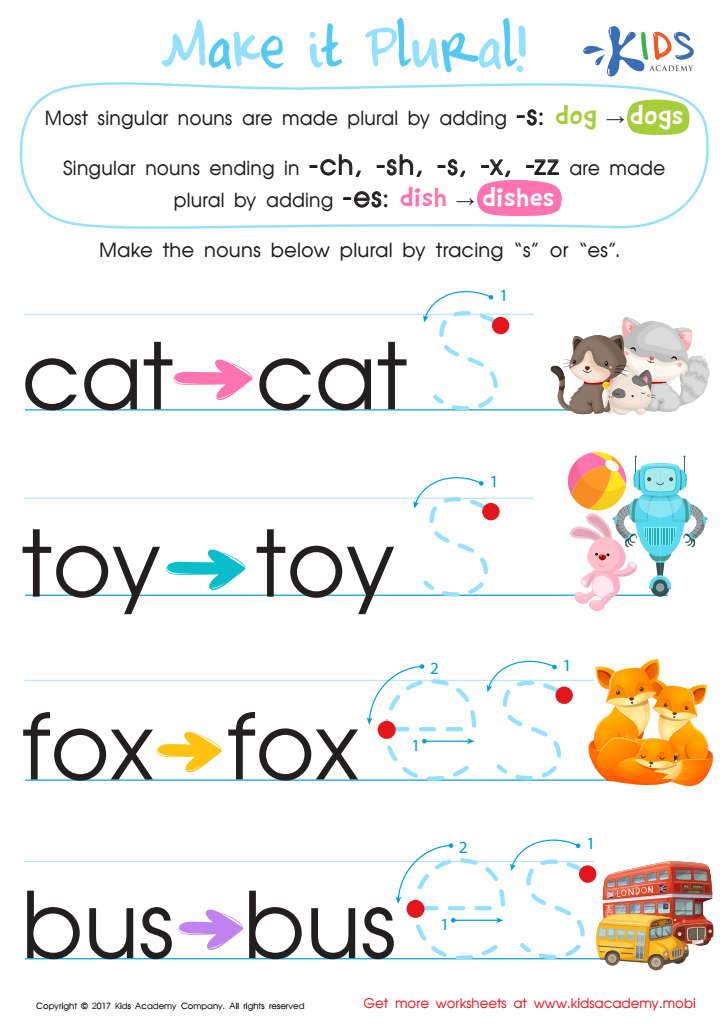
Make it Plural Worksheet
Changing words from singular to plural can be tricky as there are many word endings with special rules. Most words just need an -s, while endings like -ch, -sh, -s, -x or -zz need -es. This worksheet helps kids read words and trace the correct ending for each, making it easier to master these rules!
Make it Plural Worksheet
Worksheet
Join Kids Academy for Free
Who is primarily going to use this learning content?






.jpg)

Understanding plurals is a key milestone in early language development for children aged 3-6, making it a crucial focus for parents and teachers. At this age, children are expanding their vocabularies rapidly, and learning to correctly form and use plurals helps enhance their communication skills. Mastery of plurals enables children to convey more precise meanings, distinguishing between one item and multiple items. This specificity is vital for clearer understanding and more effective interaction with their environment.
Additionally, grasping plural concepts supports cognitive development. It involves recognizing patterns, applying rules, and sometimes noting exceptions, all of which facilitate logical thinking and problem-solving skills. This foundational knowledge also eases future learning of more complex grammatical structures.
For teachers, incorporating plurals into lessons nurtures literacy. Children become more competent readers and writers when they can relate language sounds to written forms. Plural mastery improves their spelling and sentence construction, setting a strong foundation for academic success.
For parents, reinforcing plurals at home strengthens parental involvement in education, offering children consistent practice in varied settings, reinforcing their learning. Understanding and using plurals proficiently all help build children’s self-esteem as confident communicators among peers and adults, ultimately supporting their social and emotional growth.








