
Encourage attention to detail Worksheets for Ages 3-7
3 filtered results
Difficulty Level
Grade
Age
-
From - To
Subject
Activity
Standards
Enhance your child's learning experience with our "Encourage Attention to Detail Worksheets" designed specifically for ages 3-7. These engaging and interactive worksheets focus on developing critical observation skills, fostering concentration, and boosting fine motor skills through fun activities. Children will enjoy completing colorful exercises that challenge them to identify differences, match objects, and complete puzzles. Our resources are perfect for both classroom use and at-home learning, making them ideal for little detectives eager to explore their surroundings. Encourage your child's love for learning while they discover the power of keen observation and attention to fine details with our comprehensive worksheets!
Favorites
With answer key
Interactive
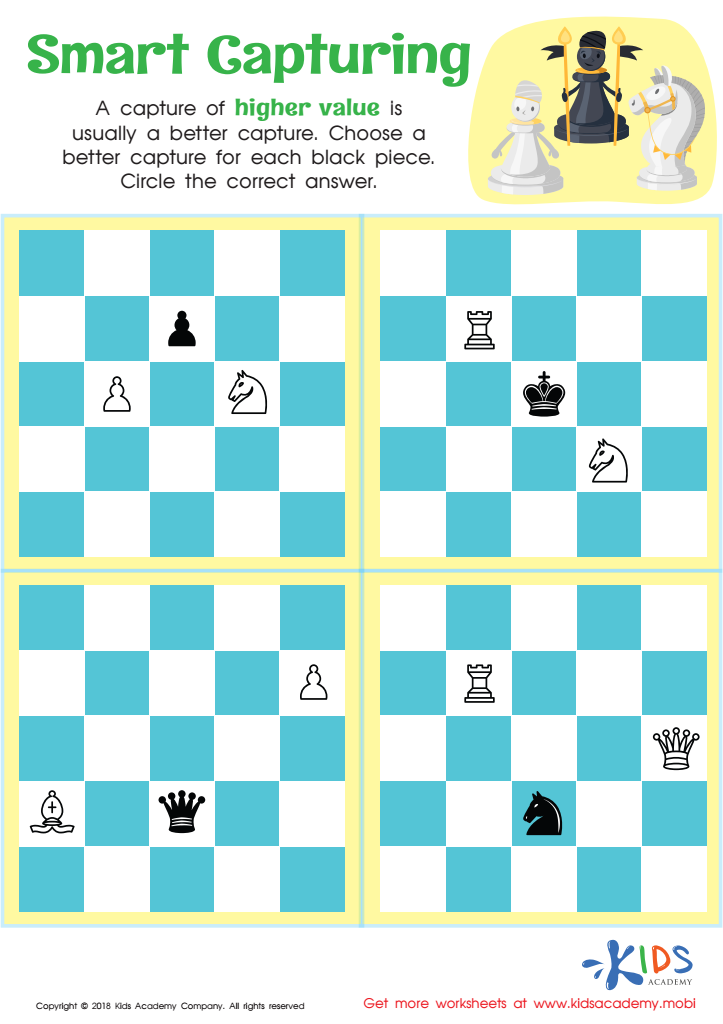
Smart Capturing Worksheet
Chess is a game of strategy and calculation. When presented with two captures, a player should always go for the one that yields the highest value. For example, taking a knight over a pawn. In this worksheet, your children will choose the best capture for each black piece. Ask them to circle the correct answers. (80 words)
 Assign to My Students
Smart Capturing Worksheet
Worksheet
Join Kids Academy for Free
Who is primarily going to use this learning content?







.jpg)
Encouraging attention to detail in children aged 3-7 is crucial for their overall development and learning. At this stage, children are like sponges, absorbing information from their environment. When parents and teachers focus on nurturing this skill, they help children hone their observation skills and enhance their critical thinking abilities. This attention to detail supports early literacy, as children learn to recognize letters, numbers, and patterns. It fosters stronger problem-solving skills as they are better equipped to analyze situations and notice discrepancies.
Moreover, cultivating attention to detail promotes creativity. As children learn to observe carefully, they are encouraged to explore and express their thoughts and ideas more vividly in art, storytelling, and play. It also builds self-discipline and patience, as they develop the ability to concentrate and follow through with tasks.
In social settings, attention to detail helps children grasp social cues and understand the feelings of others, enhancing their emotional intelligence. Ultimately, fostering this skill early on lays the groundwork for lifelong learning, successful academic performance, and improved interpersonal relationships. Therefore, it is essential for parents and teachers to integrate activities and practices that encourage attention to detail in young children’s daily routines.








