
Enhancing mathematical logic Worksheets for Ages 3-7
3 filtered results
Difficulty Level
Grade
Age
-
From - To
Subject
Activity
Standards
Enhancing Mathematical Logic Worksheets for Ages 3-7 provides young learners with engaging activities designed to boost their problem-solving and critical-thinking skills. Our thoughtfully crafted worksheets introduce foundational concepts such as patterns, sequencing, and basic operations in a fun and interactive way. Each activity encourages children to explore mathematical reasoning through colorful illustrations and relatable scenarios, making learning playful. Ideal for both classroom and at-home use, these worksheets cater to diverse learning styles, promoting cognitive development in early childhood. Equip your child with essential math skills while they enjoy the journey of discovery and confidence-building in mathematics! Perfect for parents and educators alike!
Favorites
With answer key
Interactive
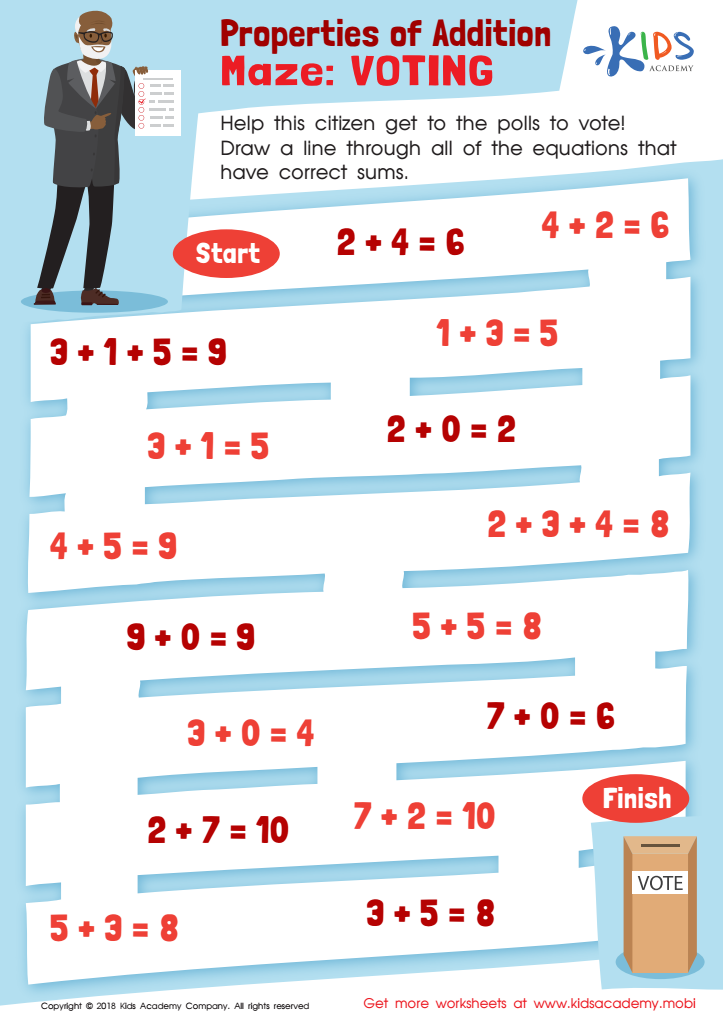
Properties of Addition Maze: Voting Worksheet
The good citizen in the worksheet needs your child's help to vote. Ask them to draw a line through all equations with correct sums to get the citizen to the polls. Voting is the right and obligation of all good citizens. It helps elect the right candidates and exercise legal rights.
 Assign to My Students
Properties of Addition Maze: Voting Worksheet
Worksheet
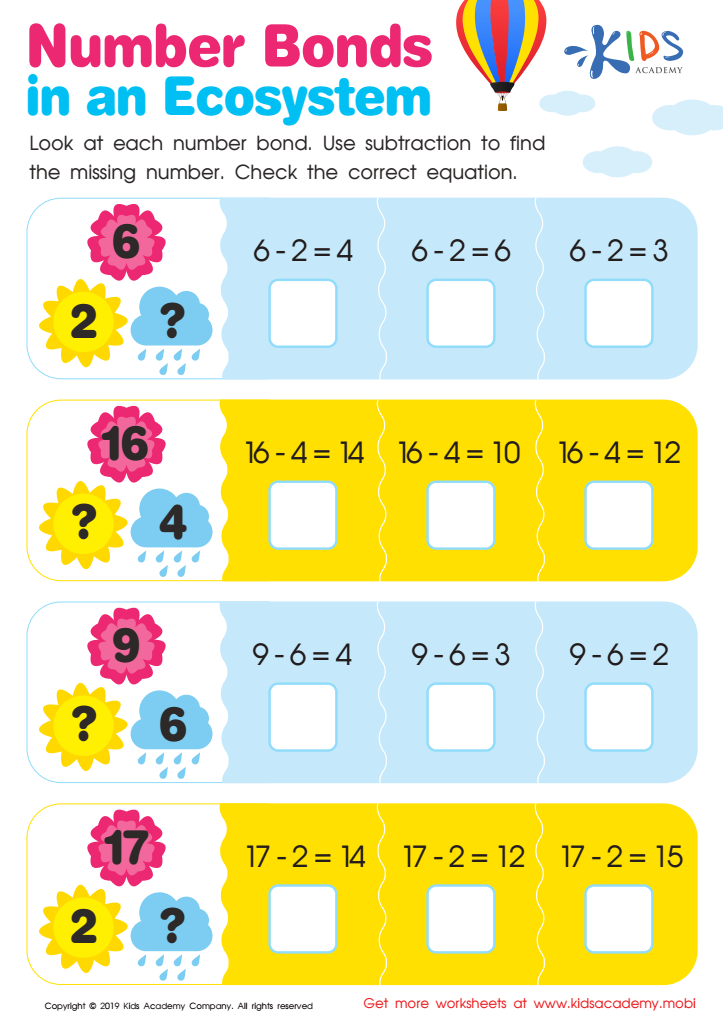
Number Bonds in an Ecosystem Worksheet
This worksheet is a great tool to help your kids sharpen their maths skills. Use the colourful images to teach them how to subtract the missing numbers and check the equation. Show them the four different images and let them try solving each number bond. With your guidance, they'll be able to hone their maths skills in no time!
Number Bonds in an Ecosystem Worksheet
Worksheet
Join Kids Academy for Free
Who is primarily going to use this learning content?








Enhancing mathematical logic in children aged 3-7 is crucial for their cognitive development and future academic success. At this age, children begin to build foundational skills in critical thinking, problem-solving, and reasoning, which are all integral to mathematics. By nurturing these skills early, parents and teachers can help foster a love for math, making it less intimidating and more accessible.
Children who are introduced to mathematical logic through playful activities—like puzzles, games, and tangible objects—develop the ability to recognize patterns, classify objects, and understand number relationships. These skills not only benefit their math performance but also translate to real-life situations, boosting their confidence in tackling problems outside of school.
Moreover, early exposure to mathematical concepts can bridge potential gaps in learning down the line. Research shows that strong early math skills correlate with improved academic outcomes in later grades, particularly in STEM-related fields. By focusing on enhancing mathematical logic during these critical developmental years, parents and teachers can equip children with the tools they need to be successful learners and critical thinkers, laying the groundwork for lifelong learning and achievement. Investing in these early skills is essential for enriching children's educational experiences and future opportunities.








