Understanding patterns Adding up to 100 Without Regrouping Worksheets for Ages 3-7
3 filtered results
-
From - To
Unlock the world of math for your little learners with our "Understanding Patterns: Adding Up to 100 Without Regrouping" worksheets designed for ages 3-7. These engaging activities help children develop essential number sense by exploring patterns in numbers. Our colorful worksheets guide young minds through the process of addition, enabling them to visualize and recognize patterns that lead to sums of 100. By practicing addition without regrouping, kids build a strong foundation for future math skills. Perfect for home or classroom use, these resources make learning fun and interactive, fostering confidence and curiosity in young mathematicians. Dive into math today!
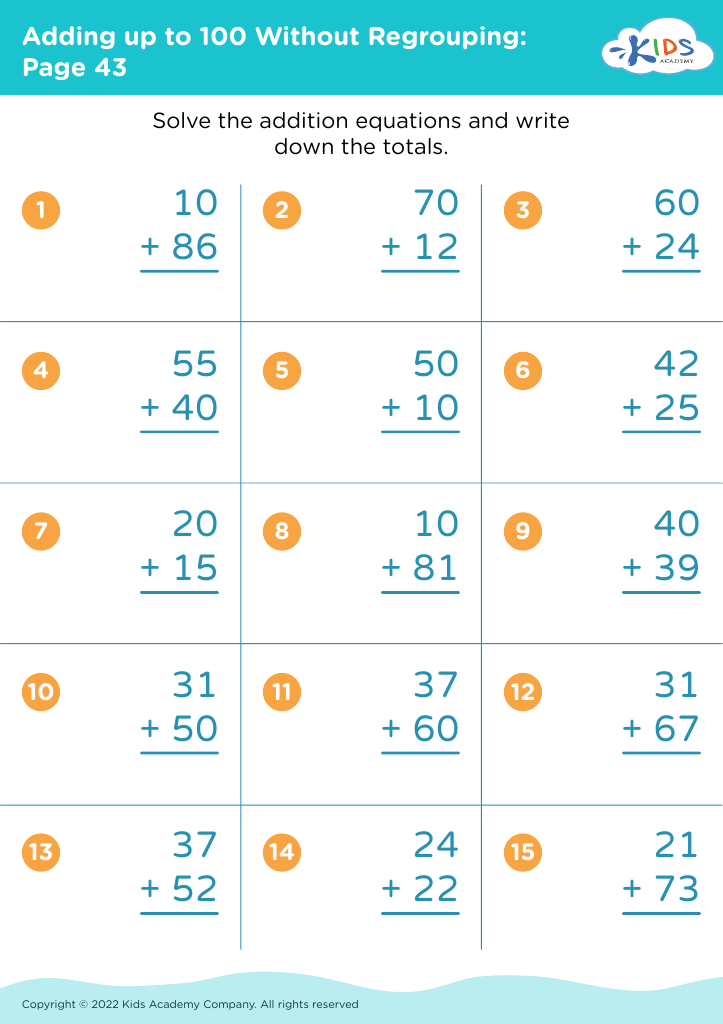
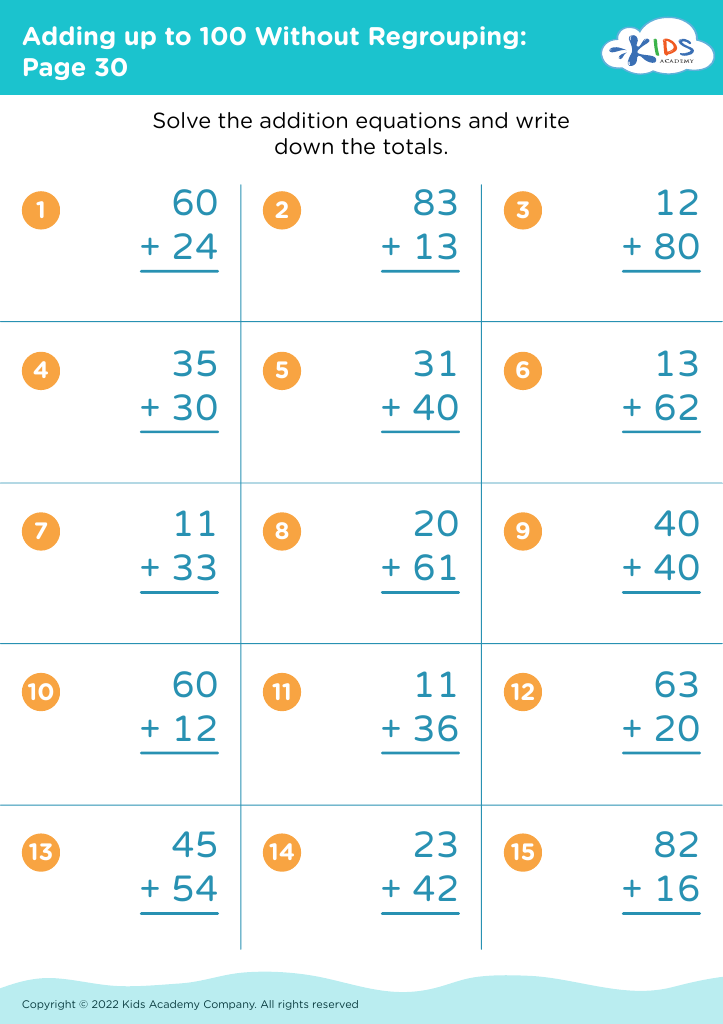
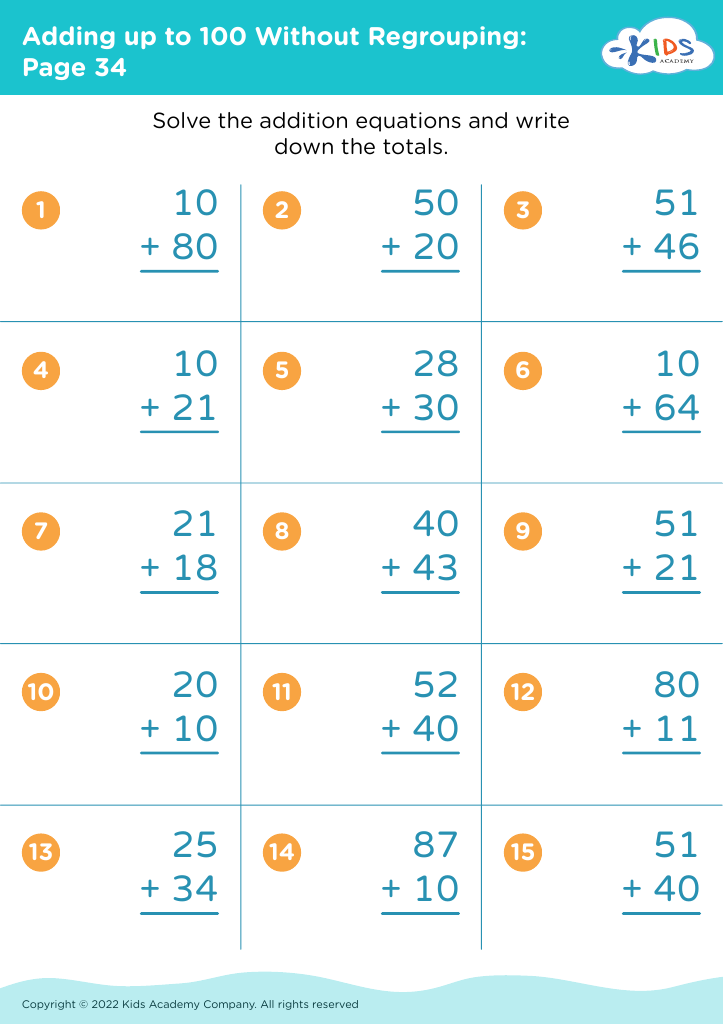




Understanding patterns and basic math concepts like adding up to 100 without regrouping is crucial for children aged 3-7. At this developmental stage, children are naturally curious and eager to learn about the world around them. Introducing the idea of patterns helps them make connections between numbers, establishing a foundation for mathematical reasoning. Recognizing patterns not only aids in addition but also sharpens their problem-solving skills and logical thinking.
Teaching children how to add up to 100 without regrouping encourages fluency in basic arithmetic, fostering confidence and comprehension in math. It allows them to build a strong foundation for more complex calculations in the future. Moreover, this skill can often be linked to everyday situations, such as counting items during shopping or sharing snacks, which reinforces learning through practical experience.
Parents and teachers who emphasize this understanding can help children develop a positive attitude towards math early on. Cultivating a sense of competence in math can pave the way for lifelong learning, making it essential for educators and caregivers to prioritize these foundational skills. In a world increasingly driven by analytics and technology, equipping young learners with essential mathematical knowledge is more important than ever.