Improving number sense Addition & Subtraction Worksheets for Ages 3-7
3 filtered results
-
From - To
Boost your child's mathematical foundation with our "Improving Number Sense: Addition & Subtraction Worksheets" designed for ages 3-7. These engaging and colorful worksheets aim to develop strong number sense by introducing young learners to basic addition and subtraction concepts.
Through fun, hands-on activities and exercises, children will enhance their understanding of counting, recognizing numbers, and simple problem-solving. Perfect for preschool and early elementary students, our worksheets make learning math enjoyable and effective, setting the stage for future success. Improve your child’s number sense today with our expertly crafted resources.
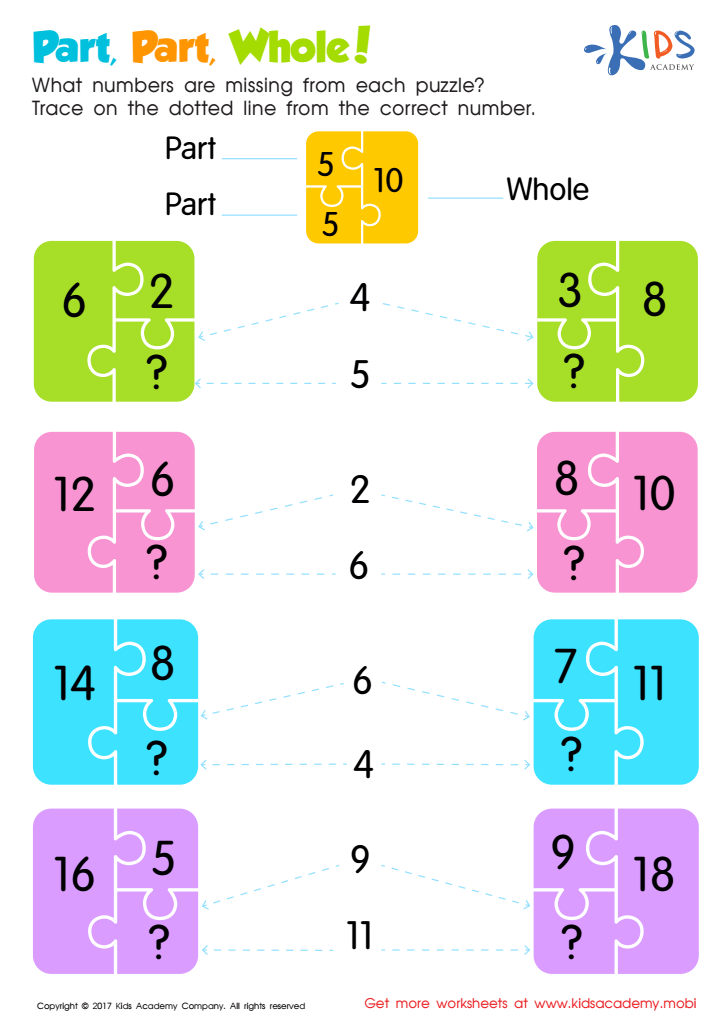
Part, Part, Whole Worksheet
 Assign to My Students
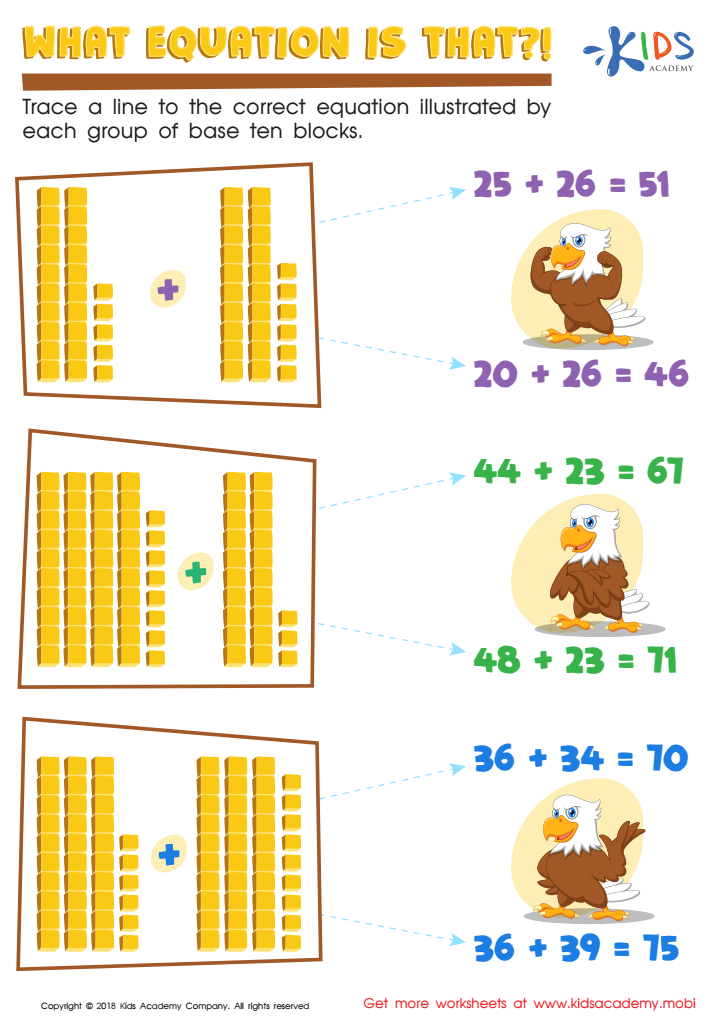
What Equation Is That? Worksheet








Parents and teachers should prioritize improving number sense, particularly in addition and subtraction, for children ages 3-7 because it forms the foundation for all future mathematical learning. During these formative years, young children develop critical thinking and reasoning skills that influence their ability to understand and manipulate numbers. A strong number sense helps them grasp concepts such as quantity, order, and the relationships between numbers, making complex math topics more accessible as they grow.
Firstly, number sense instills confidence. Children who feel competent in their math skills are more likely to approach math with enthusiasm rather than apprehension. Secondly, early math skills are a strong predictor of later academic success, not only in mathematics but across other subjects that require logical thinking and problem-solving.
Moreover, early addition and subtraction go beyond rote learning; they enable children to understand real-world applications, such as sharing, measuring, or organizing objects. When they see how math applies to everyday life, learning takes on greater meaning and interest.
Lastly, fostering these skills promotes equity. Children with a strong mathematical foundation are better equipped to keep up with instructional demands as they advance through school, closing achievement gaps. Thus, enhancing number sense and early arithmetic sets children on a path towards lifelong learning and achievement.








