
Improving mental math Addition Worksheets for Ages 3-7
3 filtered results
Difficulty Level
Grade
Age
-
From - To
Subject
Activity
Standards
Unlock your child's potential with our "Improving Mental Math Addition Worksheets for Ages 3-7"! Tailored specifically for young learners, these engaging worksheets make mastering math fun and effective. Using playful illustrations and age-appropriate challenges, we focus on building essential addition skills while nurturing mental calculation. Each activity is designed to reinforce understanding, boost confidence, and foster a love for learning numbers. Help your child embark on a math adventure that cultivates critical thinking and problem-solving abilities from an early age. Explore our collection and watch as your child's math proficiency flourishes in a joyful, supportive environment.
Favorites
With answer key
Interactive
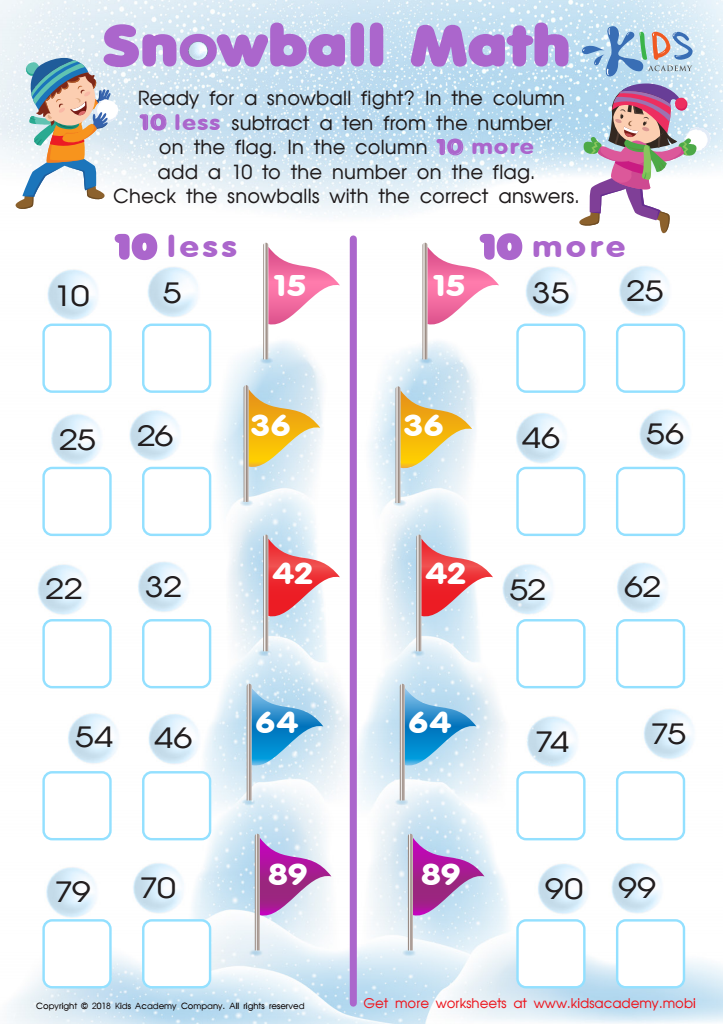
Snowball Math Worksheet
Kids can have a snowball fight and build math skills at the same time with this free worksheet. Kids can use tens to add and subtract for quick math equations and select the correct answers. No need to worry about getting cold either - these snowballs won't chill you!
 Assign to My Students
Snowball Math Worksheet
Worksheet
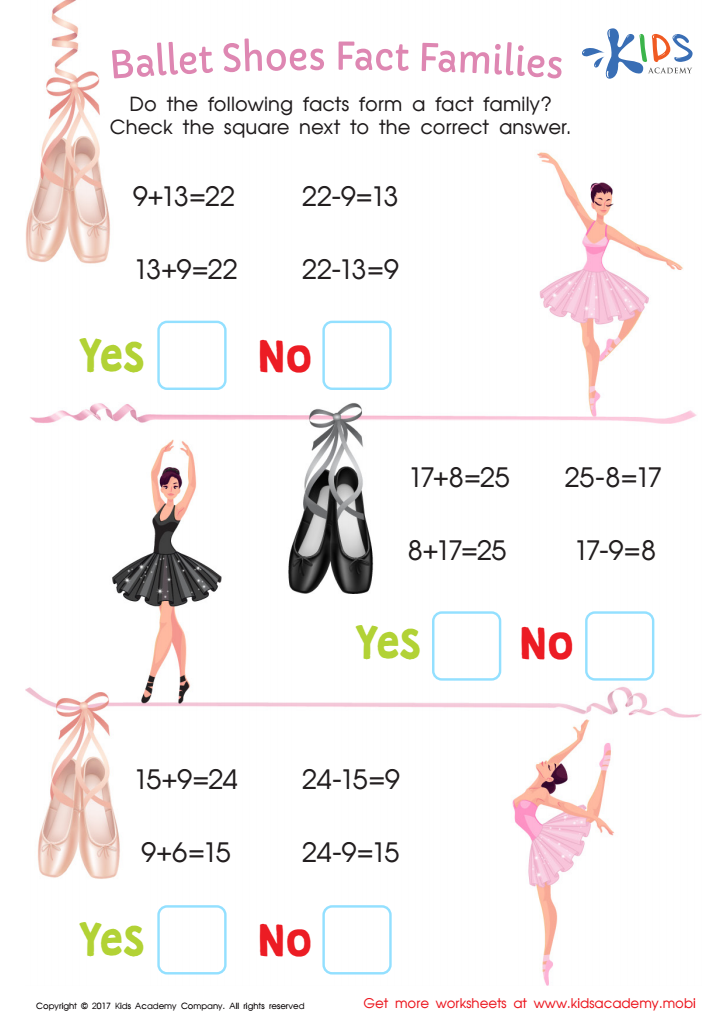
Ballet Shoes Fact Family Printable
Have them observe the equations and determine which groupings are fact families for a delightful learning experience. It encourages critical thinking, showing how addition and subtraction are related.
Ballet Shoes Fact Family Printable
Worksheet
Join Kids Academy for Free
Who is primarily going to use this learning content?






.jpg)

Improving mental math addition for children aged 3 to 7 is essential for several reasons, benefiting both their immediate and long-term educational development. At this early stage, children's brains are highly adaptable and responsive to learning new skills. Introducing mental math addition during these formative years lays a strong foundation for their overall numeracy skills. Mastering mental addition enhances cognitive abilities such as memory, focus, and problem-solving, which are critical across all areas of learning.
Moreover, building proficiency in mental addition boosts a child's confidence and reduces math-related anxiety, fostering a positive attitude towards mathematics. When children feel competent and confident with basic math skills, they are more likely to engage with and enjoy more complex mathematical concepts later in their academic journey.
In practical terms, mental math skills are invaluable in daily life, from counting objects and telling time to making simple calculations quickly and accurately. Developing these skills early helps children adapt to these everyday tasks with ease.
Furthermore, strong mental math skills streamline their transition to more advanced math topics in later grades. Teachers and parents investing time in improving a child's mental math abilities are essentially preparing them for academic success and a future ease with numbers, making it a vital focus during their early education years.








