
Mathematical thinking Addition Worksheets for Ages 3-7
4 filtered results
Difficulty Level
Grade
Age
-
From - To
Subject
Activity
Standards
Enhance your child's mathematical thinking with our engaging Addition Worksheets tailored for ages 3-7! These fun and interactive activities help young learners develop essential addition skills while fostering critical thinking. Featuring colorful illustrations and age-appropriate exercises, our worksheets make learning enjoyable and effective. Perfect for home or classroom use, they stimulate cognitive growth and reinforce foundational math concepts. Parents and educators can easily track progress as kids explore early numerical reasoning through playful math challenges. Start your child's journey to becoming a confident problem solver today with our thoughtfully crafted addition resources! Let the learning and fun begin!
Favorites
With answer key
Interactive
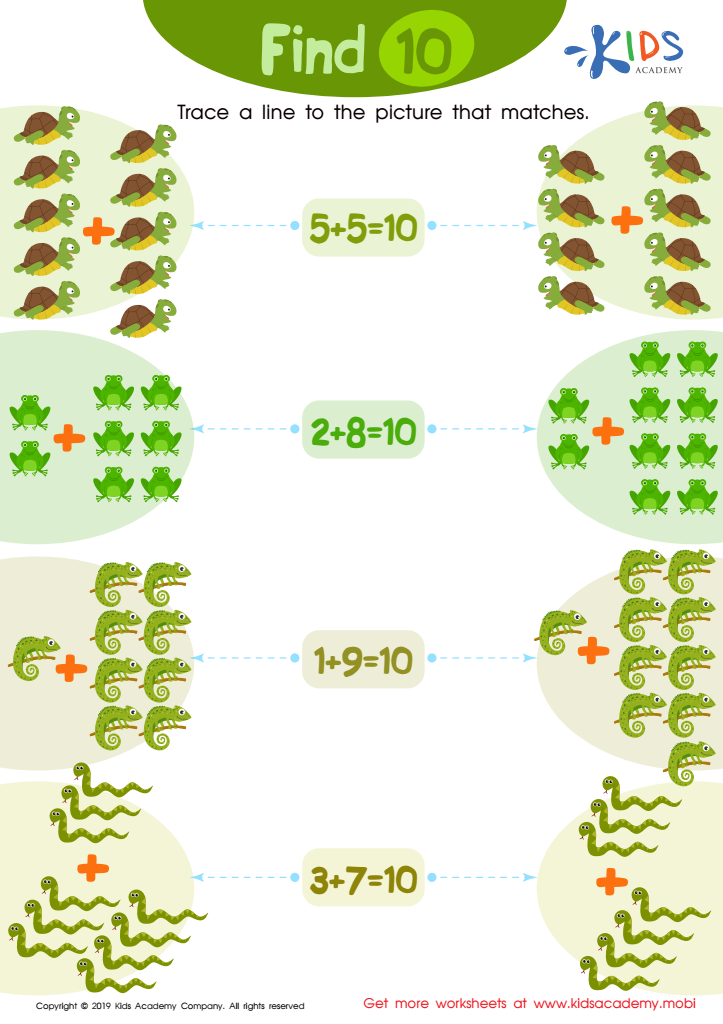
Find 10 Worksheet
Counting can be tricky, but your kids can master it with regular practice. Here's a fun activity to help: count the animals, then trace a line to the pictures that matches. With these tips, math will be an easy walk in the park.
 Assign to My Students
Find 10 Worksheet
Worksheet
Join Kids Academy for Free
Who is primarily going to use this learning content?








Mathematical thinking in early childhood, especially regarding addition, is foundational for a child’s cognitive development. For ages 3 to 7, engaging with the concept of addition lays the groundwork for problem-solving skills and logical reasoning. When parents or teachers prioritize mathematical thinking, they promote not only numeracy but also critical thinking skills that children will use throughout their lives.
During these formative years, children learn through play and exploration, which are essential for mastering addition. Recognizing numbers, understanding quantity, and engaging in simple addition exercises transform abstract concepts into tangible knowledge. Parents and teachers can foster a love for mathematics by incorporating everyday scenarios—like sharing snacks or counting toys—to make addition relatable and enjoyable.
Furthermore, strong foundational skills in addition can increase a child's confidence in math as they progress through school. Early success can motivate them to tackle more complex concepts later, ultimately improving overall academic performance. In essence, nurturing mathematical thinking in early childhood not only prepares children for future schooling but also equips them with essential life skills that are crucial in a numerically driven world. Thus, active parental and teacher involvement in early mathematical education can have lasting, positive impacts on a child’s trajectory.








