Analog Clock Understanding Math Worksheets for Ages 3-7
3 filtered results
-
From - To
Introduce your child to the essential skill of telling time with our Analog Clock Understanding Math Worksheets designed for ages 3-7. These engaging and interactive worksheets offer fun, hands-on activities to help young learners grasp the concepts of hours, half-hours, and minutes. Through colorful illustrations and step-by-step guidance, children will learn to read and interpret analog clocks accurately. Perfect for early grade students, our worksheets encourage fine motor skills development and mathematical comprehension. Make learning time a delightful experience and build a strong foundation for your child’s future math success with Kids Academy’s expert-crafted resources.
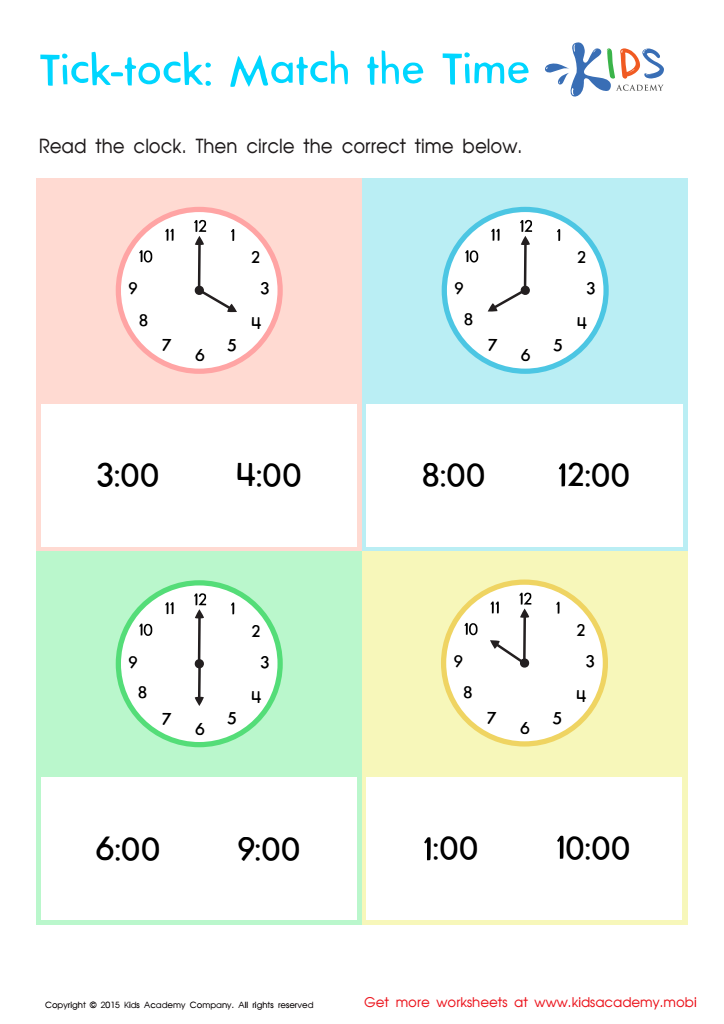
Telling The Time Worksheet: Part 4
 Assign to My Students
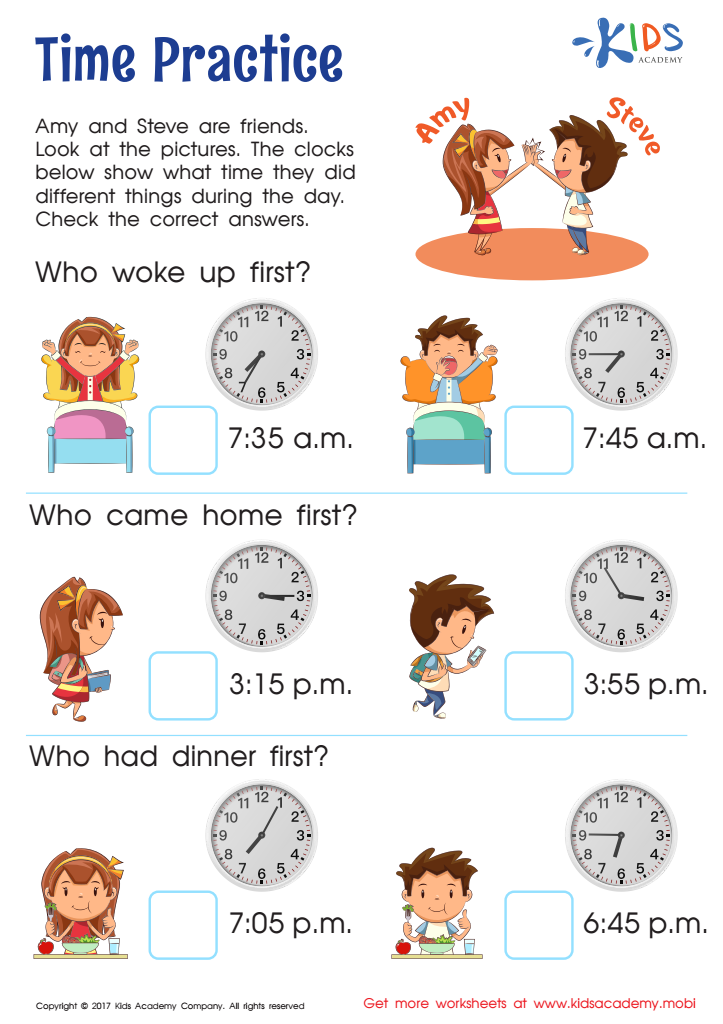
Time Practice Worksheet
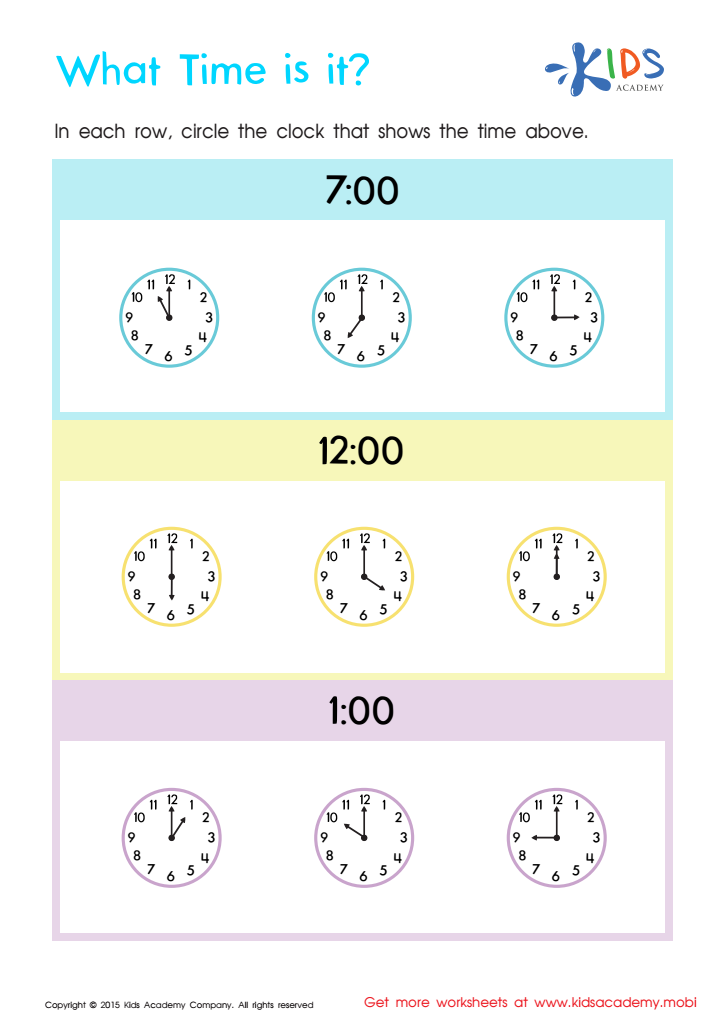
Telling The Time Worksheet: Part 3








Teaching children aged 3-7 to read and understand analog clocks is crucial for several foundational reasons:
-
Numeracy Skills: Understanding how to read an analog clock helps children develop their number sense and recognize numerical patterns. It encourages counting upward, recognizing numbers, and understanding the concept of intervals, especially increments of five which are foundational for more complex math.
-
Time Management: Early knowledge of reading analog clocks instills a sense of time management. Kids learn to anticipate daily activities and understand routines, fostering punctuality.
-
Cognitive Development: Reading an analog clock enhances a child’s cognitive abilities by challenging them to reconcile the positions of the hour and minute hands. This promotes critical thinking, spatial reasoning, and problem-solving skills.
-
Historical and Practical Relevance: In a world with digital clocks, knowing how to read analog clocks provides broader perspective and knowledge. Clocks are still pervasive in many real-life settings, such as schools, public buildings, and family homes, making this skill practical.
-
Independence: As children mature, knowing how to tell time on an analog clock fosters independence because they rely less on adults to denote the passage of time.
Promote this skill to nurture well-rounded, mathematically fluent children, prepared for future academic challenges and daily life assessments.








