
Counting money Math Worksheets for Ages 3-7
3 filtered results
Difficulty Level
Grade
Age
-
From - To
Subject
Activity
Standards
Introduce your child to the basic concepts of money and early math skills with our Counting Money Math Worksheets designed for ages 3-7. These engaging and educational worksheets make learning fun by incorporating colorful graphics, relatable scenarios, and age-appropriate tasks that reinforce counting, addition, and money recognition. Perfect for preschool through early elementary students, our worksheets build a strong math foundation and improve your child's confidence in handling money. Whether used in the classroom or at home, Kids Academy's worksheets are an excellent resource to support your child's development in math and financial literacy. Let's count and learn together!
Favorites
With answer key
Interactive
Recognizing Money Money Worksheet
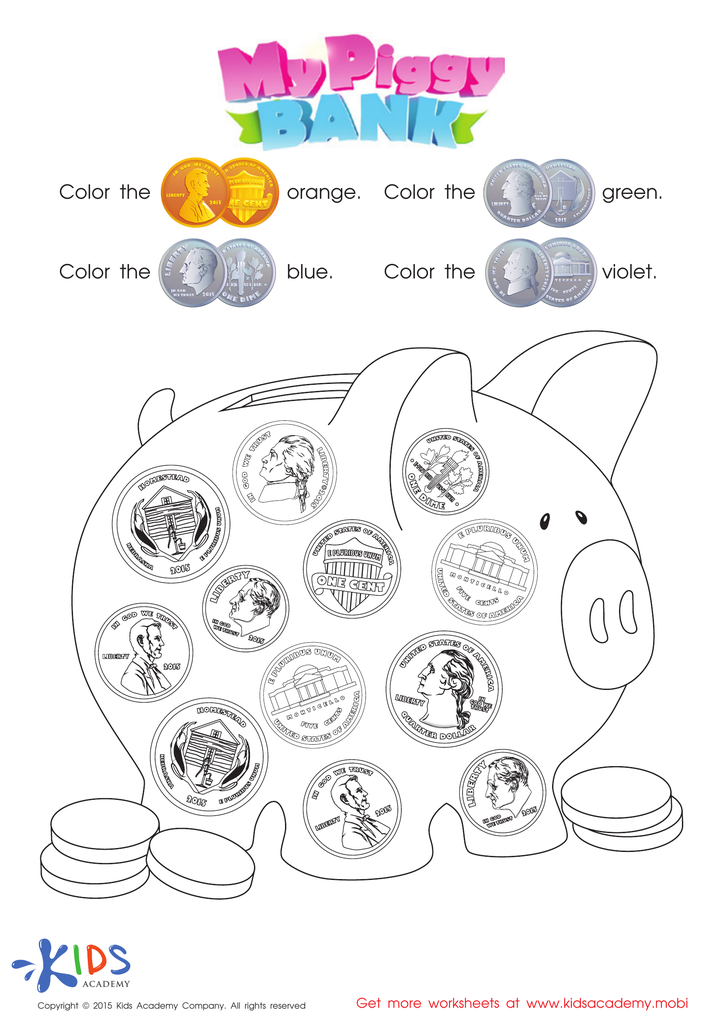
Help the piggy bank by coloring its coins with Kids Academy's free money worksheets! Learn the different coins and their values with your kids. Printable worksheets are available to continue the lesson. Let's learn and have fun!
Recognizing Money Money Worksheet
Worksheet
Ten Cents or the Dime Money Worksheet
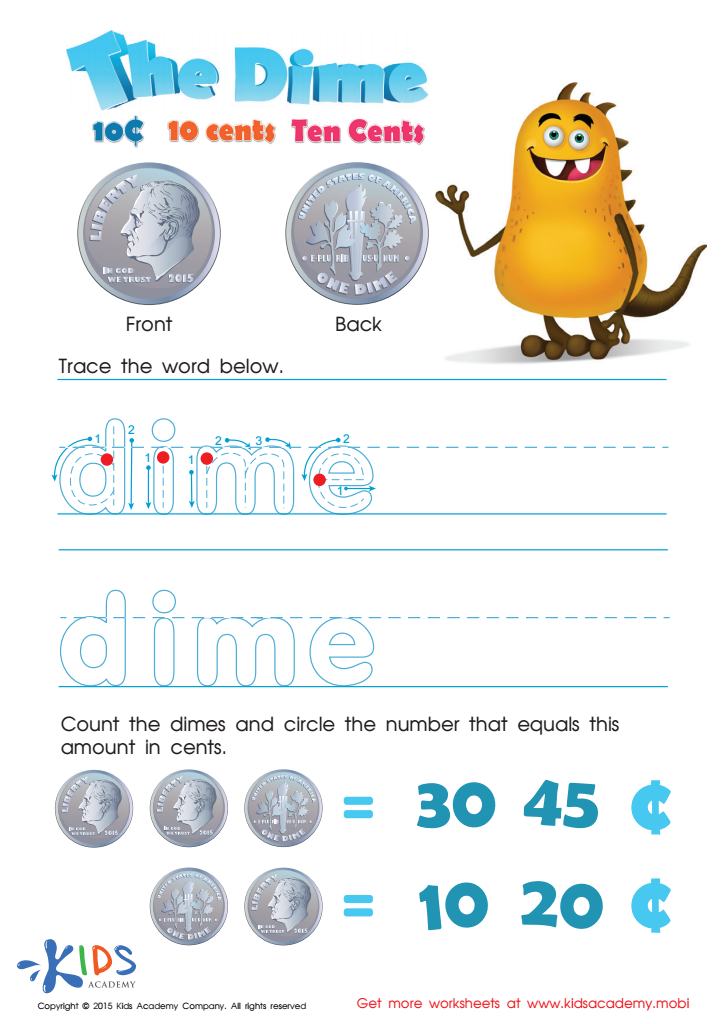
Introduce your kids to coin games! Start with a dime: trace the word on both sides and count the dimes. Kids Academy has printable worksheets to help your kids learn how to count money.
 Assign to My Students
Ten Cents or the Dime Money Worksheet
Worksheet
Join Kids Academy for Free
Who is primarily going to use this learning content?






Counting money is an essential skill for young children aged 3-7 as it lays the foundation for their future mathematical understanding and practical life skills. Parents and teachers should prioritize this aspect of math education because it intertwines several crucial learning areas: numeracy, value recognition, and everyday problem-solving.
Firstly, it enhances numeracy by reinforcing basic counting, addition, and subtraction, which are fundamental for later math concepts. For instance, counting coins requires recognizing the value of each coin and adding them together correctly, thereby enhancing arithmetic skills.
Secondly, understanding money introduces children to the concept of value. Learning that different coins represent different amounts helps children grasp the broader concept of numerical value and relative worth, making abstract numbers more concrete and meaningful.
Finally, counting money equips children with indispensable life skills. From a young age, they begin to understand how transactions work, making them more aware of financial literacy by practicing scenarios like buying toys or small snacks. This practical knowledge fosters independence and critical thinking.
In essence, the ability to count money not only supports academic growth in math but also aids in developing real-world financial competencies indispensable for everyday interactions and decisions. Parents and teachers can create engaging, hands-on activities to help children familiarize themselves with money, thereby making learning both fun and practical.








