Counting skills improvement Math Worksheets for Ages 3-7
3 filtered results
-
From - To
Enhance your child's counting skills with our engaging Math Worksheets designed for ages 3-7. At Kids Academy, we provide a variety of fun, interactive activities perfect for young learners. Our worksheets are crafted to build foundational math skills, including recognizing numbers, counting objects, and simple addition and subtraction. These exercises are curated to keep children motivated and excited about learning, helping them master counting through playful challenges and colorful illustrations. Ideal for both classroom and home use, these worksheets are an excellent resource to support your child's early math development and set them on a path to success.
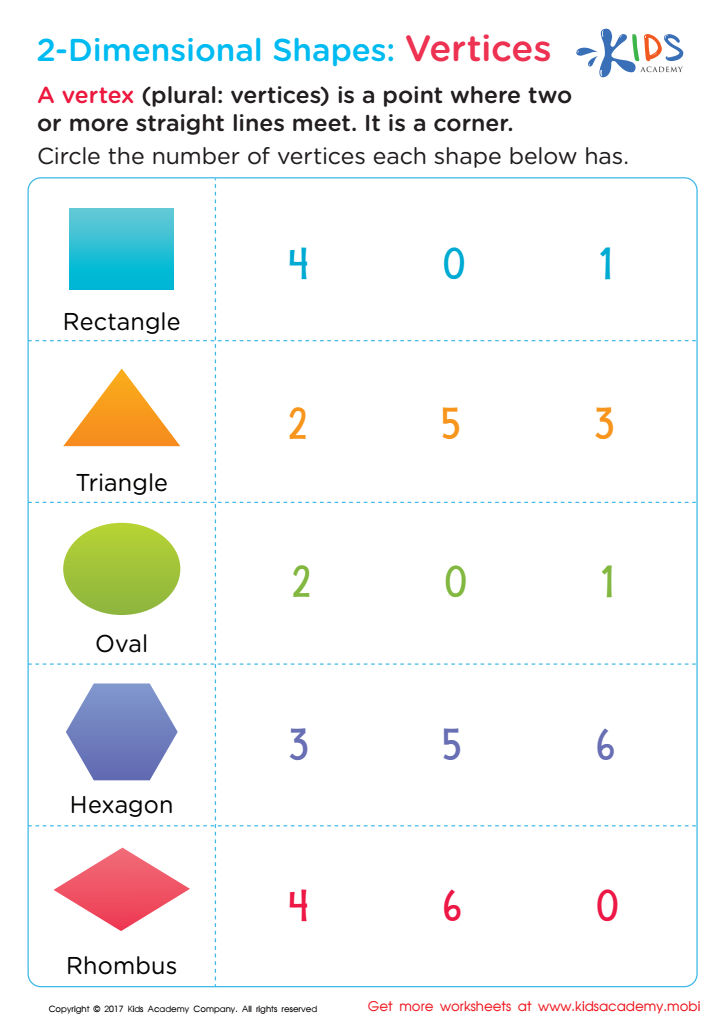
Two–Dimensional Shapes: Vertices Printable
 Assign to My Students
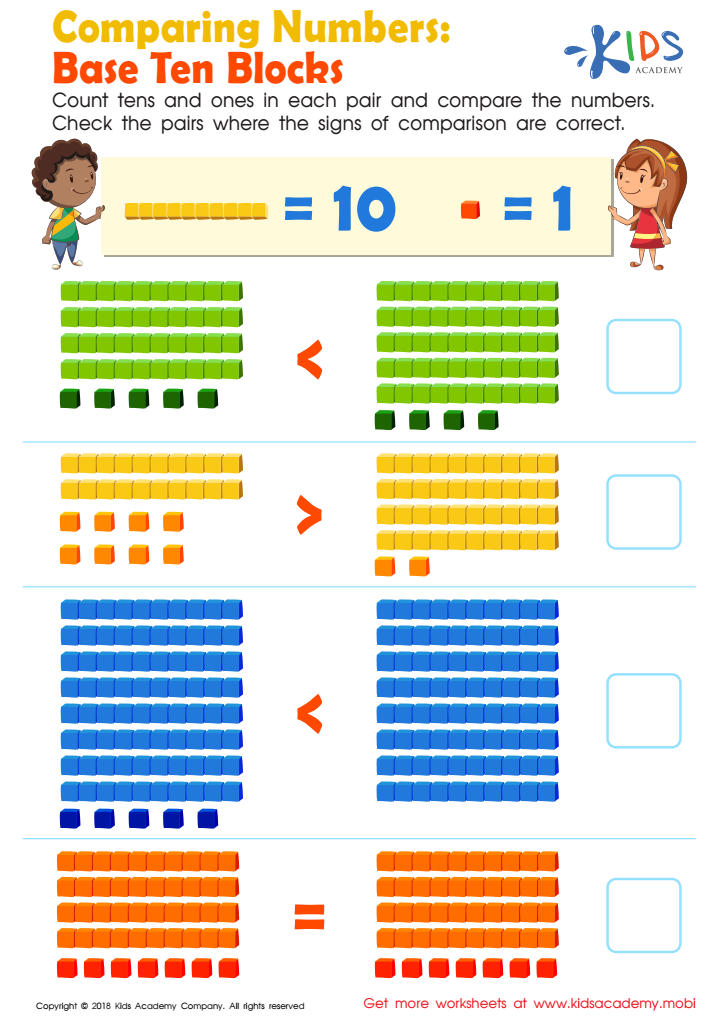
Comparing Numbers: Base Ten Blocks Worksheet
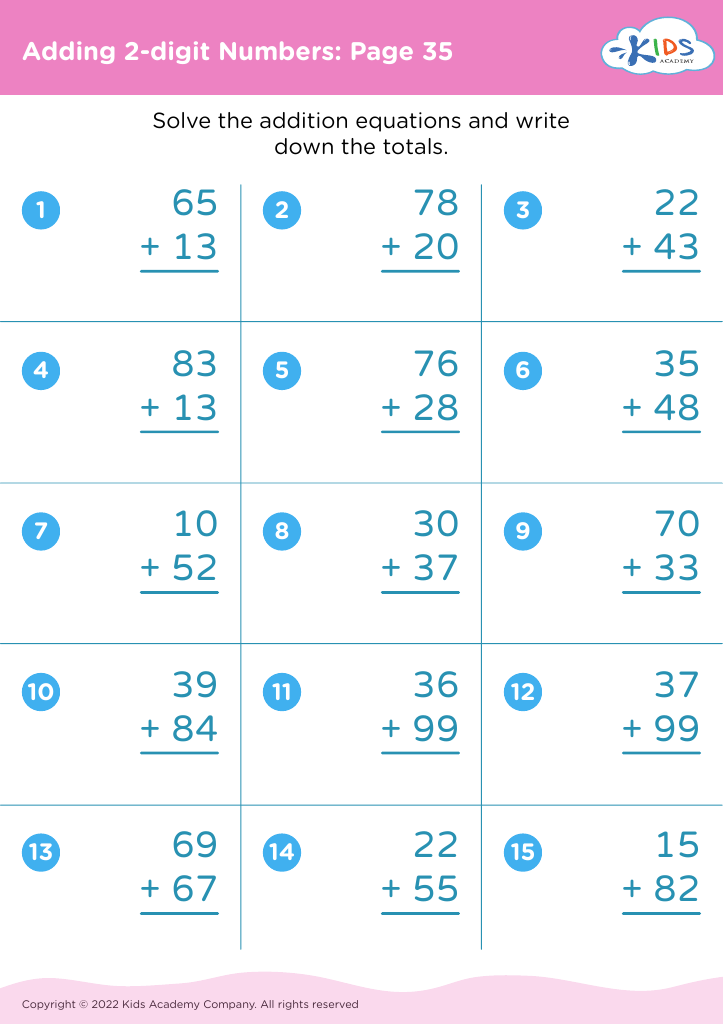








Counting skills for children aged 3-7 are foundational for their overall mathematical development and have far-reaching impacts beyond simple numeracy. For parents and teachers, fostering these skills is crucial as it promotes cognitive development, problem-solving abilities, and logical thinking. Early proficiency in counting helps children understand number value and relationships, laying the groundwork for more advanced mathematical concepts such as addition, subtraction, and sequencing.
Moreover, strong counting skills contribute to academic confidence. When children feel adept with numbers, they are more likely to participate in and enjoy math-related activities, fostering a positive attitude towards learning. This early love for math can motivate continuous engagement and reduce math anxiety later in life.
By developing counting skills at a young age, children also improve their fine motor skills, memory, and concentration, all of which are integral to overall academic success. Additionally, these skills translate into real-world applications, helping children understand time, money, and quantities, essential for everyday tasks.
Parents and teachers play a critical role in this developmental phase by integrating counting activities into play, reading, and daily routines, making learning engaging and seamless. Investing time and effort in nurturing counting skills prepares children for a lifetime of mathematical literacy and academic achievement.








