Fine motor skills (drawing lines) Math Worksheets for Ages 3-7
7 filtered results
-
From - To
Enhance your child's fine motor skills with our engaging Math Worksheets, specifically designed for ages 3 to 7. These worksheets focus on drawing lines, a vital precursor to mastering writing and complex mathematical tasks. Through colorful illustrations and fun activities, children will practice gripping tools, following paths, and creating shapes, all while building confidence in their abilities. Our resources cater to various skills levels, ensuring a well-rounded learning experience that promotes hand-eye coordination and concentration. Download our worksheets today and watch your child flourish as they develop essential fine motor skills necessary for future academic success!

Count and Match Vegetables 1 – 7 Math Worksheet
 Assign to My Students

Counting Eggs Worksheet

Count and Match Vegetables 2 – 8 Math Worksheet
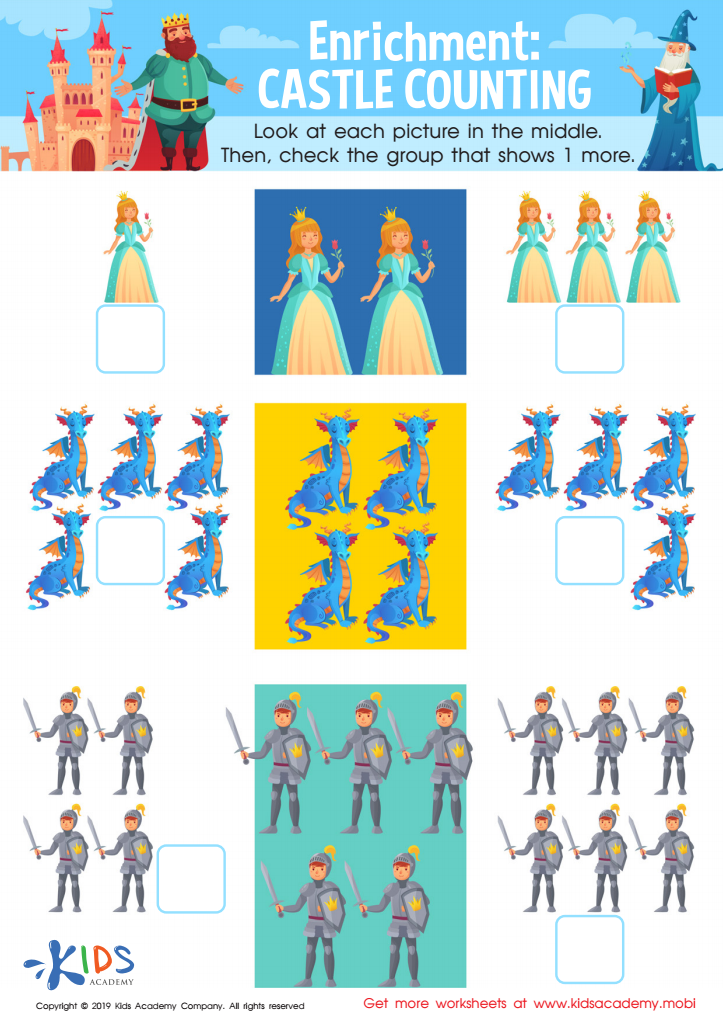
Enrichment: Castle Counting Worksheet







Fine motor skills, such as drawing lines, are crucial for children aged 3-7 as they lay the groundwork for both academic and everyday tasks. These skills involve the coordination of small muscles in the hands and fingers, which are essential for activities like writing, using scissors, and even buttoning shirts. When children engage in tasks like drawing lines, they're not only improving their dexterity but also enhancing their cognitive skills.
Fine motor skills are closely linked to early math development. For example, tracing and drawing straight and curved lines helps children understand shapes and spatial relationships—key concepts in mathematics. As they learn to control their pencils, they also begin to grasp concepts such as length, direction, and position. Moreover, the act of drawing reinforces hand-eye coordination, which is critical for more advanced math tasks like measuring and graphing.
Parents and teachers should care about fostering these skills because they set the stage for academic success. Children who struggle with fine motor tasks may face challenges in school, potentially affecting their confidence and motivation. By integrating fine motor activities into early childhood education, we can support holistic development, paving the way for strong learners endowed with problem-solving abilities and critical thinking skills from an early age.








