Motor skills development Math Worksheets for Ages 3-7
6 filtered results
-
From - To
Help your child build foundational math skills and enhance their fine motor abilities with our Motor Skills Development Math Worksheets for Ages 3-7. Specially designed by experts, these engaging activities integrate counting, sorting, and basic arithmetic with fun tasks like tracing, coloring, and cutting. Perfect for preschool and early elementary levels, our vibrant and interactive worksheets ensure young learners stay motivated and develop essential hand-eye coordination alongside math proficiency. Suitable for home and classroom use, these resources support parents and educators in facilitating a balanced approach to learning, making math both enjoyable and educational for young minds. Explore our collection today!
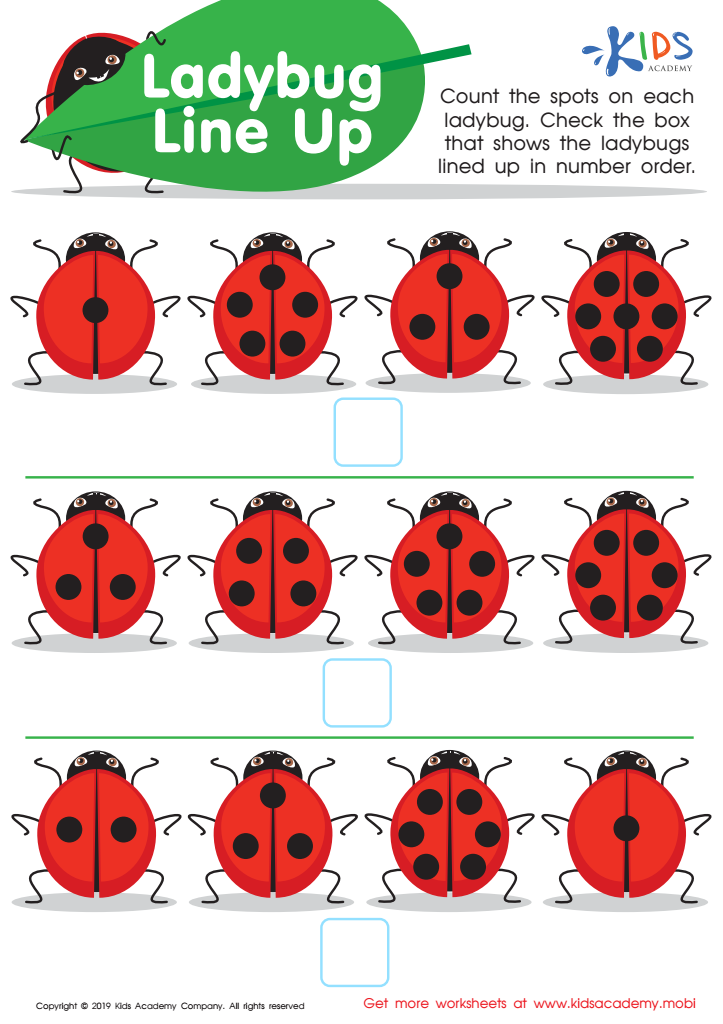
Ladybug Line Up Worksheet
 Assign to My Students







Motor skills development is crucial for children aged 3-7, as it forms the foundation for more advanced physical and cognitive abilities. Specifically, in the context of math, these skills are essential for three main reasons: coordination, understanding, and active learning.
First, fine motor skills enable children to manipulate objects, such as counting beads or pieces of a puzzle. These activities utilize hand-eye coordination, improving dexterity, which is essential for tasks such as writing numbers or solving problems.
Second, gross motor skills play a role in spatial awareness and body control. Activities like hopping, jumping, or balancing can help children understand measurements, shapes, and positions (like over, under, next to), which are fundamental concepts in math.
Third, motor skills development encourages active learning. Rather than passively receiving information, children who engage in hands-on activities develop a deeper understanding of math principles through practical applications. Interactive games, physical activities, and manipulative tools can make math engaging and tangible.
In summary, by fostering both fine and gross motor skills, parents and teachers set children up for success—not only in math but in their overall educational journey. These skills support physical coordination, a tactile understanding of numeric concepts, and active engagement in learning, all of which are pivotal during these formative years.








