Recognizing shapes Math Worksheets for Ages 3-7 - Page 2
33 filtered results
-
From - To
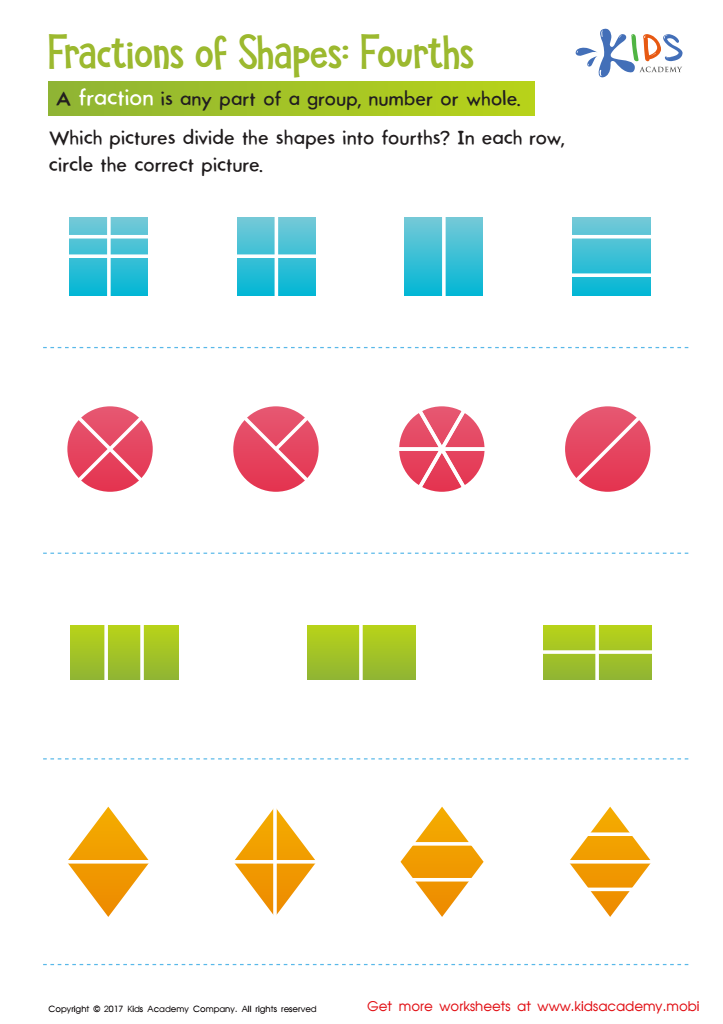
Fractions of Shapes Worksheet
 Assign to My Students








Recognizing shapes is a fundamental math skill that serves as a building block for more complex mathematical concepts, and it's especially crucial for children aged 3-7. During these formative years, children's cognitive and motor skills are rapidly developing, and shape recognition plays a vital role in this growth.
Understanding shapes enhances spatial awareness, which is the ability to understand how objects fit and move in space. This skill is not only fundamental in solving math problems but also in everyday tasks such as reading maps, assembling puzzles, and even playing sports. Recognizing shapes trains children to observe and compare the attributes of different objects, fostering analytical thinking and attention to detail.
Furthermore, recognizing shapes helps in the development of early geometry skills, laying a strong foundation for higher-level math learning. Shapes are foundational to understanding geometric properties and relations, which are critical in advanced math exercises.
Shape recognition is also interwoven with language development. Describing shapes enhances vocabulary and language structuring skills. Using terms like 'circle,' 'square,' 'triangle,' etc., helps children articulate their thoughts and improves communication.
For both parents and teachers, nurturing shape recognition in children ensures they are developing essential cognitive skills and establishes a fun, engaging way to interact with the world mathematically. This sets them on a path of lifelong learning and problem-solving.








