
Solve word problems Math Worksheets for Ages 3-7
3 filtered results
Difficulty Level
Grade
Age
-
From - To
Subject
Activity
Standards
Our "Solve Word Problems Math Worksheets for Ages 3-7" are expertly designed to develop kids' critical thinking and problem-solving skills. Perfect for young learners, these engaging worksheets combine fun illustrations with relatable scenarios to make math concepts easier to understand. Each worksheet encourages children to apply basic math operations such as addition, subtraction, and more to real-life situations, promoting both math proficiency and logical thinking. Ideal for use at home or in the classroom, our worksheets are a valuable resource for parents and educators aiming to nurture a strong mathematical foundation in early learners.
Favorites
With answer key
Interactive
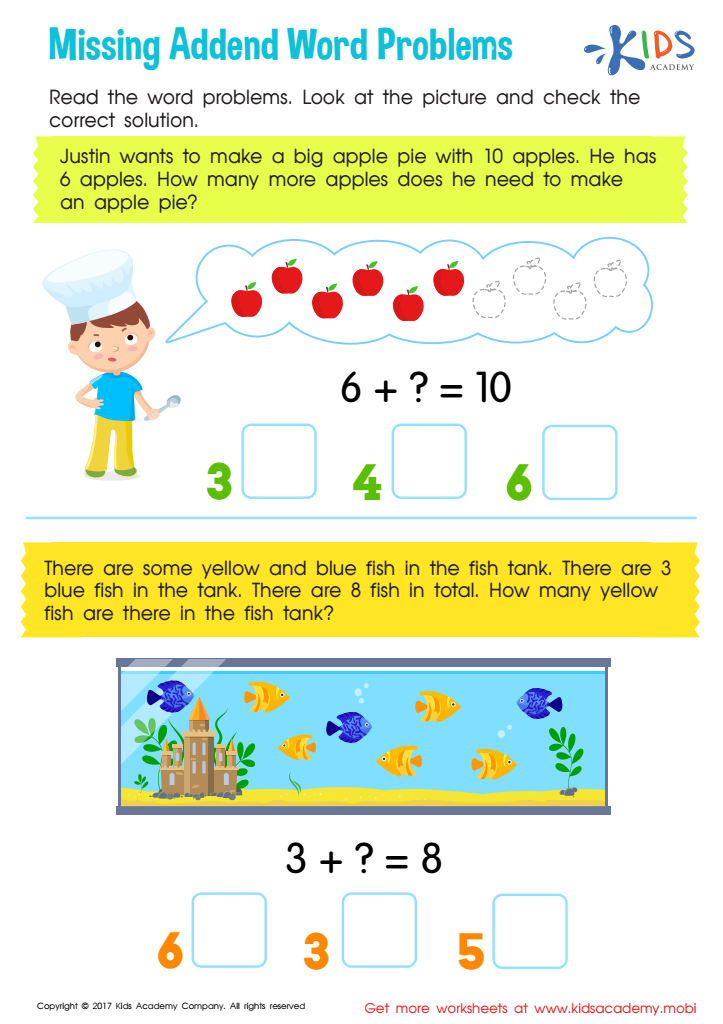
Missing Addend Word Problems Worksheet
Doing many addition and subtraction problems is key for fluency and mastery. Word problems can help kids understand how math works in everyday life. Our math worksheet uses fun scenarios and pictures to teach how to find the missing addend. It's the perfect tool to help kids understand math better!
 Assign to My Students
Missing Addend Word Problems Worksheet
Worksheet
Join Kids Academy for Free
Who is primarily going to use this learning content?







Caring about solving word problems in math for ages 3-7 is crucial for several reasons. First, word problems help children develop critical thinking and problem-solving skills. Unlike simple arithmetic, word problems require them to understand, translate, and analyze the situation before performing any calculations. This enhances their cognitive abilities and encourages logical reasoning.
Second, word problems make math relatable and engaging. By embedding mathematical concepts within stories or real-life scenarios, children find the subject more interesting and are better able to see its practical applications. This can foster a positive attitude towards math early on, potentially leading to long-term interest and proficiency in the subject.
Third, solving word problems reinforces reading and comprehension skills. Young children must read and comprehend the problem’s narrative, which strengthens their literacy.
Finally, early exposure to word problems helps kids gain confidence. As they successfully tackle and solve these challenges, their confidence in their mathematical abilities grows, setting a strong foundation for future learning.
For parents and teachers, emphasizing word problems ensures that children not only learn to calculate but also to think, understand, and apply their knowledge, equipping them with essential skills for life.








