
Understand number relationships Math Worksheets for Ages 3-7
3 filtered results
Difficulty Level
Grade
Age
-
From - To
Subject
Activity
Standards
Enhance your child's numeracy skills with our "Understand Number Relationships" math worksheets, designed specifically for ages 3-7. These engaging and colorful activities help young learners grasp essential concepts like counting, comparing, and ordering numbers through fun and interactive exercises. Perfect for early grade students, our expertly crafted worksheets build a strong mathematical foundation, promoting critical thinking and problem-solving skills. Whether for homeschool or extra practice, our resources support your child's journey to mastering number relationships in an exciting and developmentally appropriate way. Join us to make math learning a delightful adventure for your little ones!
Favorites
With answer key
Interactive
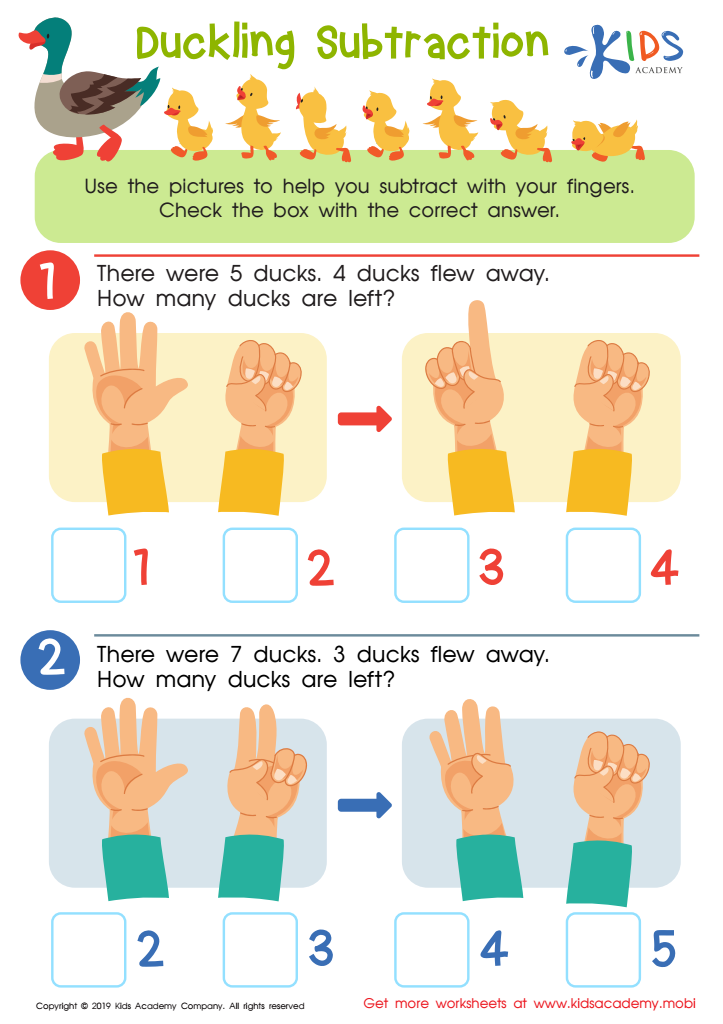
Duckling Subtraction Worksheet
Help your students learn equations and math with this fun worksheet. There are two questions to solve with the help of the pictures. Ask them to subtract with their fingers and check the box with the correct answer. This makes math easier and more enjoyable!
 Assign to My Students
Duckling Subtraction Worksheet
Worksheet
Join Kids Academy for Free
Who is primarily going to use this learning content?




.jpg)


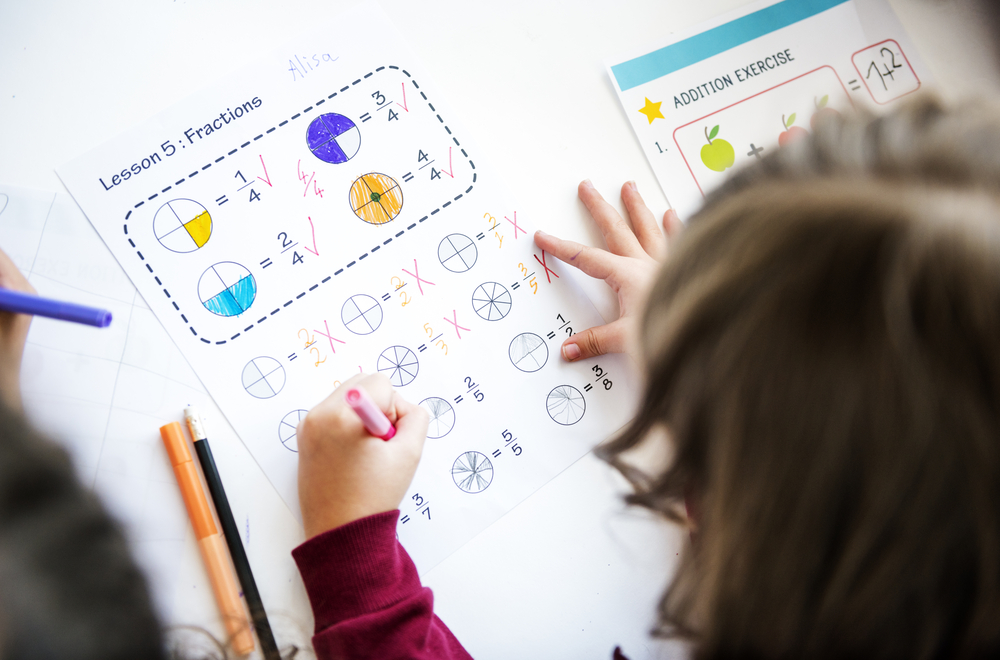
Understanding number relationships is a fundamental aspect of early math education that parents and teachers should prioritize for children ages 3-7. At this developmental stage, children are naturally curious and their brains are extremely receptive to learning new concepts, making it the optimal time to lay a strong foundation in math.
Number relationships are core to all future mathematics learning. They help children comprehend not just counting, but the concepts of more or less, addition and subtraction, and eventually multiplication and division. For instance, recognizing that 4 is 2 more than 2 or 1 less than 5 helps in building arithmetic skills that are crucial for more complex problem solving.
Furthermore, developing these relationships enhances logical thinking and problem-solving skills. Young learners begin to see patterns and understand sequences, promoting cognitive development that extends beyond mathematics. These skills are invaluable in daily life and other academic subjects, fostering a well-rounded intellectual growth.
Also, fostering an early interest and competency in math helps instill a positive attitude toward the subject. Children who experience success in understanding number relationships early on are more likely to feel confident and less anxious about math as they progress through their education.
Therefore, by nurturing these mathematical fundamentals in the stages of early childhood, parents and teachers set the stage for future academic success and lifelong critical thinking skills.








