Understanding Math Concepts Math Worksheets for Ages 3-7
3 filtered results
-
From - To
Explore our "Understanding Math Concepts" worksheets designed for children aged 3 to 7! These interactive math activities encourage early learners to engage with essential math skills, such as counting, measuring, and recognizing shapes. Our worksheets foster a fun and supportive learning environment, helping children build a solid foundation in math through colorful illustrations and age-appropriate exercises. Each activity is crafted to promote critical thinking and problem-solving, ensuring young learners not only grasp basic concepts but also enjoy the journey of learning math. Perfect for home or classroom use, these resources make math an exciting and rewarding adventure for kids!
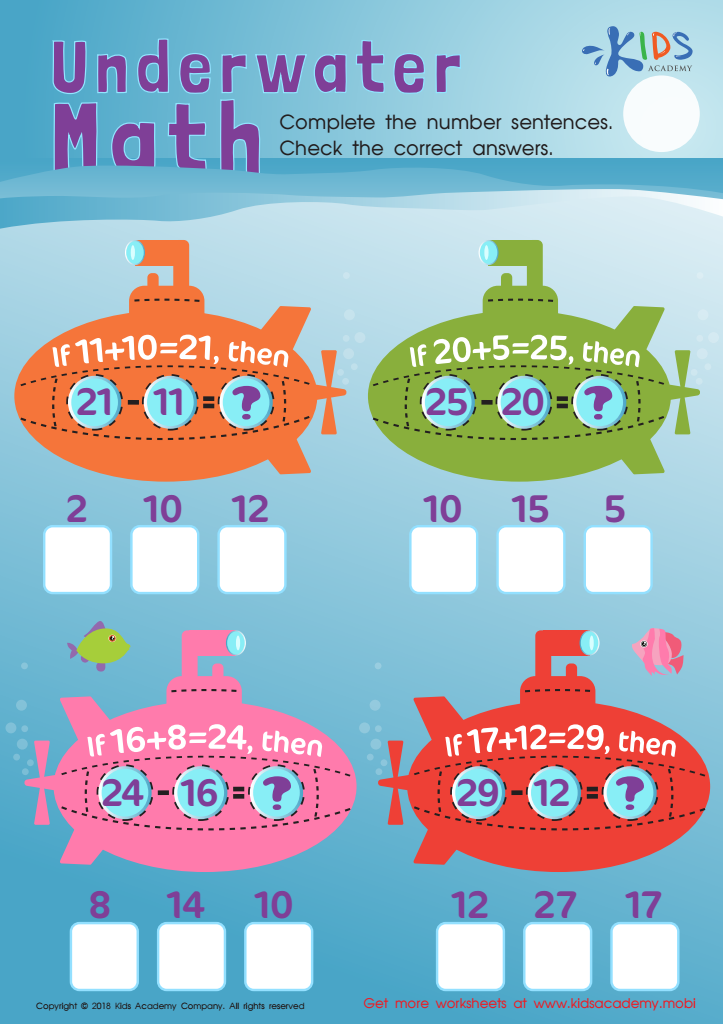
Addition and Subtraction: Underwater Math Worksheet
 Assign to My Students








Understanding math concepts from ages 3 to 7 is crucial for fostering a strong foundation in young children. During this critical developmental period, children begin to explore basic mathematical ideas such as number recognition, counting, shapes, and simple patterns. When parents and teachers emphasize these concepts, they enable children to develop essential problem-solving and critical-thinking skills, preparing them for more complex mathematical challenges later in life.
Furthermore, early math understanding is linked to overall academic success. Research shows that strong early math skills can predict later achievements in both math and literacy. This emphasizes the importance of creating engaging and playful learning environments that allow children to explore math in meaningful ways.
Moreover, positive early experiences with math can build a child’s confidence and interest in the subject. When children no longer fear math, they’re more likely to pursue it in their education and careers. Encouraging exploration and discussion of math concepts also nurtures a growth mindset, teaching children that abilities can improve with effort.
Ultimately, a solid mathematical foundation helps children navigate their world, fostering skills that contribute to lifelong learning and problem-solving. Parents and teachers play a pivotal role in guiding this essential stage of learning.








