
Counting proficiency Numbers Worksheets for Ages 3-8
3 filtered results
Difficulty Level
Grade
Age
-
From - To
Subject
Activity
Standards
Enhance your child's counting skills with our engaging Counting Proficiency Numbers Worksheets, designed for ages 3-8. These worksheets provide a fun and interactive way to foster early math skills, helping young learners count, recognize, and compare numbers. With a variety of exercises, including tracing numbers, counting objects, and matching quantities, children will develop a solid foundation in numeracy. Our resources cater to diverse learning styles and promote confidence in mathematical abilities. Whether at home or in the classroom, these worksheets make learning numbers an enjoyable experience. Explore our collection and watch your child excel in counting proficiency!
Favorites
With answer key
Interactive
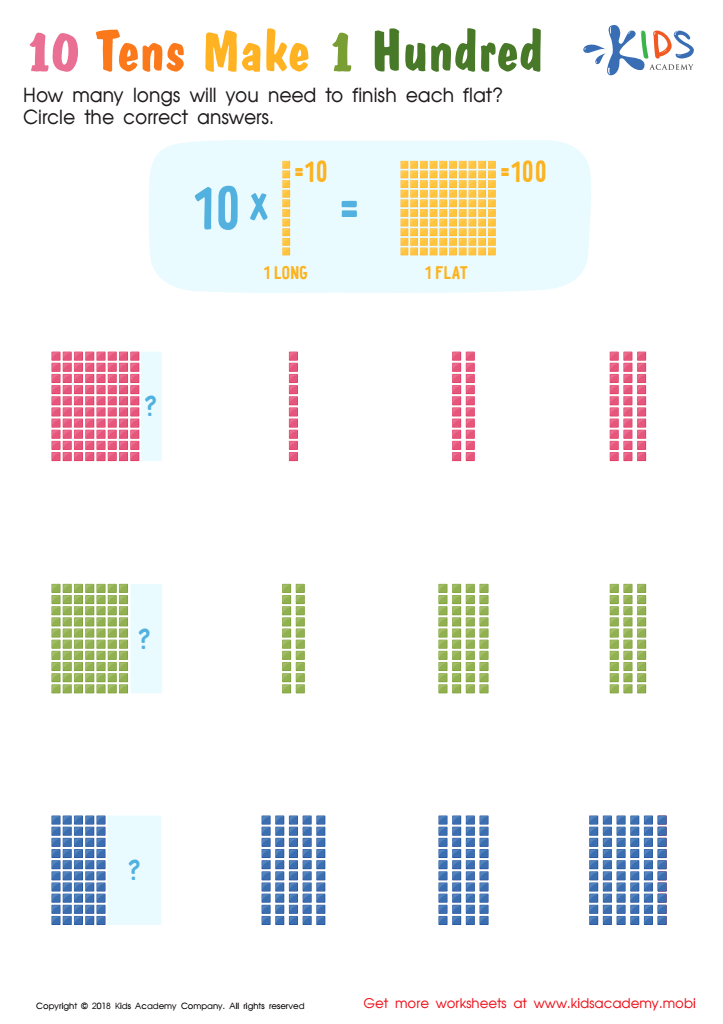
10 Tens Make 1 Hundred Worksheet
Help your child understand multiplication with this worksheet. Ask them how many 'longs' will be needed to complete each flat, then have them circle the correct answer from the options. With this exercise, your child will learn that 10 'tens' make 1 'hundred'!
 Assign to My Students
10 Tens Make 1 Hundred Worksheet
Worksheet
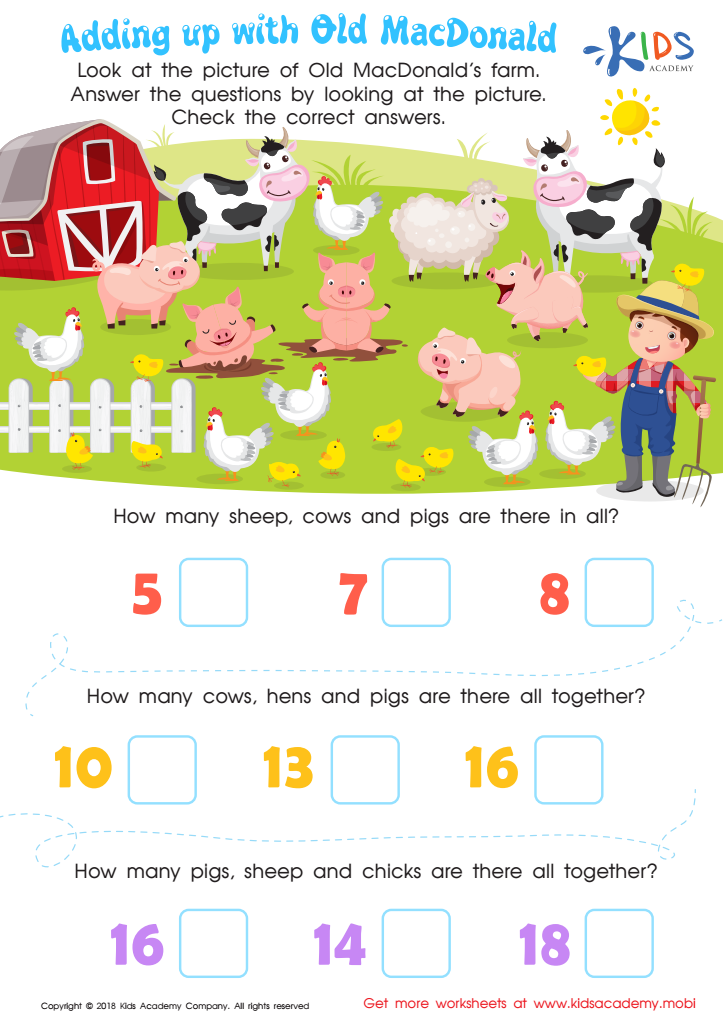
Adding Up with Old MacDonald Worksheet
Old MacDonald needs help counting his animals! Give your little math whiz a fun challenge with a free PDF worksheet. They'll love counting the animals and doing basic addition with two or three addends. Who knew math could be so much fun on the farm?
Adding Up with Old MacDonald Worksheet
Worksheet
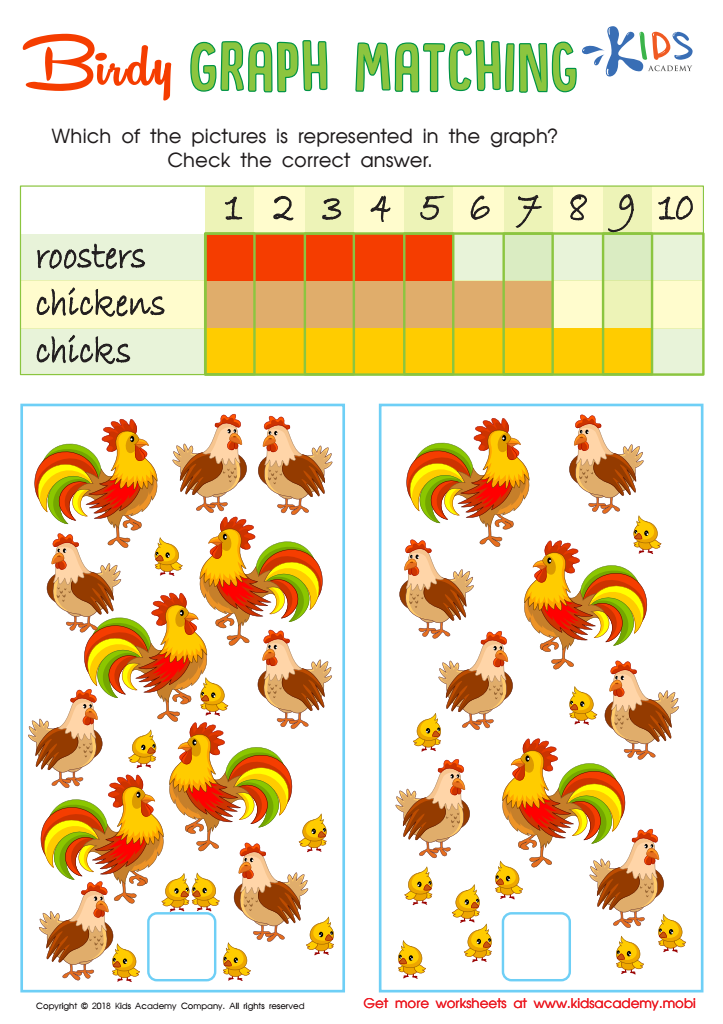
Birdy Graph Matching Worksheet
Treat your little one to a fun worksheet to practice visual discrimination, counting, graphing and tallying! They will sort the birds, count and assign values and use graph reading to answer the questions. They'll be so busy enjoying the counting that they won't even realize they are honing their skills!
Birdy Graph Matching Worksheet
Worksheet
Join Kids Academy for Free
Who is primarily going to use this learning content?








Counting proficiency in children aged 3-8 is crucial for several reasons. Firstly, this foundational skill serves as the gateway to more complex mathematical concepts. Mastery of counting helps children understand number relationships and quantities, setting the stage for addition, subtraction, and later arithmetic and geometric skills.
Moreover, counting proficiency fosters cognitive development, enhances critical thinking, and encourages problem-solving abilities. Engaging with numbers aids in language development, as children learn to articulate quantities and sequence, contributing to their overall literacy.
Beyond academics, counting lays the groundwork for life skills. It helps children navigate everyday tasks, like sharing snacks, understanding time, and managing money. Such skills boost their confidence and independence, impacting their emotional well-being.
Moreover, strong counting skills can be a predictor of future academic success, while struggling with numbers at an early age may indicate potential learning difficulties, allowing parents and teachers to intervene early.
Lastly, involving parents in counting activities supports family bonding and reinforces learning at home, creating a rich, supportive environment. Therefore, prioritizing counting proficiency is essential for fostering well-rounded development and ensuring a solid mathematical foundation in young learners.








