
Reading analog clocks Math Worksheets for Ages 3-8
8 filtered results
Difficulty Level
Grade
Age
-
From - To
Subject
Activity
Standards
Discover our engaging Reading Analog Clocks Math Worksheets designed for children aged 3-8. These worksheets make learning to tell time fun and interactive, helping young learners grasp essential skills while developing confidence in their math abilities. Packed with colorful visuals and hands-on activities, our resources encourage children to read clock faces and understand concepts of minutes and hours. Whether at home or in the classroom, these worksheets provide the perfect foundation for mastering analog clocks. Let your child embark on a time-telling adventure with our comprehensive and easy-to-follow worksheets, designed to inspire curiosity and foster a love of learning!
Favorites
With answer key
Interactive
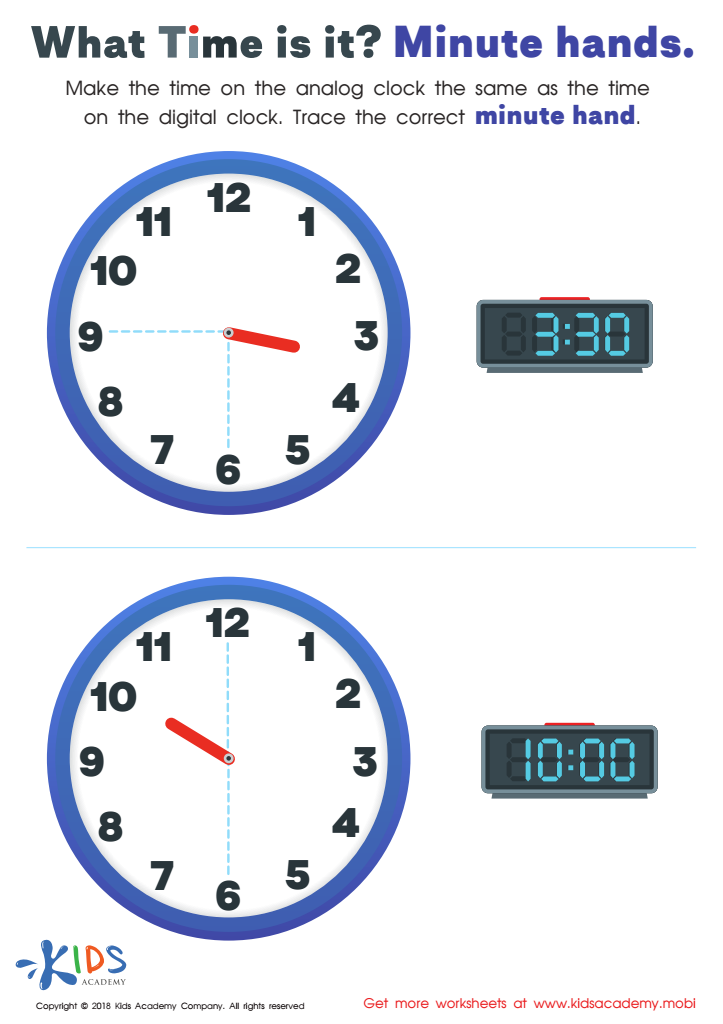
What Time Is it? Minute Hands Worksheet
Help your kids telling time with the minute hand correctly with this tracing sheet. Trace the correct minute hand to make the time on the analog clock the same as the time on the digital clock. Give them a pictured demonstration of how to do it and you'll be all set!
 Assign to My Students
What Time Is it? Minute Hands Worksheet
Worksheet
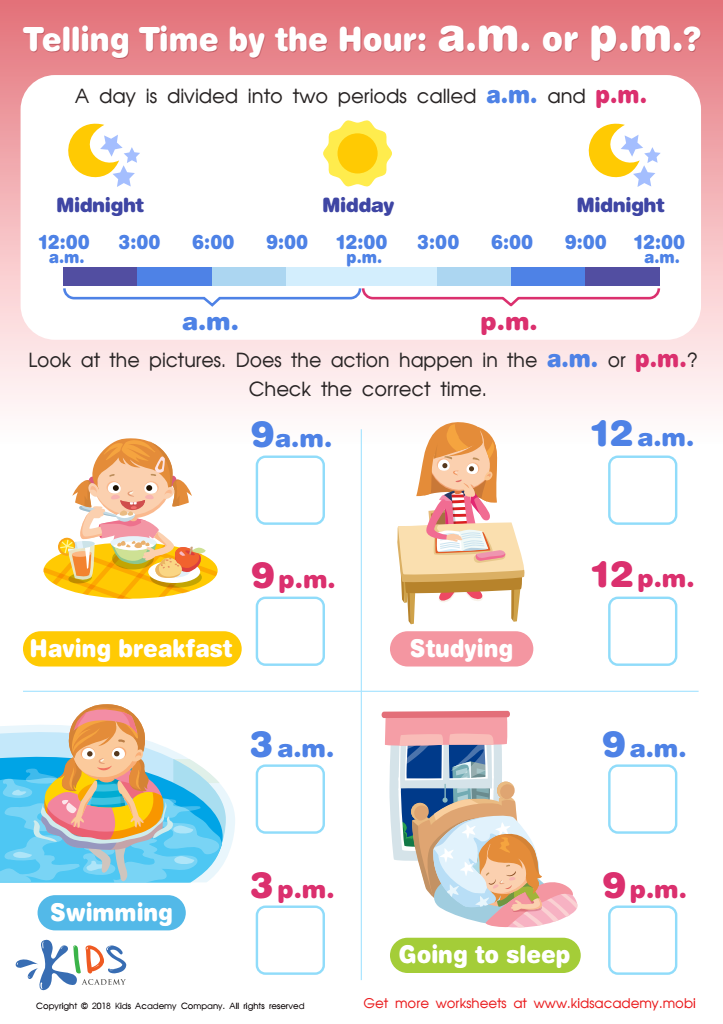
Tilling Time by the Hour: a.m. or p.m.? Worksheet
Can your child tell the time? This worksheet will help them learn. Explain a.m and p.m. and look at the pictures together. Ask your child if the activities happen in the a.m or p.m and help them check the correct time.
Tilling Time by the Hour: a.m. or p.m.? Worksheet
Worksheet
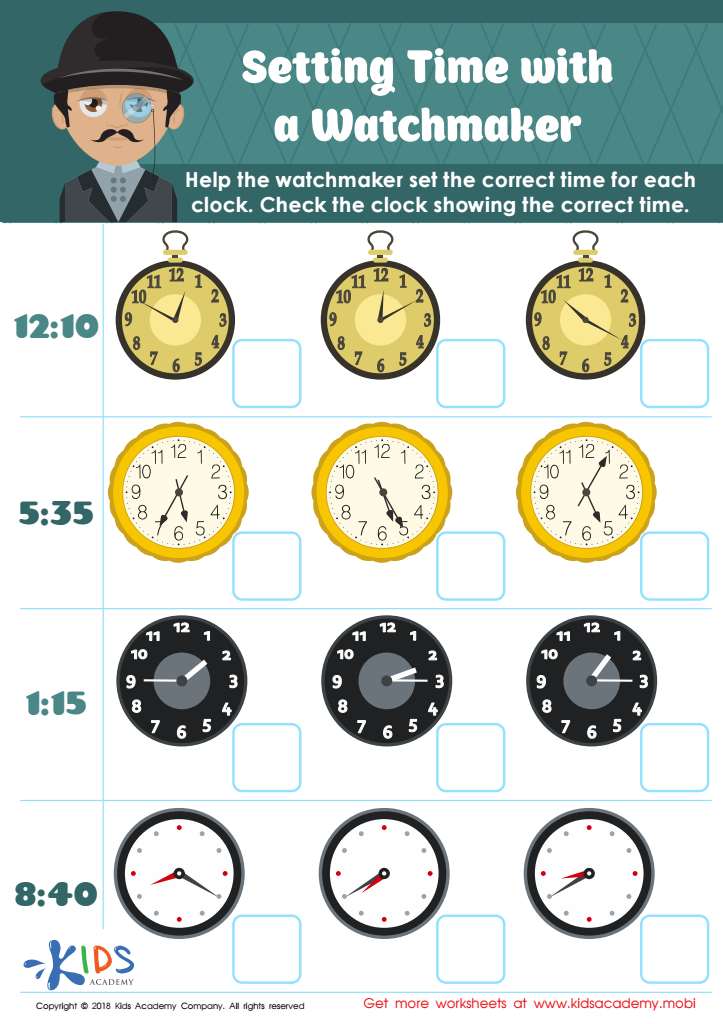
Setting Time with Watchmaker Worksheet
Can your kids tell the time? If so, this worksheet should be easy. Help them set the time for each clock: look at the time written on the left side and find the clock on the right side that matches.
Setting Time with Watchmaker Worksheet
Worksheet
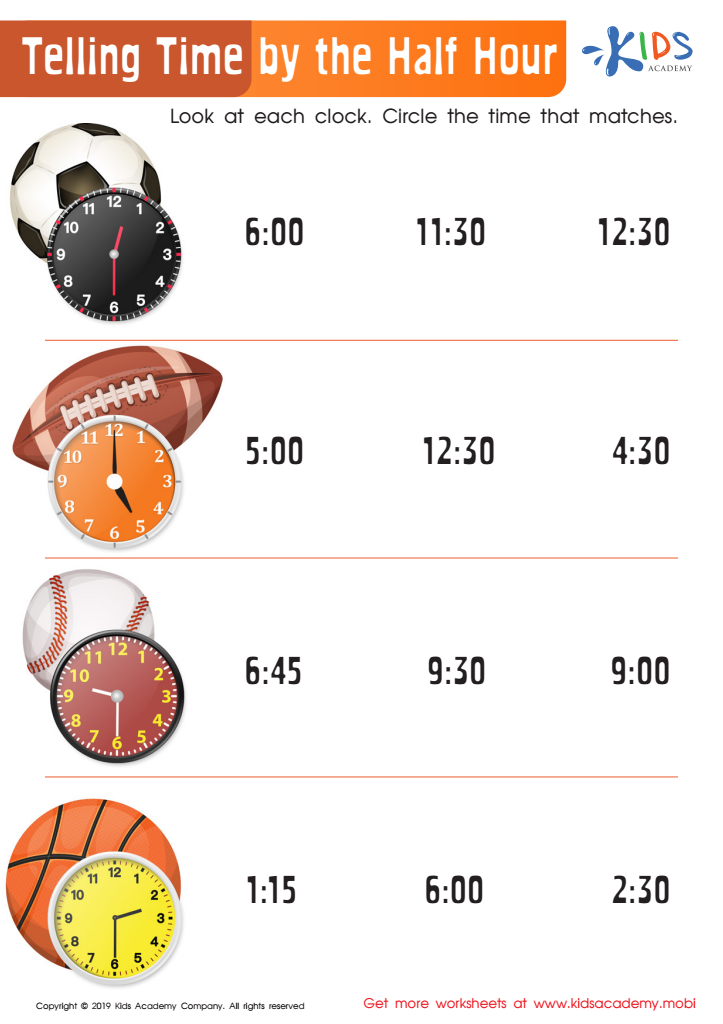
Telling Time by the Half Hour Worksheet
Teach kids to tell time with this worksheet! Four clocks are labeled with different times; help your child circle the right one. It's a great way to teach them to read analog and digital clocks, watches, and written times. Easy and fun learning!
Telling Time by the Half Hour Worksheet
Worksheet
Join Kids Academy for Free
Who is primarily going to use this learning content?








Teaching young children to read analog clocks is an essential mathematical and life skill that offers numerous cognitive benefits. For parents and teachers, encouraging this comprehension fosters critical thinking and problem-solving abilities. Understanding time not only enhances children’s number sense but also integrates concepts like fractions and sequencing, essential components of early mathematics.
Analog clocks present a visual representation of time, contrasting digital formats, which can help children develop spatial awareness. This skill is vital as they progress in their education, impacting their ability to comprehend graphs, charts, and other mathematical concepts. Moreover, reading analog clocks teaches children how to estimate, reason, and make calculations—fundamental skills across various subjects.
In addition to bolstering academic skills, reading clocks fosters independence. Children learn how to manage their time, enhancing their organizational skills and paving the way for responsibility. As they grasp concepts related to time, such as schedules and routines, they build awareness necessary for daily life. Emotionally, being able to tell time boosts confidence; as children accomplish this task, they gain a sense of achievement.
Ultimately, engaging children with analog clocks cultivates foundational skills that positively influence their academic, social, and personal growth.








