
Improving math skills Subtraction Worksheets for Ages 3-8
3 filtered results
Difficulty Level
Grade
Age
-
From - To
Subject
Activity
Standards
Enhance your child's math proficiency with our "Improving Math Skills: Subtraction Worksheets" designed for ages 3-8. These interactive and engaging worksheets help build a solid foundation in subtraction through fun activities and challenges. Perfect for preschoolers and early elementary students, our carefully curated exercises improve problem-solving skills and mathematical thinking. Each worksheet is crafted to make learning subtraction enjoyable, incorporating colorful visuals and age-appropriate difficulty levels. Instill confidence in your young learner as they practice subtraction, preparing them for future math success. Ready to make math fun? Boost subtraction skills today with our expert-created resources.
Favorites
With answer key
Interactive
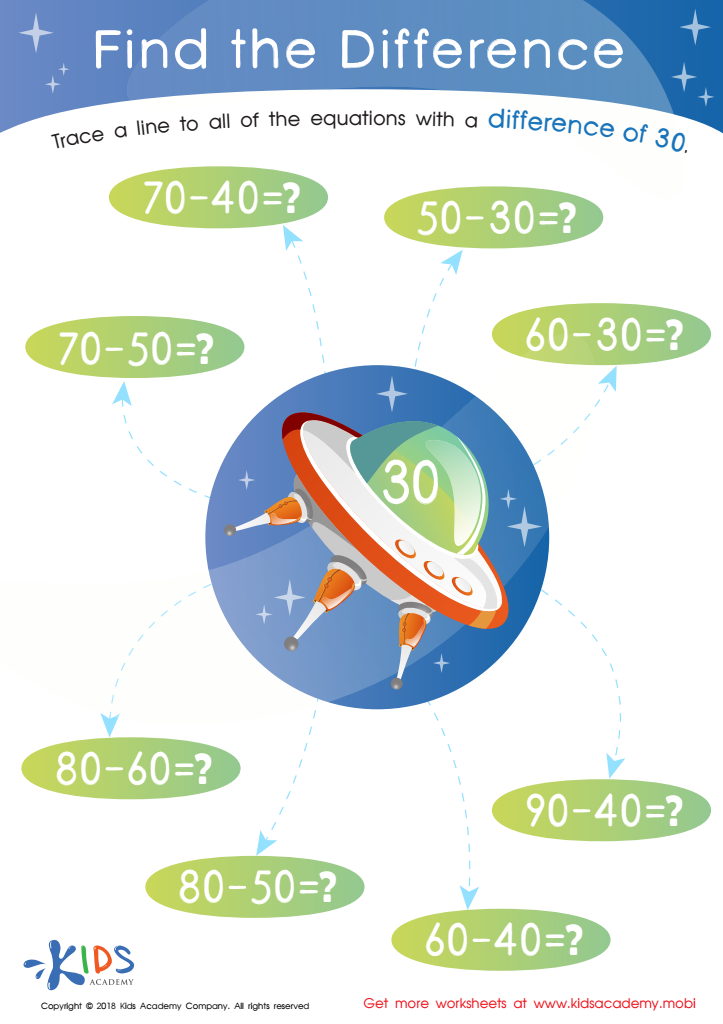
Find The Difference Worksheet
Kindergarteners need to work out subtraction problems and get the right answers. To help them, point to the alien ship with '30' in it on the worksheet. Get them to follow a line to the equations with a difference of 30. Solving these simple subtraction problems will give the answers.
 Assign to My Students
Find The Difference Worksheet
Worksheet
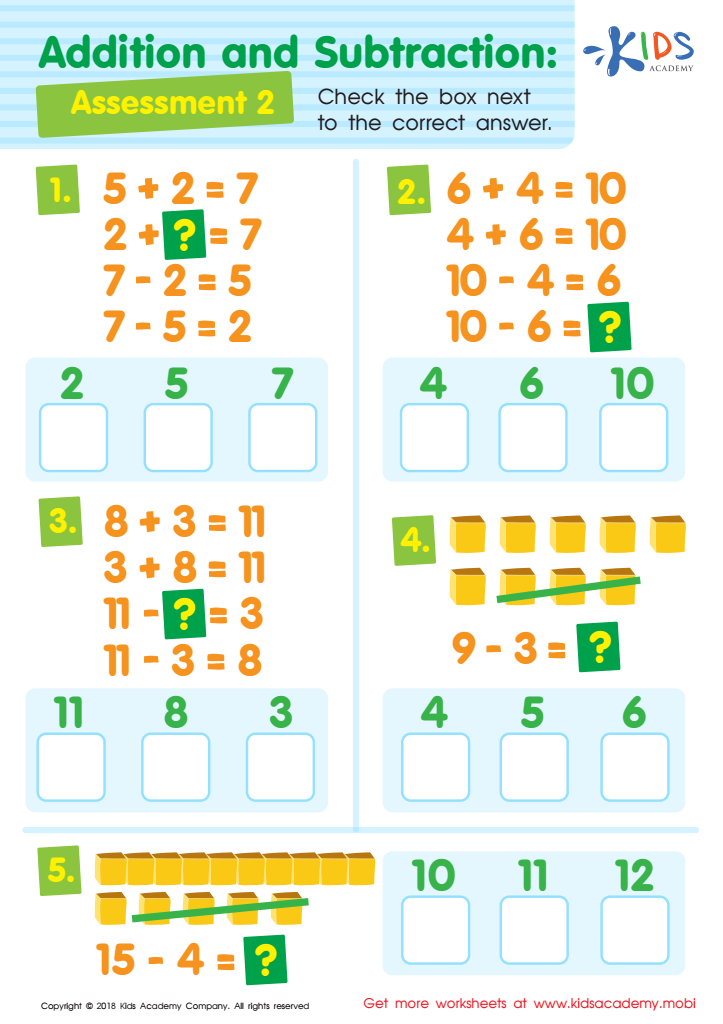
Addition and Subtraction Assessment 2 Worksheet
As your child grows, math problems become harder. To keep their brains active and provide extra help if needed, use this math worksheet. It'll help them become more familiar with equations. Go through each one carefully with your child and have them check the box next to the right answer.
Addition and Subtraction Assessment 2 Worksheet
Worksheet
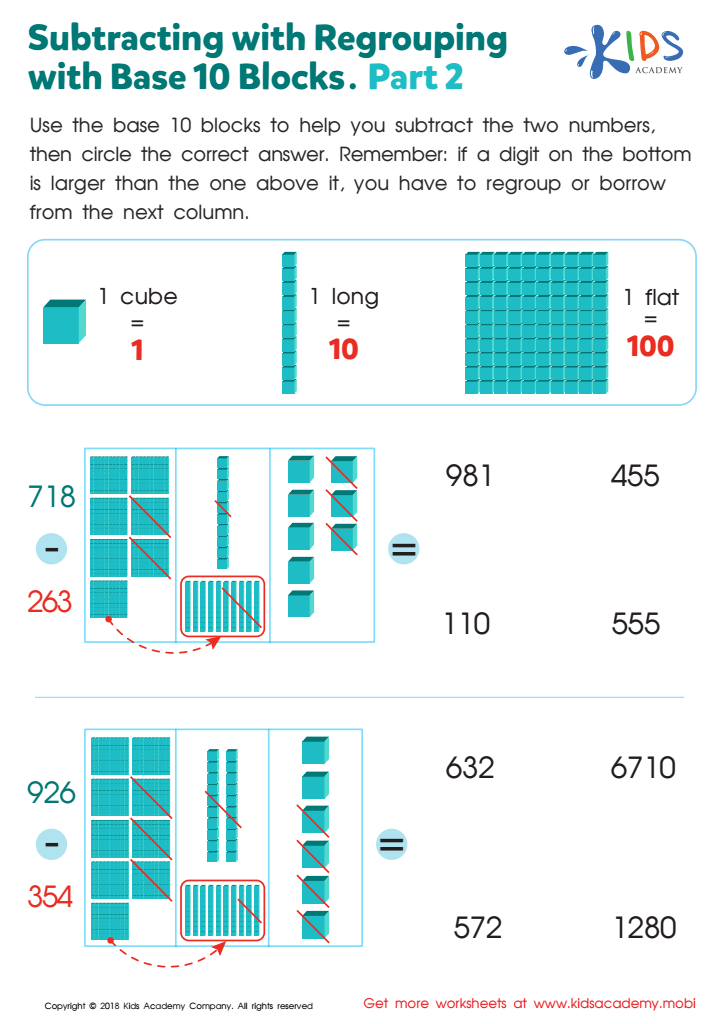
Subtracting with Regrouping with Base 10 Blocks. Part 2 Worksheet
Give your kids the practice they need to master subtracting with regrouping with Kids Academy's printable worksheet. It contains two 3-digit problems for kids to solve, plus colorful blocks to help them understand the concept more easily. Help your kids succeed!
Subtracting with Regrouping with Base 10 Blocks. Part 2 Worksheet
Worksheet
Join Kids Academy for Free
Who is primarily going to use this learning content?







Parents and teachers should prioritize improving subtraction skills in children aged 3-8 because it forms the cornerstone for mathematical understanding, critical thinking, and future academic success. Subtraction is not just about taking away numbers; it involves cognitive processes like problem-solving and logical reasoning. Mastering these skills early on aids children in understanding more complex math concepts, enabling smoother transitions to advanced topics.
Subtraction is also integral in daily life. Whether it's understanding the concept of "how many are left" or managing simple transactions, these skills foster independence and practical decision-making. Building strong subtraction abilities at a young age boosts a child’s confidence in interacting with their environment, fostering a positive attitude towards learning.
Moreover, early math proficiency is a strong predictor of future academic performance in various subjects. Early success in subtraction promotes a sense of achievement and encourages learning persistence, hence reducing anxiety around math, which is common as children grow older.
For parents and teachers, ensuring that subtraction skills are well-developed during these formative years means they are providing tools for children to think analytically, approach problems methodically, and build a solid foundation for lifelong learning and everyday functionality.








