
Understanding matter Physical Science Worksheets for Ages 3-8
3 filtered results
Difficulty Level
Grade
Age
-
From - To
Subject
Activity
Standards
Explore the fascinating world of matter with our Understanding Matter Physical Science Worksheets, designed for children ages 3-8! These engaging and interactive worksheets make learning about the properties and states of matter fun and approachable. With a variety of activities tailored to this age group, young learners will develop essential scientific concepts through coloring, sorting, and hands-on experiments. Each worksheet is crafted to foster curiosity and encourage critical thinking, helping kids understand solids, liquids, and gases. Perfect for classroom use or at-home learning, our resources are ideal for sparking a lifelong interest in science. Start your child's journey into the world of matter today!
Favorites
With answer key
Interactive
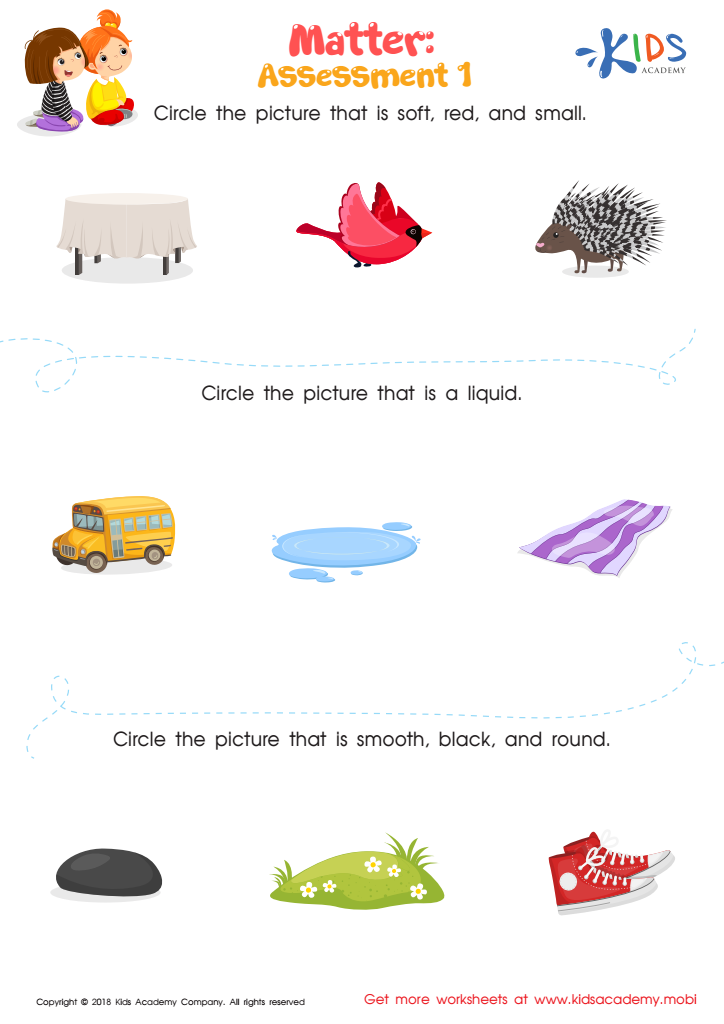
Matter: Assessment 1 Worksheet
Have your children learn that anything that has weight and takes up space is matter. Examples include buses, tables, people, animals, and more. Use this worksheet to help them identify the objects and circle the soft, red, and small one; the liquid; and the smooth, black, and round one.
 Assign to My Students
Matter: Assessment 1 Worksheet
Worksheet
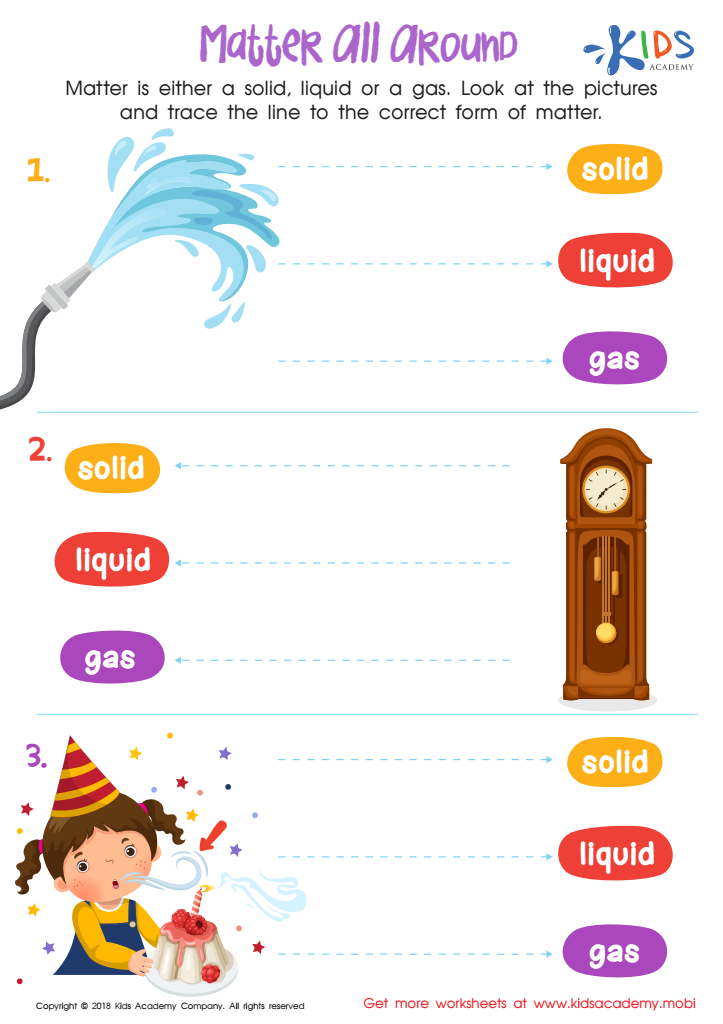
Matter all Around Worksheet
Have you taught your students about matter? Use this worksheet to help them understand that matter is anything that has weight and takes up space, either as a solid, liquid, or gas. Guide them to trace the line to the correct form of matter as they look at the pictures. This will be easy if they already know the topic, but it's also a great opportunity to teach them.
Matter all Around Worksheet
Worksheet
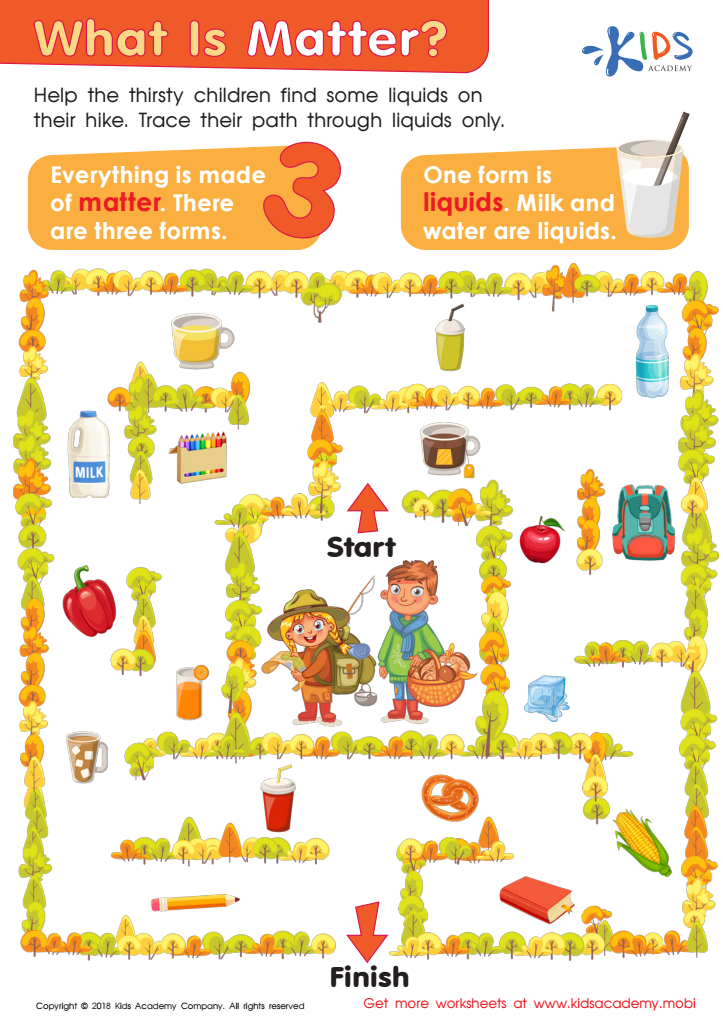
What Is Matter? Worksheet
Matter is anything that occupies space and has weight. Show your child examples, like people, cars, food, animals, objects etc. Ask them to name more. Help the thirsty kids in the picture find liquids - have them trace the path in the tracing sheet.
What Is Matter? Worksheet
Worksheet
Join Kids Academy for Free
Who is primarily going to use this learning content?








Understanding matter is crucial for young learners aged 3-8 because it forms the foundation of scientific literacy and critical thinking skills. Children naturally inquire about the world around them, and exploring the properties of matter—solids, liquids, and gases—allows them to satisfy their curiosity. Engaging with the concepts of matter promotes investigation and experimentation, pivotal aspects of learning in the early years.
Through hands-on activities and playful exploration, kids develop investigative skills, observation techniques, and vocabulary related to science. Simple activities like mixing substances, exploring textures, or observing states of matter can ignite interest and foster a lifelong love of science. Additionally, understanding matter aids children in grasping essential concepts such as changes from one state to another and how different materials interact.
Parents and teachers play a significant role in facilitating this exploration. They can create rich learning environments that encourage questions, facilitate hands-on projects, and integrate everyday experiences—like cooking or water play—to teach scientific principles in a relatable context. Ultimately, fostering an understanding of matter nurtures not only a child's cognitive development but also nurtures problem-solving, creativity, and curiosity, priming them for future academic success.







