
Enhance fine motor skills Worksheets for Ages 3-9
6 filtered results
Difficulty Level
Grade
Age
-
From - To
Subject
Activity
Standards
Welcome to our dedicated section for "Enhance Fine Motor Skills Worksheets" designed specifically for children ages 3-9! Our engaging and fun worksheets are crafted to help young learners develop essential fine motor skills through a variety of hands-on activities. From tracing and coloring to cutting and pasting, these worksheets provide the perfect balance of creativity and skill-building. Each exercise is designed to improve dexterity, hand-eye coordination, and focus, ensuring a well-rounded foundation for future learning. Download our worksheets today to make learning enjoyable, as your child builds confidence and proficiency through playful skill enhancement! Perfect for home or classroom use!
Favorites
With answer key
Interactive
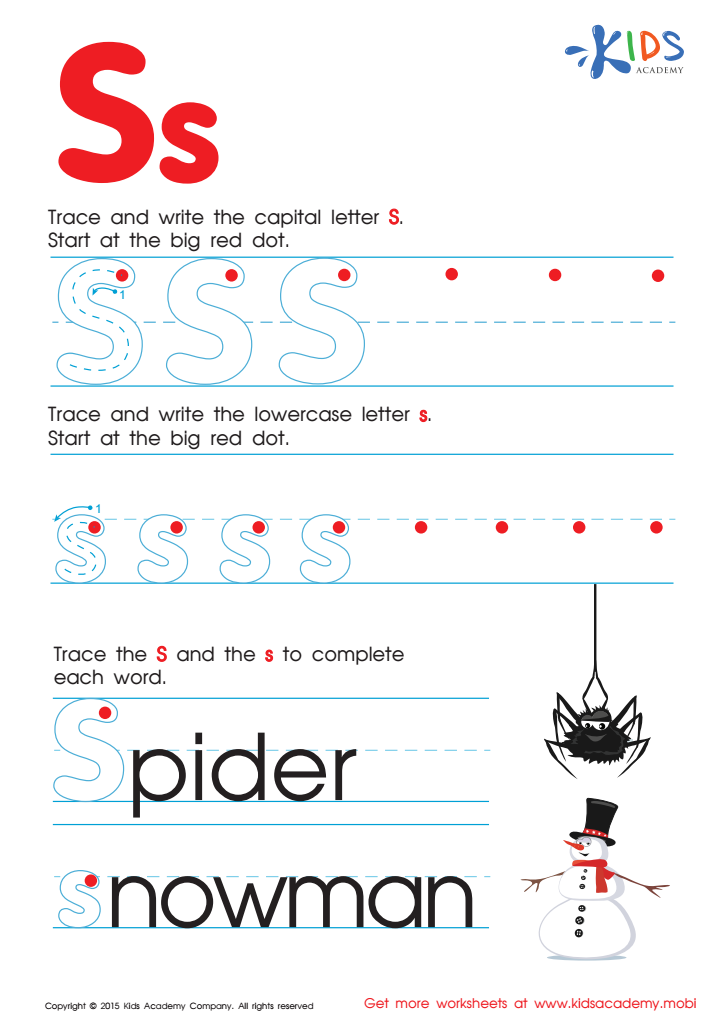
Letter S Tracing Page
Trace and write the capital and lowercase "S" on this ABC worksheet for kindergarten. Start with the big red dot and be careful. When you finish, help the spider and snowman in the pictures restore their words with the capital and lowercase letters. Continue learning the alphabet with Kids Academy.
 Assign to My Students
Letter S Tracing Page
Worksheet

Join Kids Academy for Free
Who is primarily going to use this learning content?






Enhancing fine motor skills in children aged 3-9 is crucial for their overall development and future learning. Fine motor skills involve the coordination of small muscles in the hands and fingers, which are essential for a wide array of daily tasks, such as writing, buttoning clothes, and using utensils. As children refine these skills, they gain confidence in their abilities and independence in self-care.
From an educational perspective, fine motor skills significantly impact school readiness and success. Children who struggle with these skills may find activities like writing or manipulating educational tools more challenging, leading to frustration and a potential decrease in motivation. Activities that promote fine motor development—such as playing with building blocks, coloring, or crafting—are not only enjoyable but also foundational to cognitive and language development.
Moreover, fine motor activities also enhance hand-eye coordination and spatial awareness, which are integral for tasks like sports and lifelong learning. When parents and teachers prioritize these skills, they help equip children with the necessary tools to thrive academically and socially. Investing time in fine motor skill development lays a strong groundwork for future learning and success, reinforcing the importance of early childhood education.








