
Practicing division Worksheets for Ages 3-9
3 filtered results
Difficulty Level
Grade
Age
-
From - To
Subject
Activity
Standards
Discover our engaging division worksheets designed for children aged 3-9! These printable resources make learning division fun and interactive, helping young learners grasp essential mathematical concepts. Our carefully crafted worksheets feature vibrant illustrations and age-appropriate exercises that encourage skill development while keeping kids entertained. Tailored to different skill levels, these worksheets foster a solid understanding of division through practice and repetition. Ideal for use in classrooms or at home, our division worksheets empower children to build confidence and improve their math abilities. Start your child's mathematical journey today and watch them excel with our easy-to-use resources!
Favorites
With answer key
Interactive
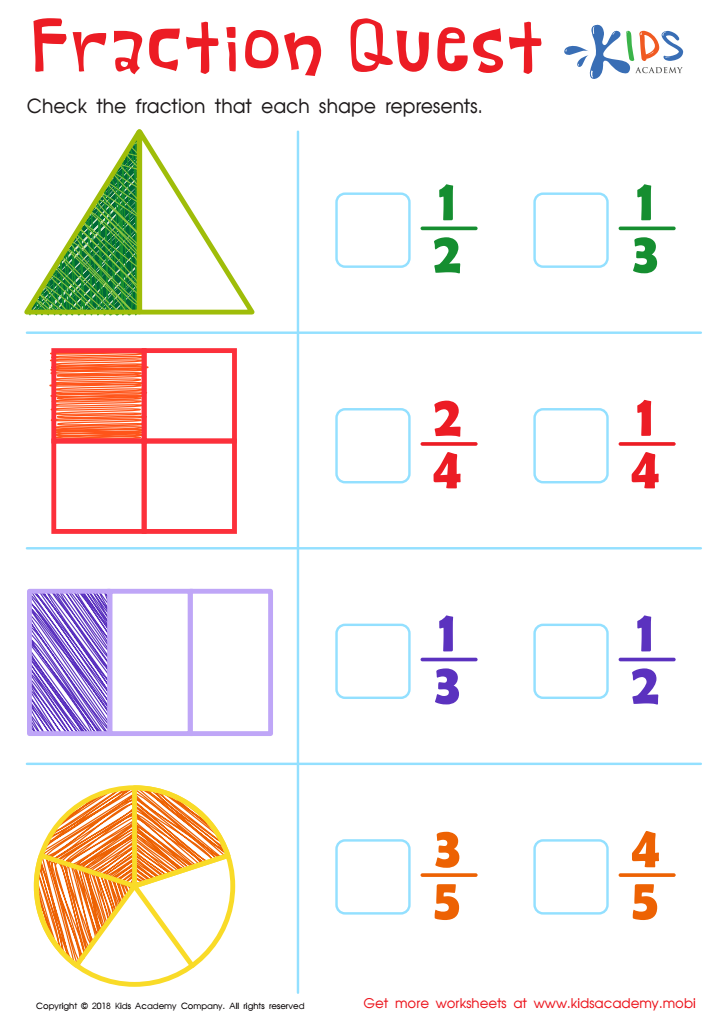
Fraction Quest Worksheet
This colorful and educative worksheet can help kids conquer their fractions struggles. Ask them to identify the four shapes, then the fractions they represent. They can then check the correct answers from the options given.
 Assign to My Students
Fraction Quest Worksheet
Worksheet
Join Kids Academy for Free
Who is primarily going to use this learning content?




Practicing division for children ages 3 to 9 is crucial for several reasons. First, division forms the foundation of most mathematical concepts that children will encounter later in their education. By introducing division concepts early, parents and teachers can help kids develop numerical fluency and comfort with numbers, which are essential for future learning.
Moreover, division encourages critical thinking and problem-solving skills. As children learn to divide, they engage in activities that require reasoning, such as sharing objects evenly or grouping items, promoting cognitive development. This early exposure helps them understand the relationship between multiplication and division, laying the groundwork for more complex mathematical operations.
Social skills also benefit from learning division. When children share or divide objects among their peers, they practice cooperation and negotiation, essential for social development.
Additionally, division is a valuable life skill; understanding this concept prepares kids for real-world situations where sharing, distributing resources, or budgeting is necessary. By integrating division practice into their routines, parents and teachers cultivate confidence and a positive attitude towards math. Ultimately, these skills not only improve academic performance but also foster a love of learning that can last a lifetime.








