Understanding base ten Numbers Worksheets for Ages 3-9
3 filtered results
-
From - To
Our "Understanding Base Ten Numbers Worksheets for Ages 3-9" are specially designed to strengthen young learners' foundational math skills. By focusing on the base ten system, these fun and engaging printable worksheets help kids grasp the concept of counting, place value, and number sense. Tailored for children aged 3-9, these exercises gradually build complexity, ensuring a smooth learning curve. With vibrant visuals and interactive tasks, children stay excited and motivated as they explore elementary math concepts. Perfect for parents and educators, these worksheets are an invaluable tool to support early math education and foster a lifelong love for learning numbers.
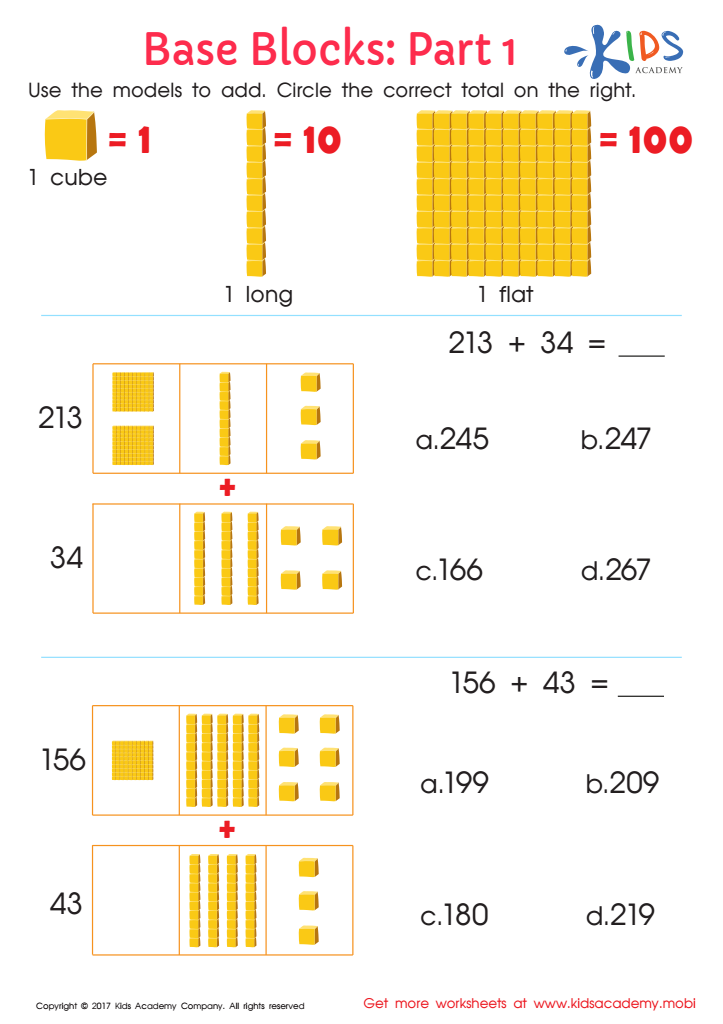
Base Ten Blocks Worksheet: Part 1
 Assign to My Students
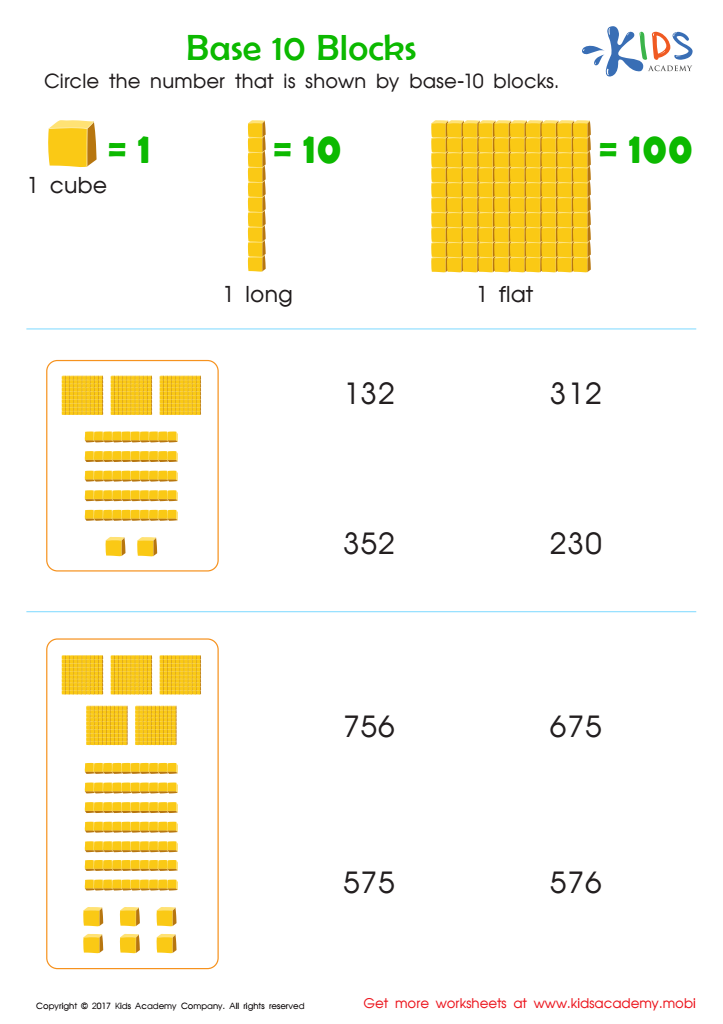
Base Ten Blocks Worksheet
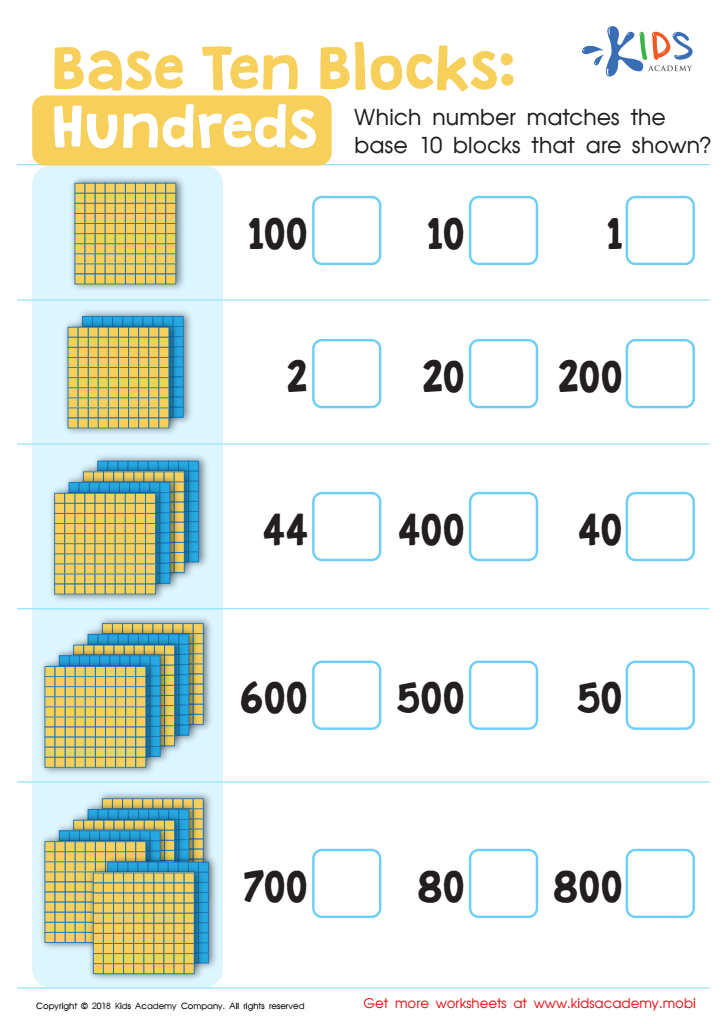
Base Ten Blocks: Hundreds Worksheet








Understanding base ten numbers is crucial for young children, ages 3-9, because it lays the foundation for future math skills and cognitive development. Base ten, or the decimal system, is the primary numbering system used globally, essential for all mathematical operations. When children grasp this concept early, they develop strong numerical sense, enabling them to perform basic arithmetic like addition, subtraction, and later, more complex operations such as multiplication and division.
For parents and teachers, fostering a solid base ten understanding helps children see numeric relationships clearly, promoting logical thinking and problem-solving abilities. This understanding also boosts confidence in math, reducing anxiety and building a strong foundation for advanced mathematical concepts. It aids in real-life applications too, such as understanding money, time, and measurements, all crucial life skills.
Children ages 3-9 are at a developmental stage where their cognitive skills are rapidly growing. Introducing base ten concepts through engaging activities and manipulatives, like blocks or beads, capitalizes on their natural curiosity and learning ability. Thus, investing in this fundamental knowledge maximizes children's future academic success and practical day-to-day functioning, making it a paramount focus for parents and educators.








