
Time calculation Math Worksheets for Ages 3-9
3 filtered results
Difficulty Level
Grade
Age
-
From - To
Subject
Activity
Standards
Boost your child's understanding of time with our Time Calculation Math Worksheets for Ages 3-9. These engaging and educational worksheets are designed to teach young learners how to read clocks, understand calendars, and master basic time calculations. Our expertly crafted resources cater to various learning levels, ensuring your child gains confidence in telling time, identifying hours and minutes, and understanding daily schedules. With vibrant visuals and fun exercises, our worksheets make learning time concepts enjoyable and effective. Visit us today to transform your child's time-telling skills and lay a strong foundation for future mathematical success.
Favorites
With answer key
Interactive
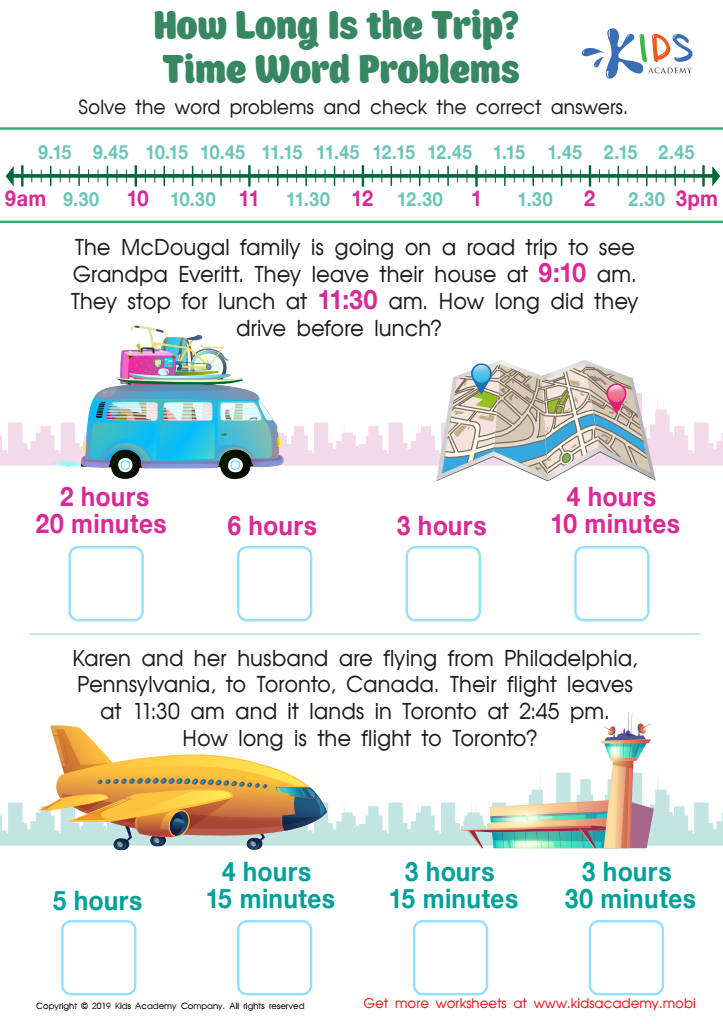
How long is the Trip? Time Word Problems Worksheet
Get your kids in the mood for learning with fun questions about trips. Point at each picture and ask them to identify the mode of transport. Read the word problems, help them solve and check the answers.
 Assign to My Students
How long is the Trip? Time Word Problems Worksheet
Worksheet
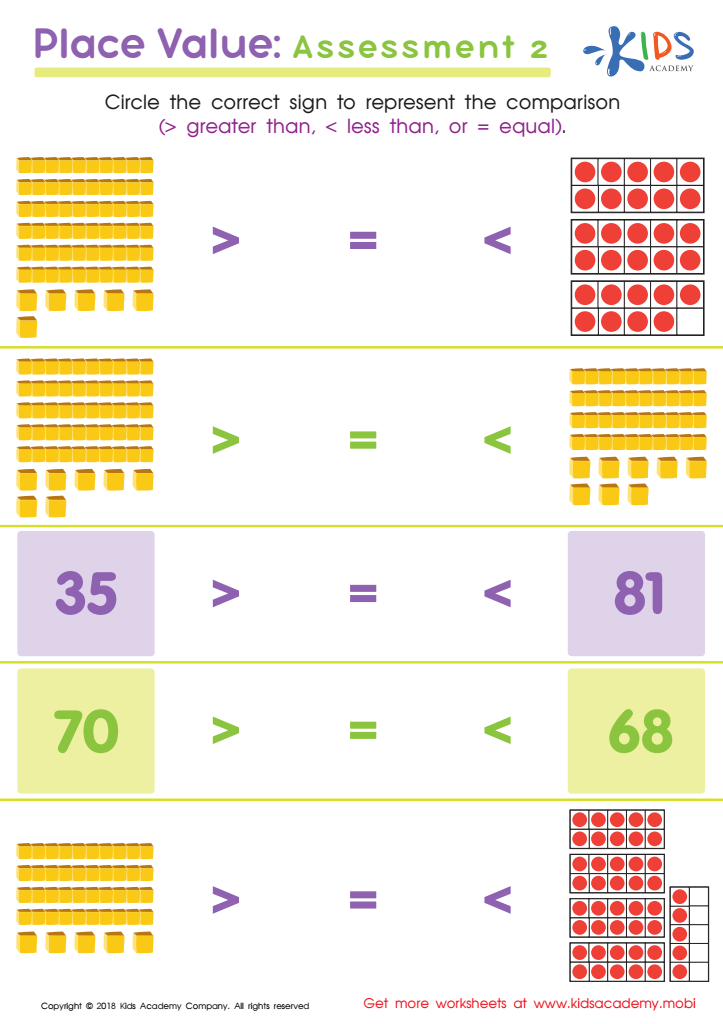
Place Value: Assessment 2 Worksheet
Children must learn to recognize the value of numbers and break them into chunks of ten. They must also be able to compare numbers to know if one is greater, less than or equal to another. The Place Value Assessment PDF is a great tool to assess their skills and identify what requires more practice.
Place Value: Assessment 2 Worksheet
Worksheet
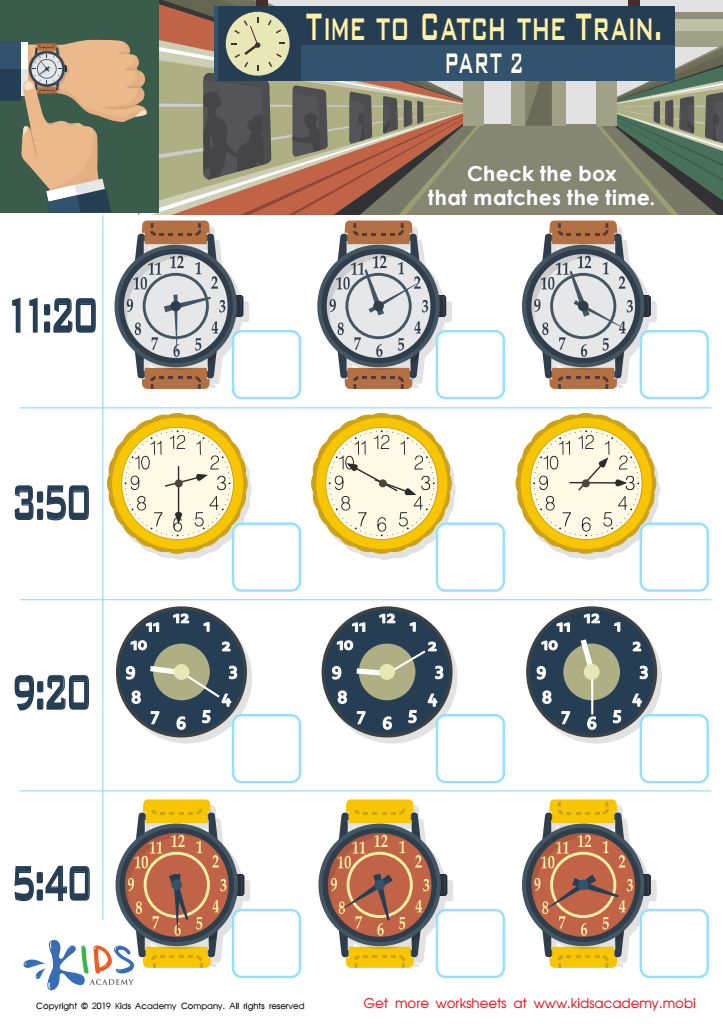
Time to Catch the Train Part 2 Worksheet
Teach your kids the importance of telling time and how to do it. Explain that there are multiple ways to show the time, such as written on the left side or watches in the picture. Guide them to check the box that matches the time. Knowing the time is essential to get things done and create order. Ensure your kids understand this and they will reap the benefits.
Time to Catch the Train Part 2 Worksheet
Worksheet
Join Kids Academy for Free
Who is primarily going to use this learning content?








Understanding time calculation is crucial for children ages 3-9 as it builds the foundation for essential life and academic skills. For parents and teachers, integrating time math early has several benefits. First, it enhances cognitive development. Learning to calculate time improves logical thinking and problem-solving. Children begin to understand sequences and durations, fostering a sense of order and anticipation.
Furthermore, time calculation promotes practical life skills. Knowing how to read a clock or a calendar helps children manage daily routines, such as getting ready for school or knowing when it’s time to play and sleep. This independence strengthens self-discipline and organization.
In an academic context, time is related to various subjects. It connects math, with counting and arithmetic, to science (understanding day and night, seasons), and history (timelines). Learning about time early on makes these concepts easier to grasp later.
Socially, telling time helps kids navigate social activities and punctuality, boosting their confidence and responsibility.
From a neurological perspective, processing time tasks can stimulate various parts of the brain, supporting overall mental agility. Incorporating time-based activities can make learning engaging and interactive.
In summary, time calculation is not just about reading a clock; it is a cornerstone skill that underpins many areas of growth, making it a pivotal part of early education.








