Understanding tens Math Worksheets for Ages 3-9
4 filtered results
-
From - To
Discover our "Understanding Tens" math worksheets, tailored for children aged 3-9. Foster your child’s early math skills with engaging activities that simplify the concept of place values and number grouping. Our expertly designed worksheets help young learners visualize tens, promoting stronger numerical comprehension. With colorful illustrations and interactive exercises, kids quickly grasp and enjoy learning essential math foundations. Ideal for both classroom and home learning environments, these printable resources support your child's journey to mastering numbers. Explore our collection today and give your child the confidence to advance in their math skills with ease!
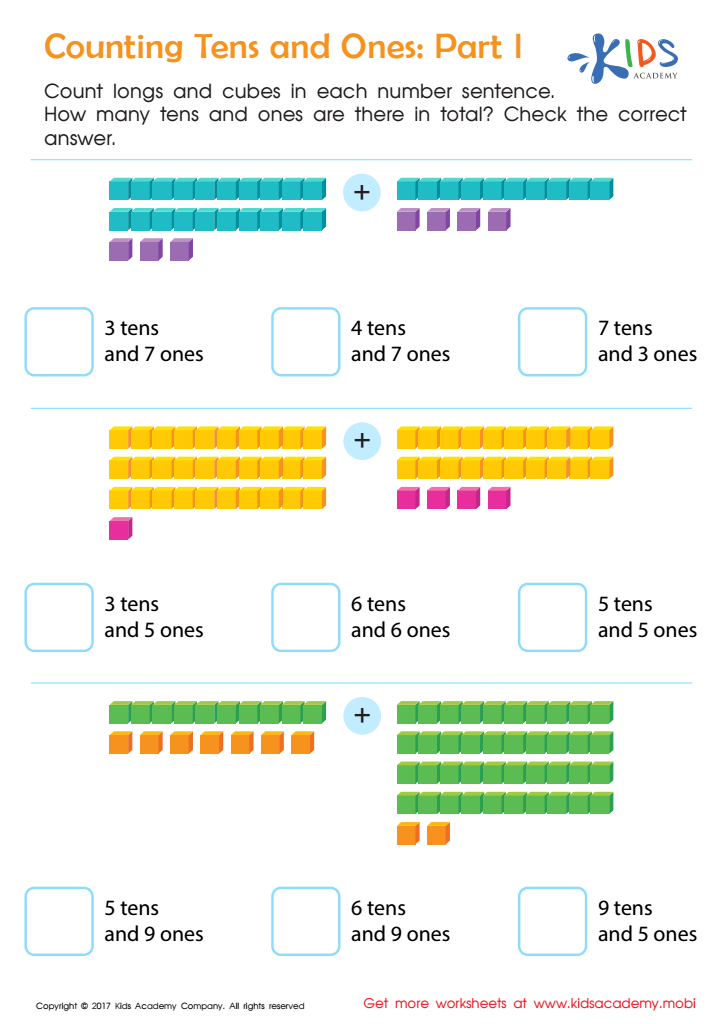
Counting Tens and Ones: Part 1 Worksheet
 Assign to My Students
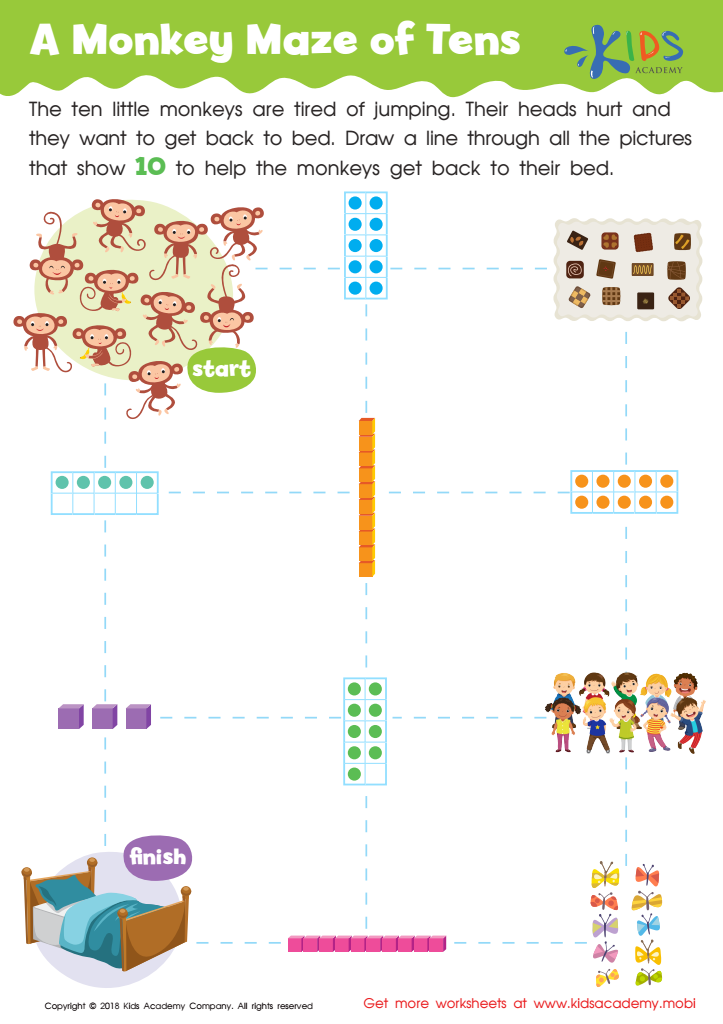
A Monkey Maze of Tens Worksheet
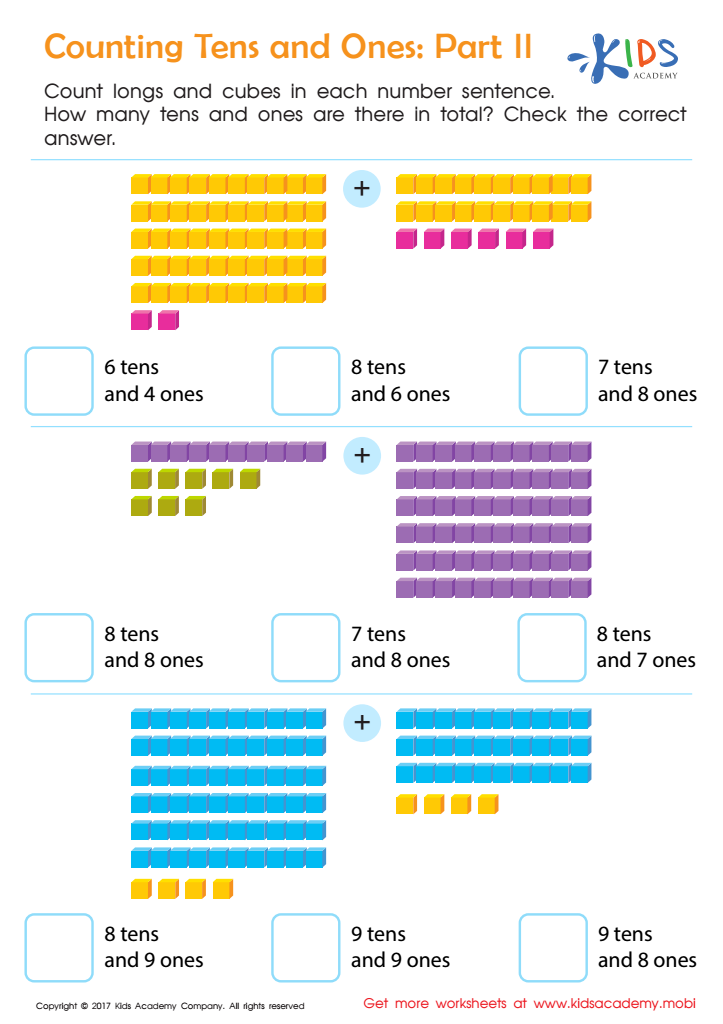
Counting Tens and Ones: Part 2 Worksheet
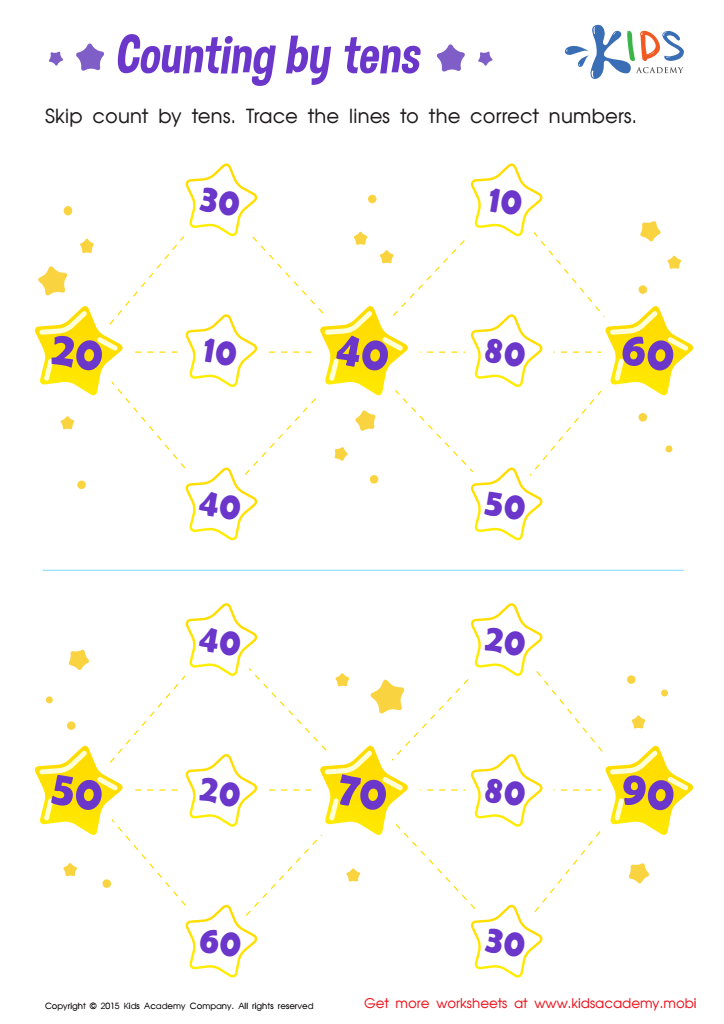
Learn Dozens: Counting by Tens Printable






Understanding the concept of 'tens' is foundational for young learners, typically ages 3-9, and underpins all future mathematical learning. Parents and teachers should prioritize this because it forms the basis of our number system, which revolves around the decimal (base-10) system. Grasping this concept helps children perform basic arithmetic with greater ease and sets a strong foundation for more advanced math concepts such as place value, addition, subtraction, multiplication, and division.
Mastery of tens aids in number sense—a child's intuition about numbers and their relationships. For example, once a child understands that the number 20 is composed of 2 tens, they can easily see that adding 10 to 20 results in 30. This visualization and comprehension make arithmetic smoother and quicker. Moreover, it is crucial for concepts beyond plain calculations, such as estimating, measuring, and understanding patterns, which are all fundamental skills in daily life and later academic pursuits.
Early understanding and strong numerical foundation reduce anxiety related to math as children progress to higher grades, providing confidence and competence in tackling more complex problems. This early proficiency is consistent with cognitive development theories suggesting that early hands-on learning and comprehension lead to better academic outcomes later. Thus, investing time and effort into teaching tens at a young age is invaluable for the child's long-term math success.








