Comparing object weights Measurement Worksheets for Ages 3-9
3 filtered results
-
From - To
Explore our engaging "Comparing Object Weights Measurement Worksheets" designed specifically for children ages 3-9. These worksheets help young learners easily understand the concept of weight comparison through fun activities and colorful illustrations. Children will practice differentiating between lighter and heavier objects, developing their measurement skills while enhancing critical thinking and observational abilities. These worksheets promote hands-on learning, making it ideal for both classroom and home settings. Perfect for early education, our resources cater to various learning styles and are aligned with educational standards. Unlock your child’s math potential with our playful and informative weight comparison activities tailored for inspired young minds!
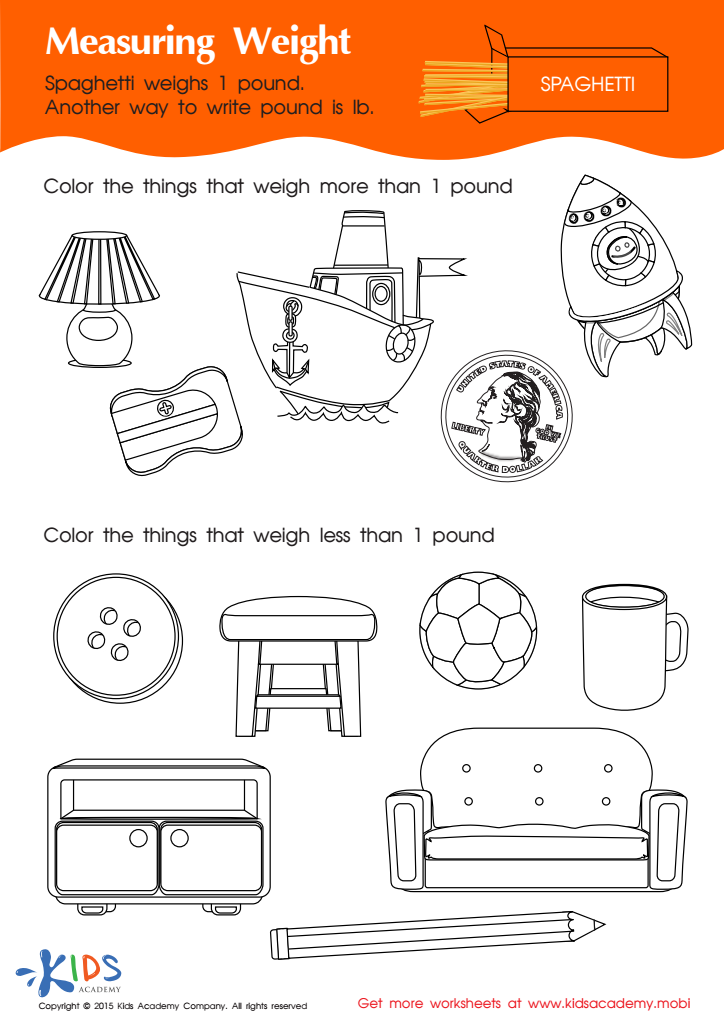
 Assign to My Students
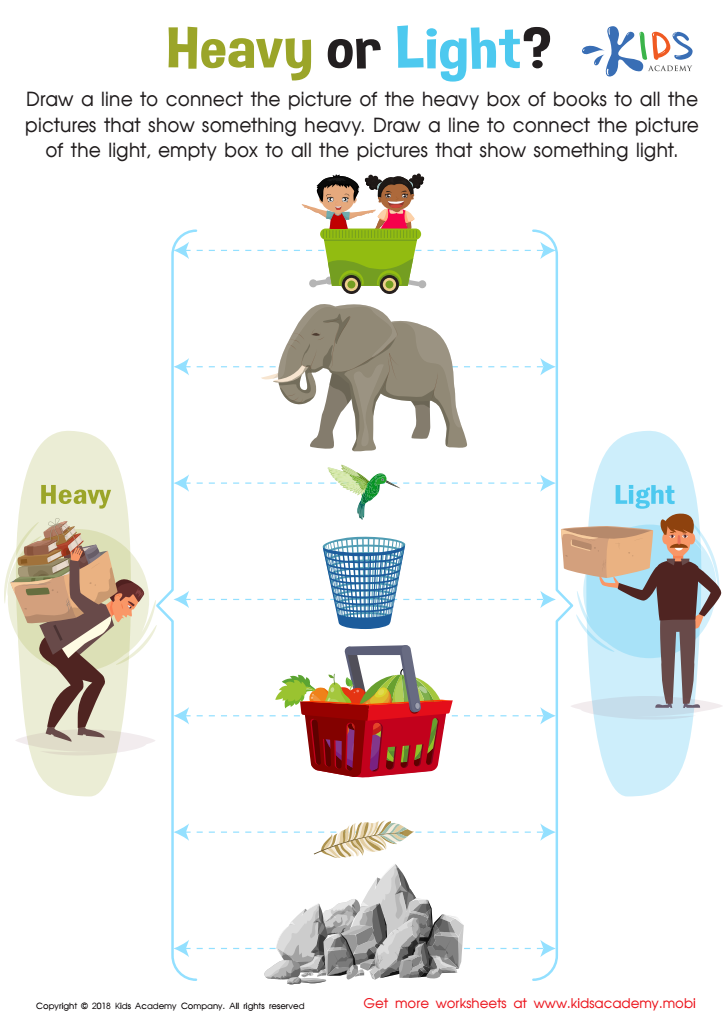
Heavy or Light? Worksheet
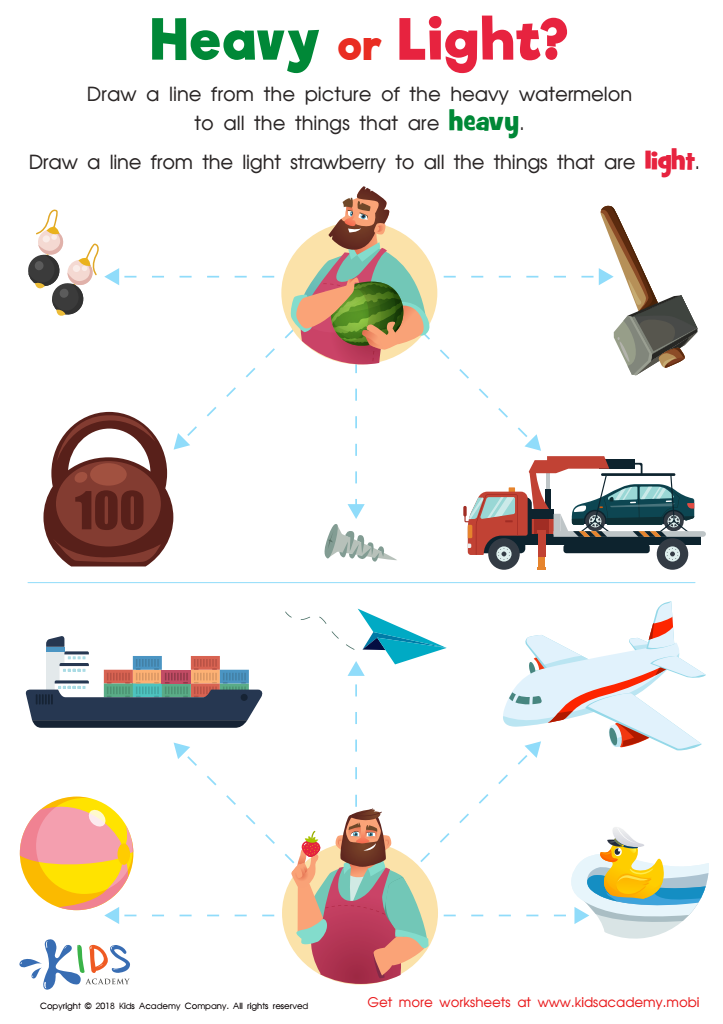
Heavy or Light? Worksheet








Comparing object weights is a fundamental concept in early childhood education that helps children develop critical thinking and foundational math skills. For parents and teachers, engaging young learners in weight comparison offers a hands-on way to explore important concepts such as heavier vs. lighter, balance, and measurement.
At ages 3-9, children are naturally curious and learn best through play and exploration. Activities that incorporate weighing different objects, either with scales or by lifting them, cultivate curiosity and promote fine motor skills. This interactive approach not only reinforces scientific thinking but also encourages vocabulary development as children learn to describe their observations with terms like "heavy," "light," and "equal."
Moreover, understanding weight comparison lays the groundwork for more complex mathematical concepts, such as addition and subtraction, while also integrating lessons in physics and engineering principles. It fosters early problem-solving skills, as children figure out how to balance scales or predict which object will tip them.
By focusing on weight measurement, parents and teachers nurture exploratory learning, encouraging children to ask questions, make predictions, and conduct experiments. This is essential for intellectual development, fostering a lifelong love of learning in science and math through simple, everyday experiences.








