
Enhance fine motor skills Worksheets for 3-Year-Olds
3 filtered results
Difficulty Level
Grade
Age
-
From - To
Subject
Activity
Standards
Welcome to our collection of Enhance Fine Motor Skills Worksheets for 3-Year-Olds! Designed to support early childhood development, these engaging and playful worksheets encourage young learners to refine their hand-eye coordination and dexterity. Each activity focuses on leadership skills necessary for daily tasks, such as coloring, tracing, and cutting, turning learning into a fun experience. Ideal for preschool settings or at-home practice, our worksheets help 3-year-olds build confidence and essential skills as they play. Discover a variety of interactive activities that promote creativity while strengthening these vital motor skills—perfect for laying a solid foundation for future learning!
Favorites
With answer key
Interactive
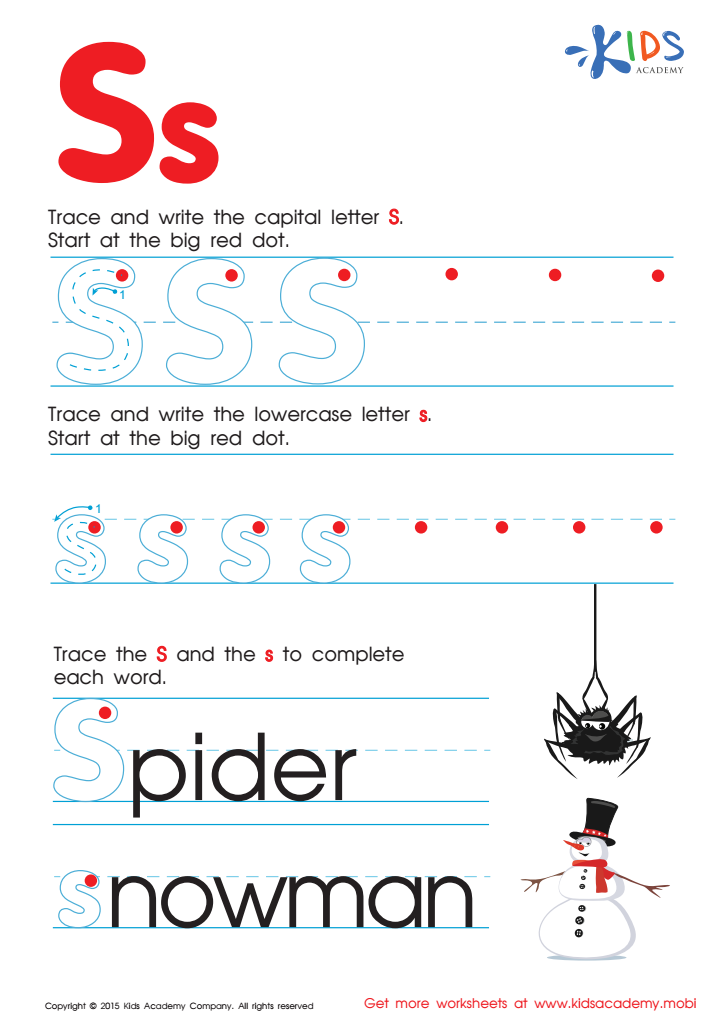
Letter S Tracing Page
Trace and write the capital and lowercase "S" on this ABC worksheet for kindergarten. Start with the big red dot and be careful. When you finish, help the spider and snowman in the pictures restore their words with the capital and lowercase letters. Continue learning the alphabet with Kids Academy.
 Assign to My Students
Letter S Tracing Page
Worksheet
Join Kids Academy for Free
Who is primarily going to use this learning content?







Enhancing fine motor skills in 3-year-olds is essential for several reasons. First, these skills underpin a child's ability to perform everyday tasks, such as dressing, eating, and participating in playful activities. Improved fine motor skills foster a sense of independence, allowing children to navigate their environment with confidence.
Additionally, fine motor skills are pivotal for academic readiness. Activities like writing, cutting with scissors, and manipulation of small objects smoothly pave the way for future learning experiences in school. When children can effectively coordinate their hand movements, they are better prepared to engage in age-appropriate art, literacy, and math activities, all critical to early education.
Moreover, developing fine motor skills is linked to cognitive development. Tasks that involve hand-eye coordination and dexterity encourage problem-solving abilities and enhance hand-brain communication. Encouraging activities like coloring, building with blocks, or stringing beads gives children the opportunity to practice these essential skills in a fun and engaging way.
Ultimately, fostering fine motor development not only equips children with essential life skills but also lays a strong foundation for their academic success and overall development. Parents and teachers play a critical role in providing opportunities for practice and encouragement, making their support vital in this formative stage.








