Visualization skills Worksheets for Ages 4-5
3 filtered results
-
From - To
Enhance your child's cognitive development with our Visualization Skills Worksheets designed for ages 4-5. These engaging activities help young learners strengthen their ability to visualize concepts and ideas, fostering essential skills such as memory retention and mental imagery. Our worksheets are thoughtfully curated to captivate the imagination, encouraging children to process information creatively. Each activity promotes critical thinking and problem-solving through colorful visuals and interactive exercises. Ideal for preschool and kindergarten settings, these printable resources provide an enjoyable way for kids to practice visualization while having fun. Unlock your child's potential and support their learning journey with our expertly designed worksheets!
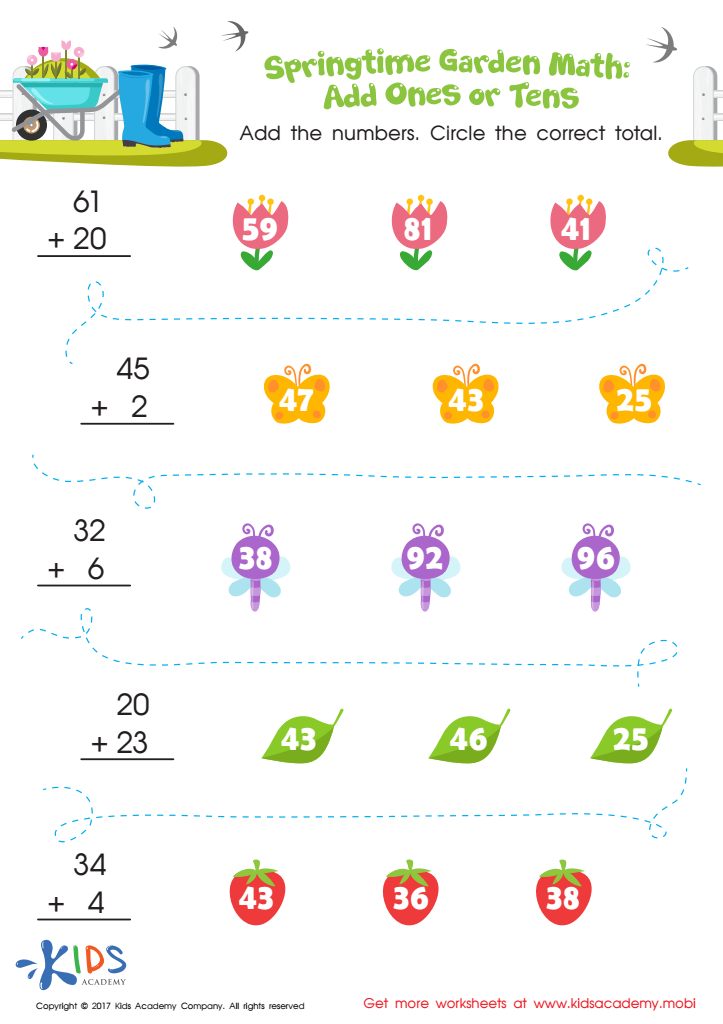
Springtime Garden Math Worksheet
 Assign to My Students







Visualization skills are crucial for children ages 4-5 as they serve as a foundation for many essential learning processes. At this age, kids begin to develop their ability to imagine and manipulate objects in their minds, which plays a vital role in problem-solving and creativity. When children can visualize, they are more likely to understand spatial relationships, enhance their reading comprehension, and improve their mathematical skills.
Moreover, strong visualization skills support language development. As children learn to picture scenarios from stories or lessons, they can better articulate their thoughts and express themselves more clearly. This enhances their communication abilities, fostering social interactions and building relationships with peers and teachers.
By focusing on visualization, parents and educators can also encourage independent thinking. Children learn to form mental images, enhancing their critical thinking skills, which further prepares them for future academic challenges. Incorporating activities such as storytelling, puzzles, and imaginative play can significantly boost these skills.
Ultimately, by nurturing visualization abilities during these formative years, parents and teachers lay the groundwork for effective learning, creativity, and cognitive development, ensuring children are equipped with the necessary tools to excel in their educational journey and beyond.








