Visual-motor skills Math Worksheets for Ages 4-5
4 filtered results
-
From - To
Develop essential visual-motor skills with our engaging Math Worksheets for ages 4-5. Tailored to support early childhood development, these worksheets teach numbers, shapes, patterns, and counting through fun, hands-on activities. Perfectly designed to enhance hand-eye coordination and fine motor skills, each worksheet uses brightly colored images and interactive tasks to captivate young learners. Whether you're a parent or an educator, our carefully crafted exercises ensure foundational math skills are mastered with ease and enjoyment. Prepare your child for academic success while fostering creative play and lifelong learning. Explore our collection to give your child the best start in math!
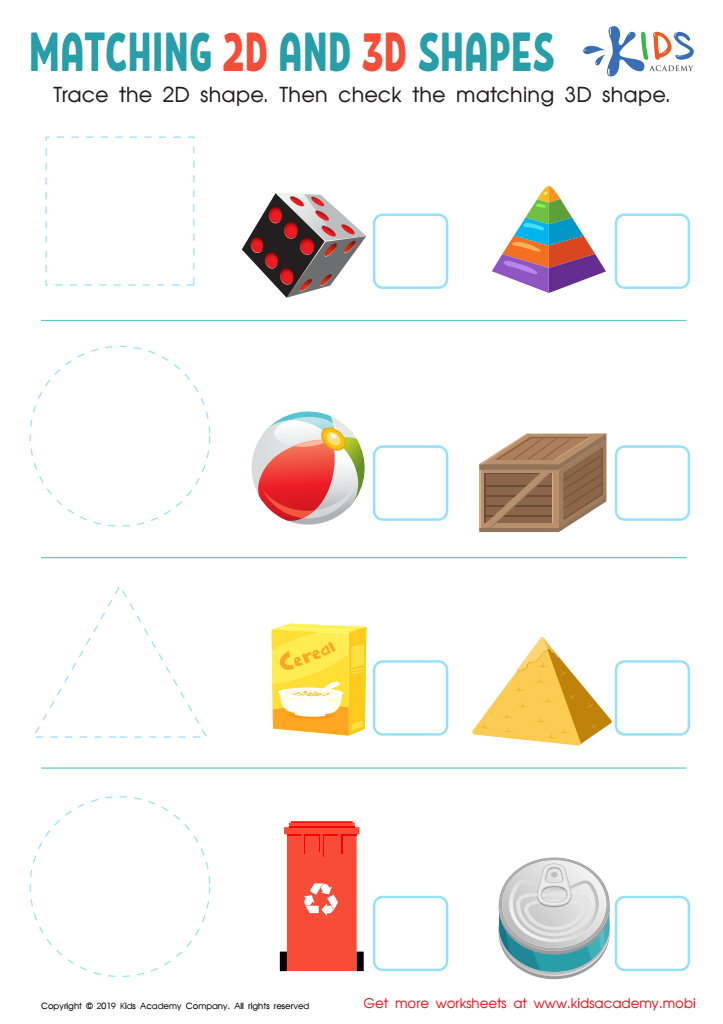
Matching 2D and 3D Shapes Worksheet
 Assign to My Students







Visual-motor skills, a child's ability to coordinate vision with body movements, form a critical foundation for cognitive development and learning, especially in math, from ages 4-5. At this stage, young students are transitioning from simple to more integrated tasks that demand these skills, such as recognizing shapes, pictures, and abstract symbols like numbers, which are fundamental in early mathematics.
Developing strong visual-motor skills helps children accurately perceive and reproduce visual information. This ability supports spatial awareness—essential for understanding geometry, patterns, and problem-solving. Activities like drawing, cutting shapes, and playing with blocks improve hand-eye coordination, fostering fine motor skills vital for writing numbers and navigating math-related tasks.
Poor visual-motor integration can lead to difficulties in math and other subjects, affecting a child's academic confidence and progression. By providing targeted support both at home and in school, parents and teachers can cultivate these skills through fun, hands-on learning experiences, such as puzzles, interactive games, and physical activities like playing catch.
Investing in visual-motor skills prepares children for the structured learning environment of formal schooling, easing their transition into more complex cognitive activities. This preparatory step is essential for nurturing a lifelong engagement with learning and academic success.








