
Cognitive Development Subtraction Worksheets for Ages 4-5
3 filtered results
Difficulty Level
Grade
Age
-
From - To
Subject
Activity
Standards
Discover our engaging Cognitive Development Subtraction Worksheets tailored for ages 4-5! These worksheets are designed to enhance early math skills through playful and interactive activities, allowing young learners to grasp the concept of subtraction in a fun and enjoyable way. Each worksheet incorporates colorful visuals and relatable scenarios that capture children's attention and encourage critical thinking. Perfect for classroom use or at-home learning, these resources support cognitive development by fostering problem-solving skills and number recognition. Help your little ones develop a strong foundation in math while having fun with these thoughtfully crafted themed worksheets today!
Favorites
With answer key
Interactive
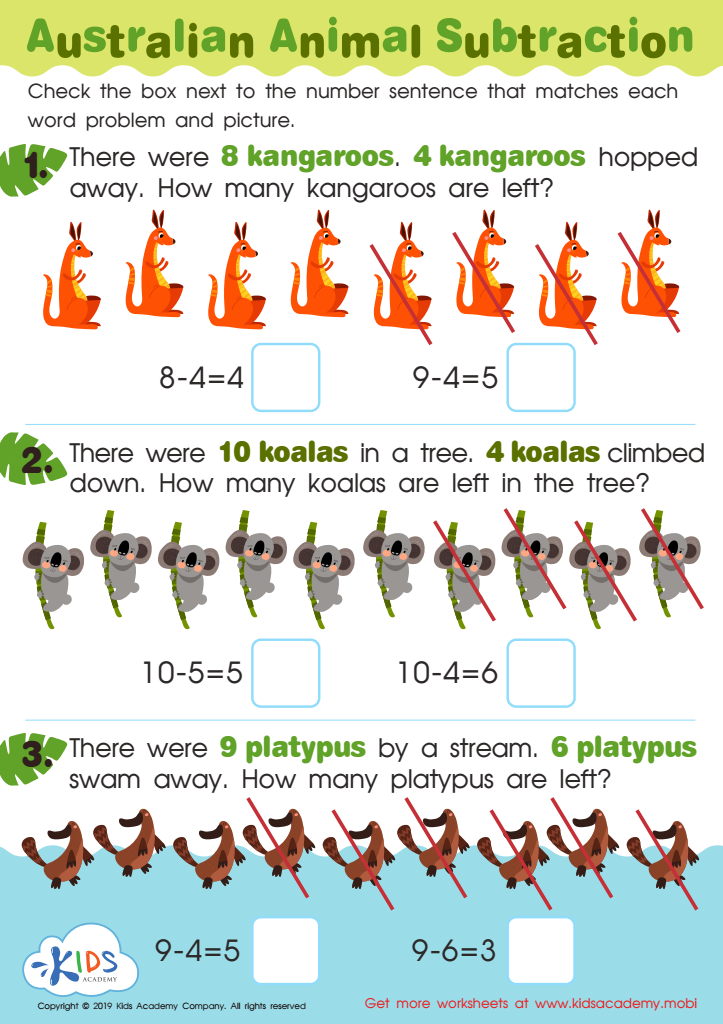
Australian Animal Subtraction Worksheet
Test your child's wildlife knowledge. Ask them to name animals indigenous to Australia or other countries. Show them the animals in this worksheet and have them match each word problem and picture with the correct number sentence.
 Assign to My Students
Australian Animal Subtraction Worksheet
Worksheet
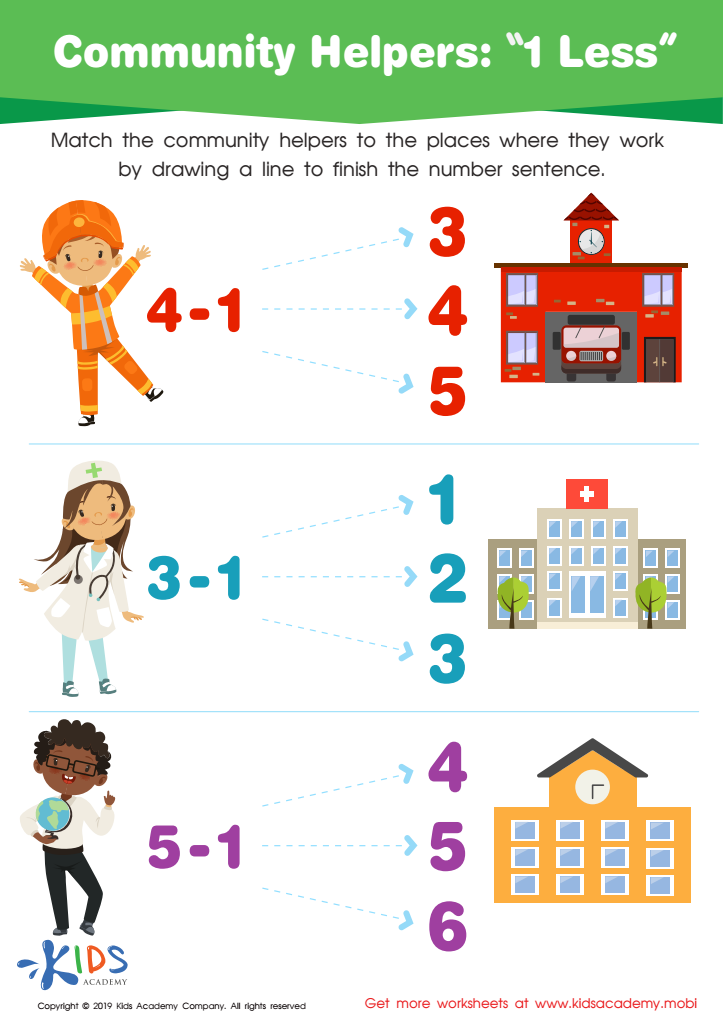
Community Helpers: 1 less Worksheet
Look at this worksheet with your child and ask them to identify the different community helpers. Match them to the places where they work by drawing a line to finish the number sentence. This helps them identify the people that help keep the community organized and running smoothly. Examples of community helpers include doctors, police officers, firefighters, teachers, etc.
Community Helpers: 1 less Worksheet
Worksheet
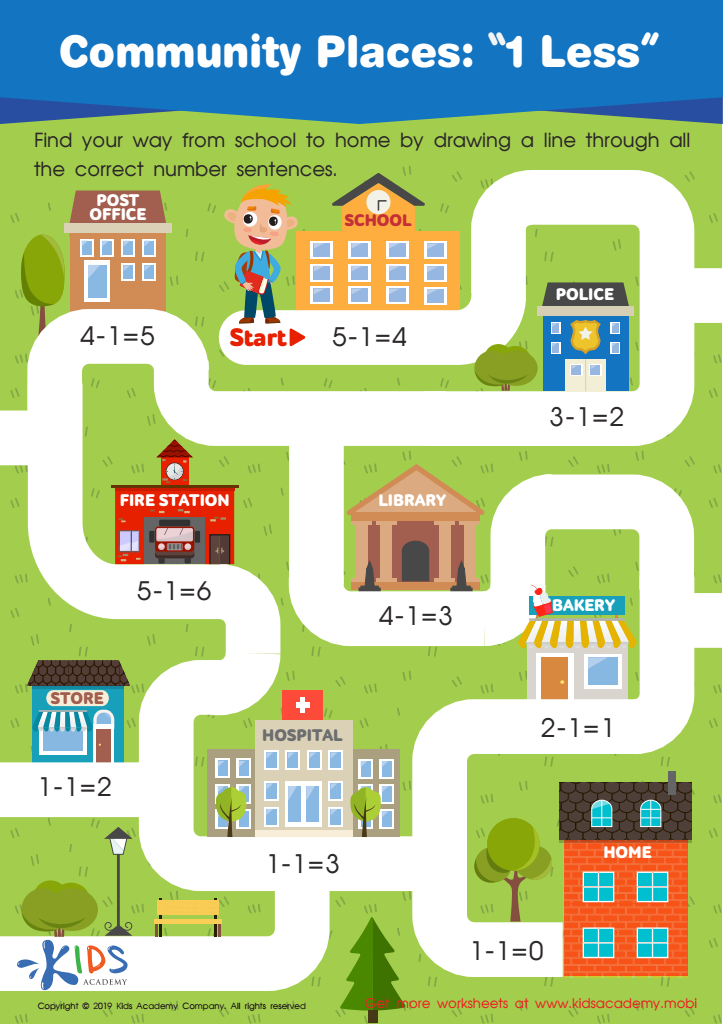
Community Places: 1 Less Worksheet
Have your kindergarteners draw a line through the correct number sentences as they find their way home from school. Ask them to identify the people, places, and buildings in their community and the jobs they do.
Community Places: 1 Less Worksheet
Worksheet
Join Kids Academy for Free
Who is primarily going to use this learning content?








Cognitive development in young children is crucial as it forms the foundation for their future learning and problem-solving abilities. Subtraction, a basic mathematical concept, is particularly important for children aged 4-5 as it enhances their understanding of numbers and fosters critical thinking skills. During this stage, children begin to develop their ability to reason, manipulate information, and engage in abstract thinking.
Teachers and parents should care about teaching subtraction because it promotes essential cognitive skills such as memory, attention, and spatial awareness. By introducing simple subtraction concepts through hands-on activities, games, and visual aids, children can grasp the idea of “taking away” and understand its practical applications in their daily lives. This understanding helps them build a more robust mathematical foundation and prepares them for more complex concepts in later years.
Moreover, engaging with subtraction can improve a child’s confidence and perseverance as they solve problems. Equipping children with these skills early on ensures they are better prepared for future academic challenges, fostering a lifelong love for learning and mathematics. Overall, supporting cognitive development during these formative years is critical in nurturing well-rounded, capable learners.








