
Reading analog clocks Math Worksheets for Ages 4-6
3 filtered results
Difficulty Level
Grade
Age
-
From - To
Subject
Activity
Standards
Discover fun and engaging "Reading Analog Clocks" math worksheets designed specifically for children ages 4-6. These printable worksheets help young learners grasp the concept of telling time through interactive exercises and colorful illustrations. Perfect for early grade math practice, our worksheets guide kids in reading hours and minutes on analog clocks, enhancing their understanding of time and boosting their confidence. Make learning a fun adventure with age-appropriate activities tailored to develop essential math skills. Download now and watch your child's time-telling abilities flourish while they enjoy playful, educational activities from the comfort of home!
Favorites
With answer key
Interactive
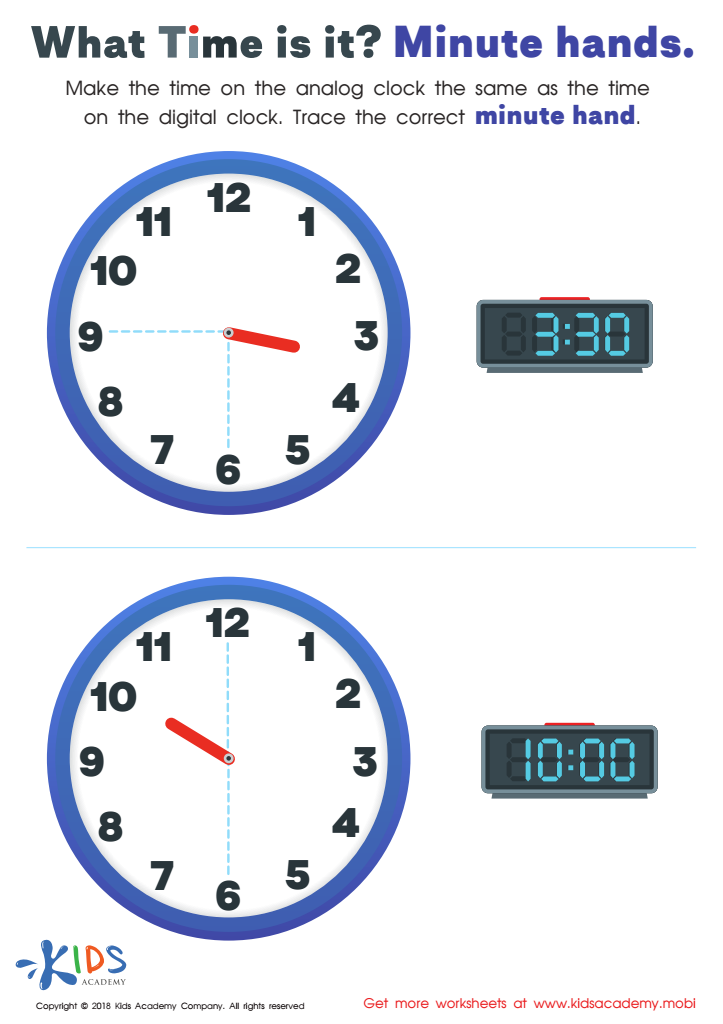
What Time Is it? Minute Hands Worksheet
Help your kids telling time with the minute hand correctly with this tracing sheet. Trace the correct minute hand to make the time on the analog clock the same as the time on the digital clock. Give them a pictured demonstration of how to do it and you'll be all set!
 Assign to My Students
What Time Is it? Minute Hands Worksheet
Worksheet
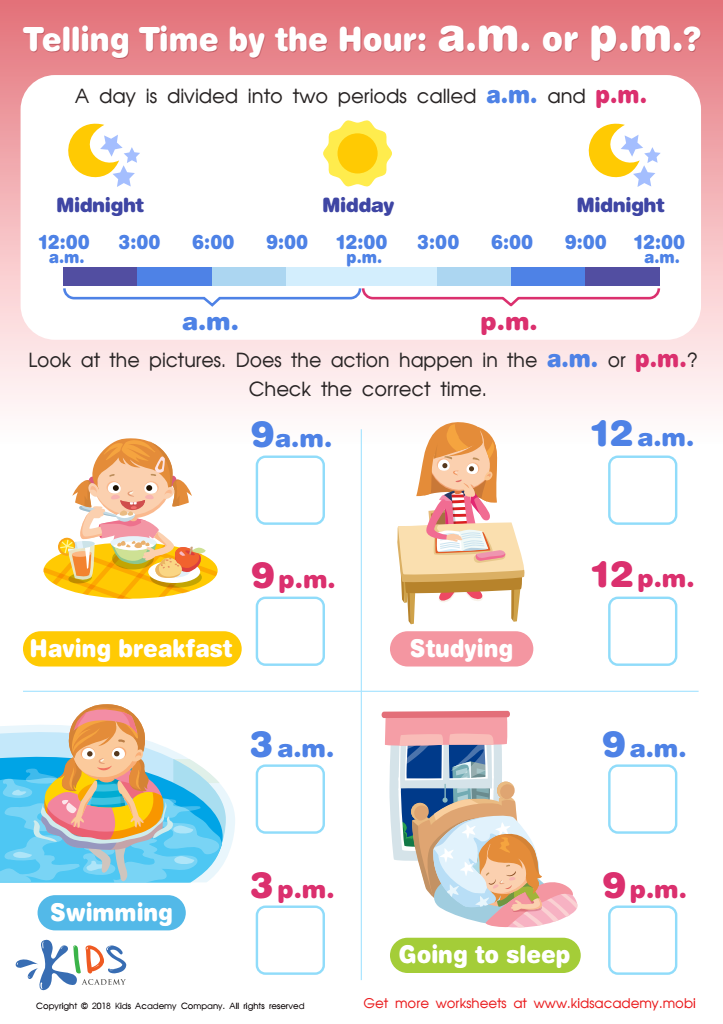
Tilling Time by the Hour: a.m. or p.m.? Worksheet
Can your child tell the time? This worksheet will help them learn. Explain a.m and p.m. and look at the pictures together. Ask your child if the activities happen in the a.m or p.m and help them check the correct time.
Tilling Time by the Hour: a.m. or p.m.? Worksheet
Worksheet
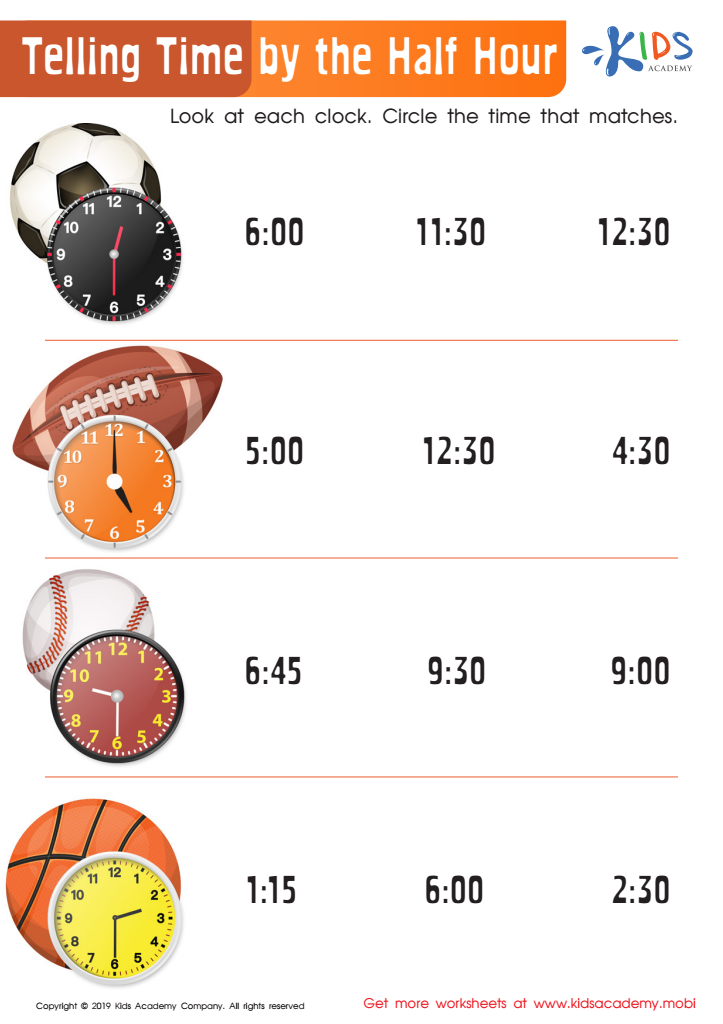
Telling Time by the Half Hour Worksheet
Teach kids to tell time with this worksheet! Four clocks are labeled with different times; help your child circle the right one. It's a great way to teach them to read analog and digital clocks, watches, and written times. Easy and fun learning!
Telling Time by the Half Hour Worksheet
Worksheet
Join Kids Academy for Free
Who is primarily going to use this learning content?




Parents and teachers should prioritize teaching children aged 4-6 to read analog clocks for several important reasons. First, it helps develop foundational math skills. As children learn to identify clock numbers and understand the concepts of hours and minutes, they enhance their number recognition, sequencing, and counting abilities. These skills serve as building blocks for more advanced math topics they will encounter later.
Second, reading analog clocks fosters a sense of time management and responsibility. By understanding how to tell time, young children can begin to grasp the concept of daily schedules, routines, and punctuality. This can lead to better self-discipline and organizational skills as children grow older.
Third, learning to read analog clocks boosts cognitive development. It requires children to practice spatial reasoning as they interpret the position of the clock’s hands relative to the numbers. This particular type of reasoning is crucial for problem-solving and critical thinking.
Finally, analog clocks are still pervasive in the real world despite the digital age. Schools, public places, and even homes often feature analog clocks, making it essential for children to understand both formats. Ultimately, teaching children to read analog clocks not only enhances academic abilities but also prepares them for practical daily life experiences.








