
Understanding prepositions Reading Worksheets for Ages 4-6
6 filtered results
Difficulty Level
Grade
Age
-
From - To
Subject
Activity
Standards
Boost your child's reading skills with our "Understanding Prepositions" reading worksheets, tailored for ages 4-6. These engaging and fun worksheets are designed to help young learners grasp the concept of prepositions through captivating exercises and colorful illustrations. By using these worksheets, children can enhance their understanding of spatial relationships and improve their sentence structure. The worksheets are perfect for building foundational reading skills in an enjoyable and interactive way. Visit our page to explore our extensive collection and give your child the learning advantage they deserve!
Favorites
With answer key
Interactive
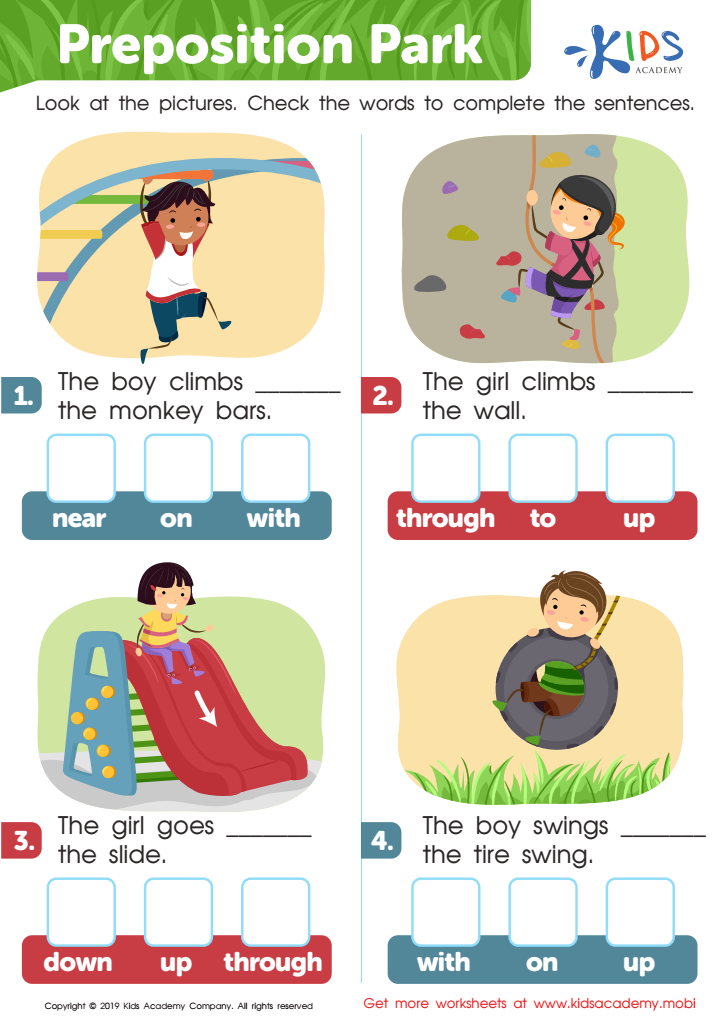
Preposition Park Worksheet
.
Check kids' understanding of prepositions by reminding them it's a word used to show location, direction or time. Look at the four pictures and ask what the kids are doing. Read the sentences below and help them check the words to complete them.
 Assign to My Students
Preposition Park Worksheet
Worksheet
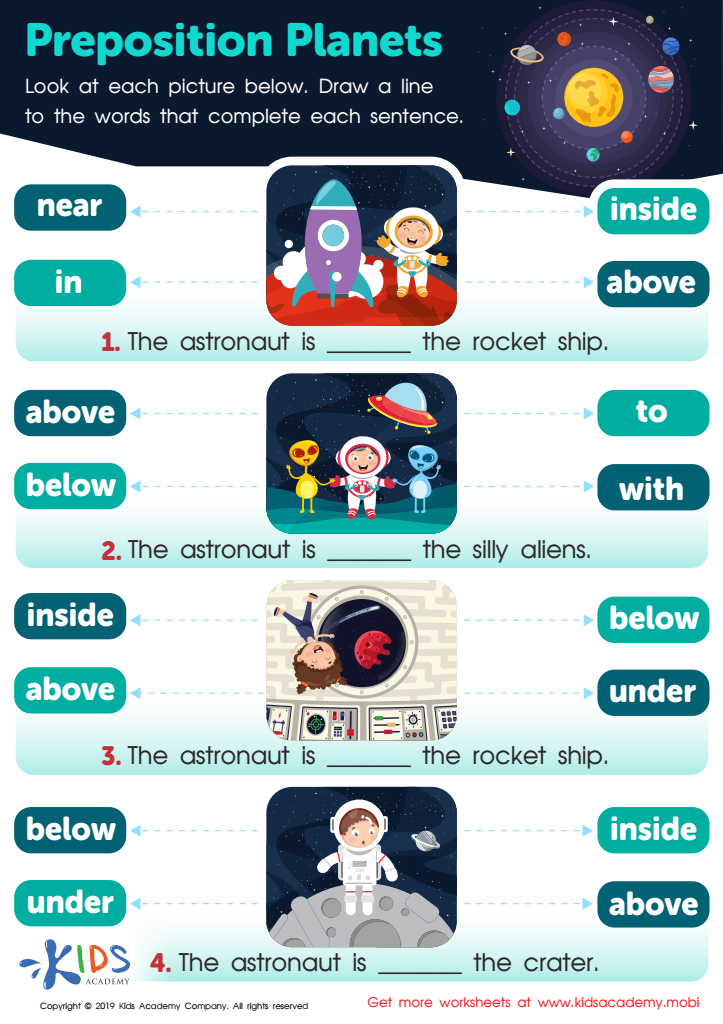
Preposition Planets Worksheet
Remind your child about outer space: which planet do we live on, and who travels there for research? Explain that prepositions show location, direction, and time. Look at the worksheet with colorful pictures of astronauts. Help your kids draw lines to the words that complete each sentence.
Preposition Planets Worksheet
Worksheet
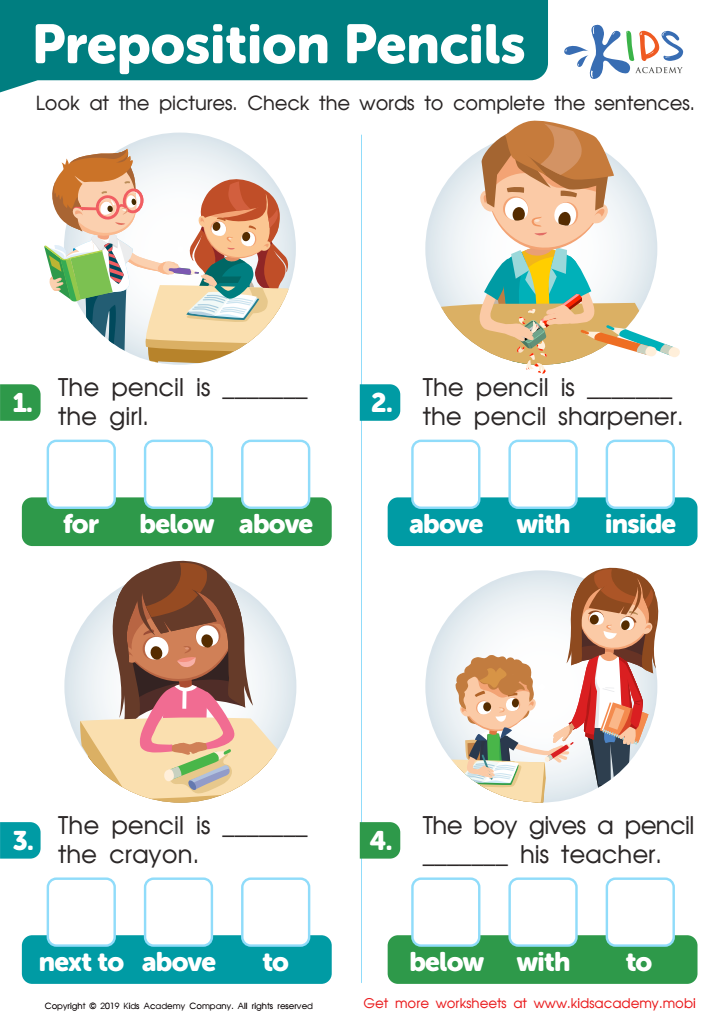
Preposition Pencils Worksheet
Constructing sentences follows rules. Parts of speech like nouns, verbs, adverbs, pronouns, and prepositions help. This worksheet focuses on prepositions. Explain prepositions to your child, then examine the pictures together and help them complete the sentences.
Preposition Pencils Worksheet
Worksheet
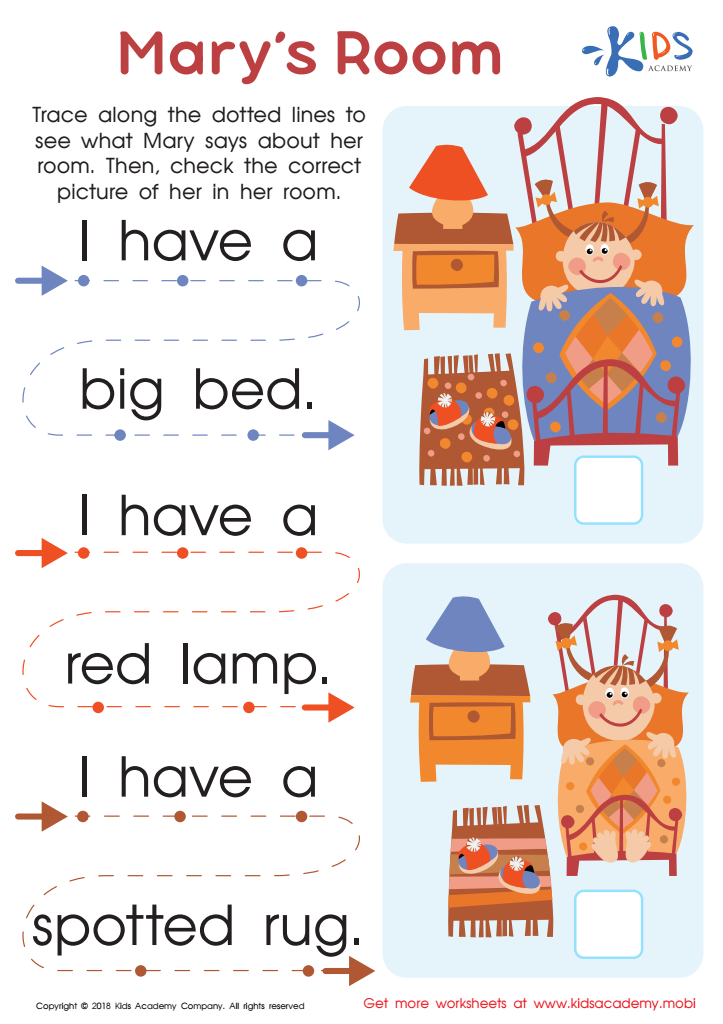
Mary's Room Worksheet
This cute PDF worksheet is a great way to help your young reader build their comprehension and directionality skills in a fun way. They'll use the images and clues to determine which room belongs to Mary. Following the traceable lines can give them a sense of being a detective, and help with directionality and fine motor skills too. Let them have fun and enjoy the activity - their skills will thank you!
Mary's Room Worksheet
Worksheet
Join Kids Academy for Free
Who is primarily going to use this learning content?






Understanding prepositions is foundational for young children, so it's crucial for both parents and teachers to prioritize this aspect of language learning. Prepositions are words that link nouns, pronouns, or phrases to other parts of a sentence—they help describe relationships in space, time, and direction. For children aged 4-6, mastering prepositions is essential for several reasons.
Firstly, it enhances their comprehension skills. When children grasp prepositions, they can better understand instructions, stories, and conversations. This comprehension is key for successful learning in all subjects and makes day-to-day communication easier and clearer.
Secondly, prepositions boost descriptive abilities and enrich vocabulary. Children learn to articulate their thoughts more precisely by saying "the toy is under the table" instead of "the toy is there." This specificity not only sharpens their language skills but also fosters cognitive development.
Moreover, understanding prepositions helps children express their creativity through storytelling, drawing, and even play. It also encourages social interaction, as they can follow directions more reliably and collaborate more effectively with peers during activities.
In essence, parents and teachers should focus on prepositions for early learners because doing so builds a strong foundation in language and cognitive skills, paving the way for academic success and effective communication throughout life.








