Fraction comparison Worksheets for Ages 4-7 - Page 2
44 filtered results
-
From - To
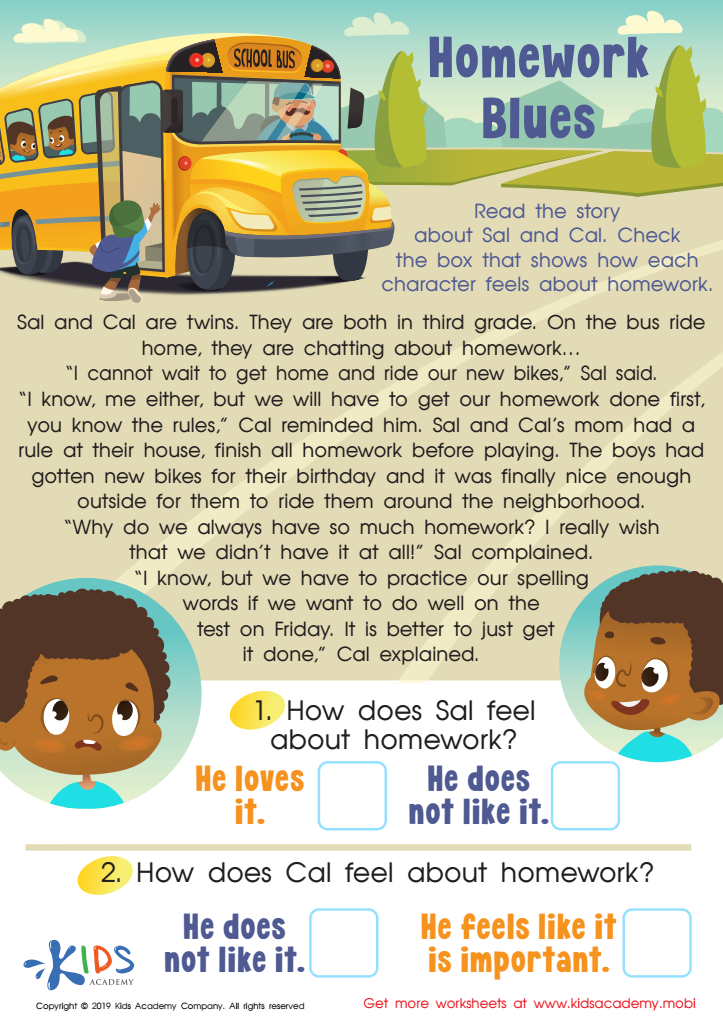
Homework Blues Worksheet
 Assign to My Students







Helping young children understand fraction comparison is crucial for their mathematical development. Even in early grades, grasping the basic concepts of fractions lays a foundation for more complex math skills they will encounter later. Fraction comparison is essential because it enhances a child's number sense, which involves recognizing and working with different quantities and numerical relationships.
When parents and teachers engage children ages 4-7 in comparing simple fractions, they cultivate critical thinking and problem-solving abilities. For instance, figuring out that 1/2 is larger than 1/4 because two parts of something are larger than one part of the same thing, teaches children to think logically and make reasoned judgments.
Additionally, nurturing an early understanding of fractions can help dispel any future anxiety or aversion toward math. Many students struggle with math as they progress to higher grades, but hands-on activities and concrete visual aids in early education can make fractions less intimidating.
Finally, fractions often appear in everyday life, such as dividing a pizza, sharing toys, or understanding parts of a whole. Early exposure helps children grasp these real-world applications naturally, making them not just better students in the classroom but more competent in routine activities.akh steps.
Hence, by focusing on fraction comparison at an early age, parents and teachers set the stage for lifelong mathematical confidence and competency.








