
Understanding fact families Worksheets for Ages 4-7
6 filtered results
Difficulty Level
Grade
Age
-
From - To
Subject
Activity
Standards
Welcome to our "Understanding Fact Families Worksheets" for ages 4-7! These engaging worksheets are designed to help young learners grasp the concept of fact families through colorful activities and exercises. Fact families show the relationship between addition and subtraction, fostering a solid foundation in mathematics. Our easy-to-follow worksheets include practical examples and interactive problems, encouraging children to identify and create fact families on their own. Perfect for home or classroom use, these materials promote critical thinking and boost confidence in math skills. Start your child's math journey today with our fun and educational fact families worksheets!
Favorites
With answer key
Interactive
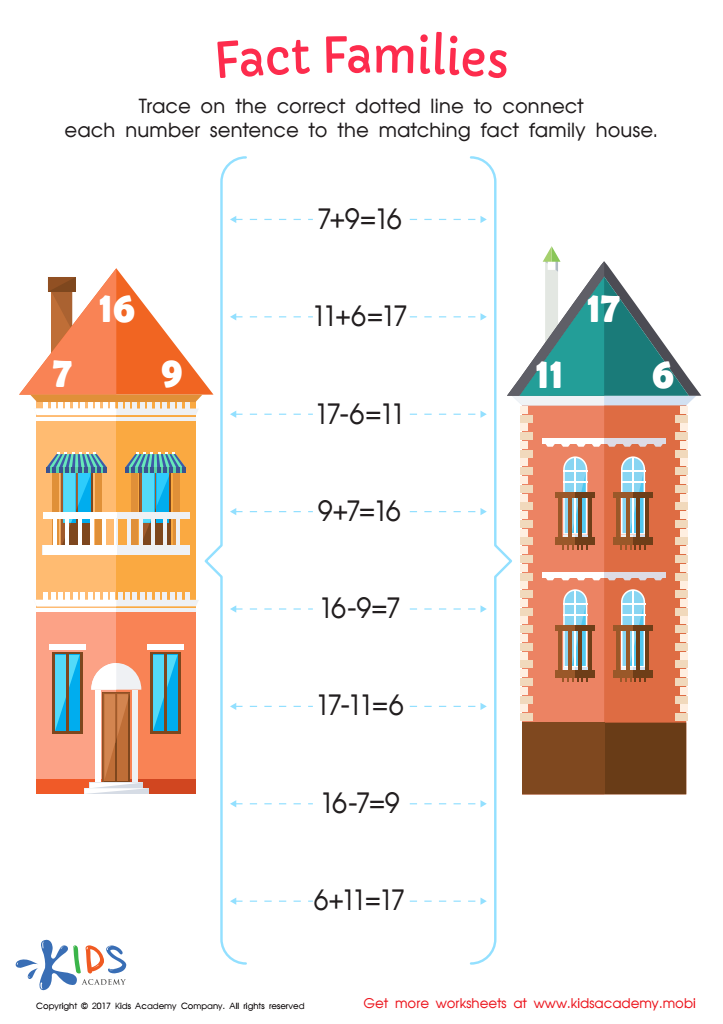
Fact Families — Add and Subtract Worksheet
Kids will love seeing how families of numbers "live" in their own houses!
 Assign to My Students
Fact Families — Add and Subtract Worksheet
Worksheet
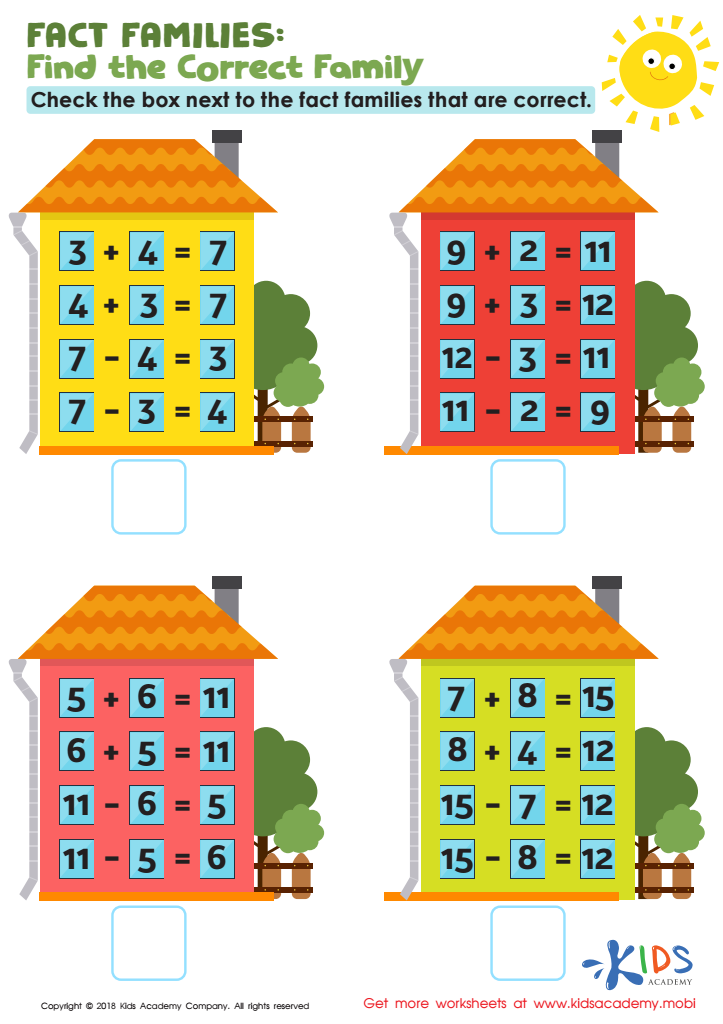
Fact Families: Find Correct Family Worksheet
Test your students' math and reasoning skills with this worksheet. It features 4 houses, each with a group of fact families on it. Some are correct, some are wrong - help students identify which are correct and circle the box next to them. This will help them progress in school.
Fact Families: Find Correct Family Worksheet
Worksheet
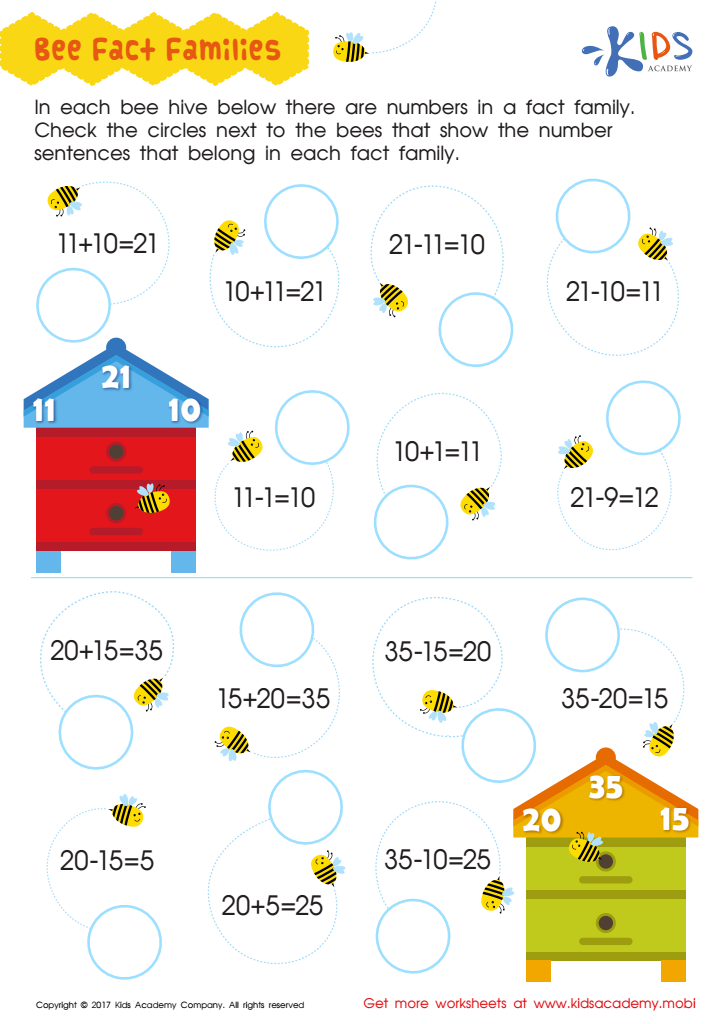
Fact Families Worksheet
Your 2nd grader will love this engaging activity.
Kids will buzz about fact families with this fun worksheet! Images of bees and their hives make learning numeracy enjoyable. Engaging and entertaining, your 2nd grader will love this activity.
Fact Families Worksheet
Worksheet
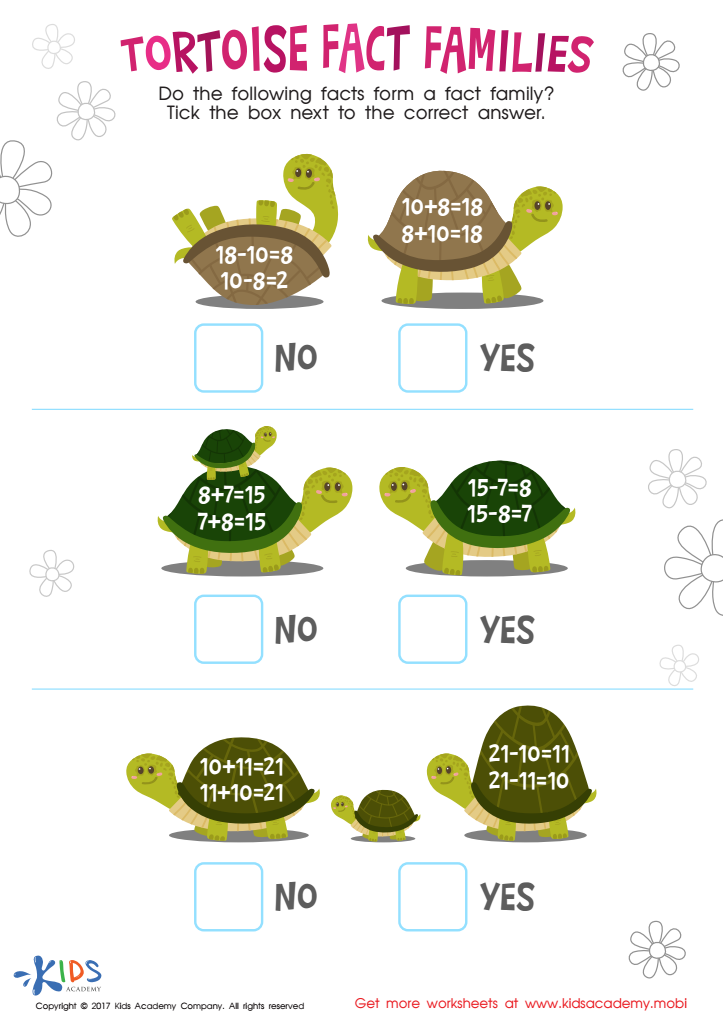
Tortoise Fact Families Printable
With 1st grade add & subtract tortoises, kids can improve their math understanding and skills. Enjoy fun, hands-on practice with fact families and strengthen logical reasoning and critical thinking!
Tortoise Fact Families Printable
Worksheet
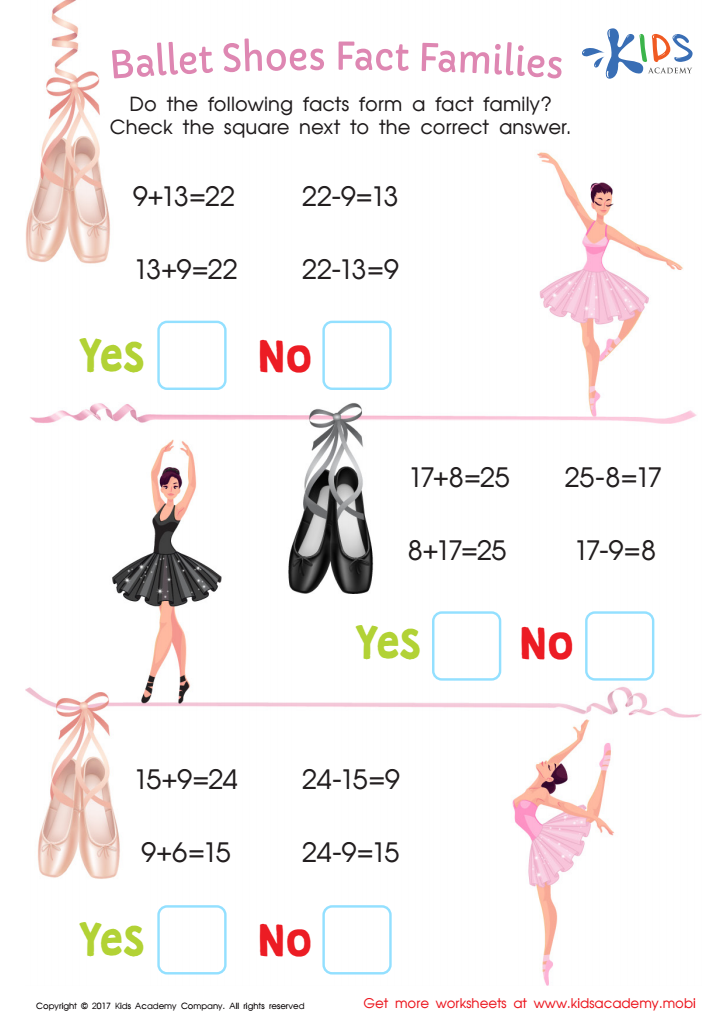
Ballet Shoes Fact Family Printable
Have them observe the equations and determine which groupings are fact families for a delightful learning experience. It encourages critical thinking, showing how addition and subtraction are related.
Ballet Shoes Fact Family Printable
Worksheet
Join Kids Academy for Free
Who is primarily going to use this learning content?







Understanding fact families is crucial for children ages 4-7 as it forms a foundational aspect of their mathematical development. Fact families help young learners grasp the concept of relationships between numbers, specifically within addition and subtraction. By understanding that a specific set of numbers can yield multiple equations (for example, 3 + 5 = 8 and 8 - 5 = 3), children develop a versatile approach to problem-solving.
Teaching fact families encourages number sense, critical thinking, and the ability to identify patterns, which are essential skills not only in math but in everyday life. When parents and teachers emphasize this concept, they foster an environment where children can confidently manipulate numbers, enhancing their overall mathematical fluency.
Additionally, engaging with fact families promotes collaborative learning as children can work together on exercises, discussing and reasoning through problem-solving processes. This dialogue reinforces their understanding while building social skills. As children learn the interconnectedness of numbers, they become more adept at approaching new mathematical challenges, setting a strong foundation for future learning. Therefore, investing time in teaching this concept is essential for nurturing capable, confident mathematicians who are prepared to tackle more complex concepts down the line.








