
Understanding number value Worksheets for Ages 4-7
4 filtered results
Difficulty Level
Grade
Age
-
From - To
Subject
Activity
Standards
Discover "Understanding Number Value" worksheets designed for ages 4-7 at Kids Academy. These meticulously crafted sheets help young learners grasp the fundamental concepts of number value through engaging and educational tasks. Perfect for both classroom use and home learning, our worksheets offer a variety of activities that make mastering number value enjoyable and effective. From counting and identifying numbers to building early math skills, ensure a strong mathematical foundation for your child with our children-friendly resources. Spark a love for learning as your little one develops crucial numerical understanding in a fun, interactive way. Explore today!
Favorites
With answer key
Interactive
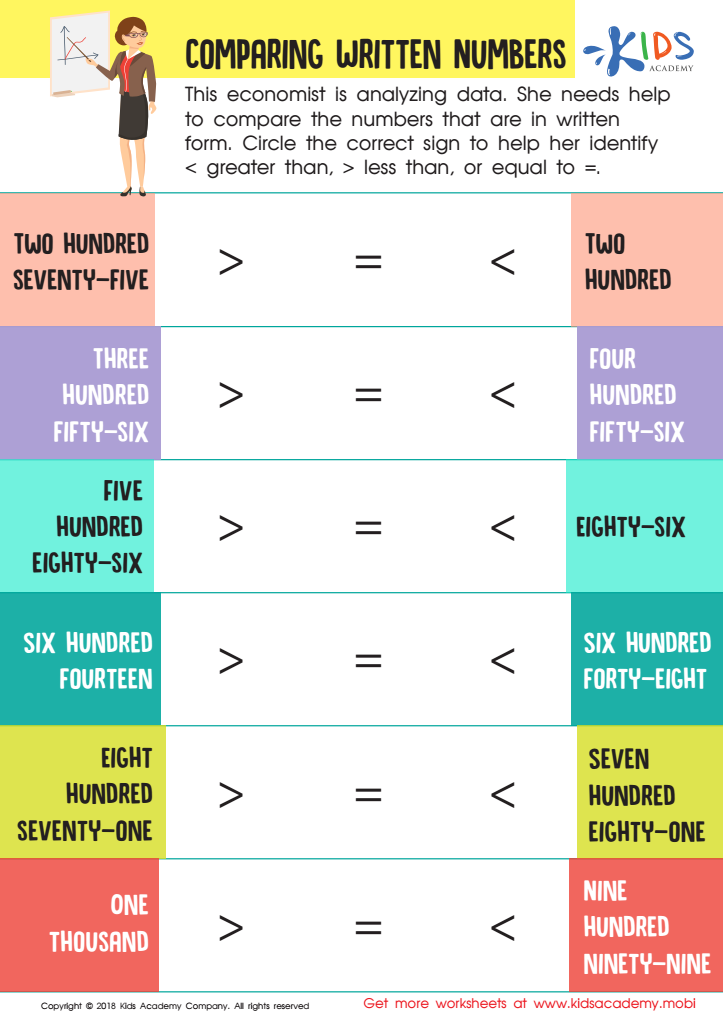
Comparing Written Numbers Worksheet
Children need to grasp that numbers come in different forms. This exciting PDF provides practice for comparing values written as words. Young economists can analyze the number pairs, then circle the sign (<, =, or >) to make comparisons true.
 Assign to My Students
Comparing Written Numbers Worksheet
Worksheet
Join Kids Academy for Free
Who is primarily going to use this learning content?


.jpg)




Understanding number value is crucial for young children's development, particularly between the ages of 4-7, as it lays the foundational groundwork for future math skills. At this age, kids are at a developmental stage where their brains are particularly receptive to learning basic numerical and mathematical concepts.
Firstly, grasping number value helps children understand more complex mathematical concepts later on, such as addition, subtraction, multiplication, and division. For example, knowing what the number "3" actually means enables them to comprehend that 3 + 2 = 5, not just as an abstract notation but as a logical outcome.
Moreover, number value understanding enhances cognitively essential skills like critical thinking and problem-solving. When children can match a quantity to its symbolic representation, they engage in a more profound level of thinking, which benefits their overall cognitive development.
It also affects practical aspects of their everyday life. From an early age, kids start recognizing amounts, comparing quantities, and eventually making fair exchanges or decisions based on number sense, like sharing toys equally among peers.
Additionally, confidence in math boosts general academic performance and fosters a positive attitude towards learning. Parents and teachers who focus on this skill set children up for future academic success and help them build self-assurance in their abilities. Consequently, integrating number sense activities in their curriculum or daily activities enriches their early education and personal growth.








