
Mathematical skills Addition & Subtraction Worksheets for Ages 4-7
3 filtered results
Difficulty Level
Grade
Age
-
From - To
Subject
Activity
Standards
Enhance your child’s mathematical abilities with our engaging Addition & Subtraction Worksheets tailored for ages 4-7. These expertly designed worksheets help young learners master fundamental arithmetic skills in a fun, interactive way. Each worksheet offers diverse exercises that bolster addition and subtraction fluency, ensuring children build a strong numerical foundation. Perfect for home or classroom use, our activities support educational growth and confidence in math. Help your child achieve success with enjoyable, age-appropriate practice that makes learning both effective and exciting. Start your journey to math excellence today with our Addition & Subtraction Worksheets!
Favorites
With answer key
Interactive
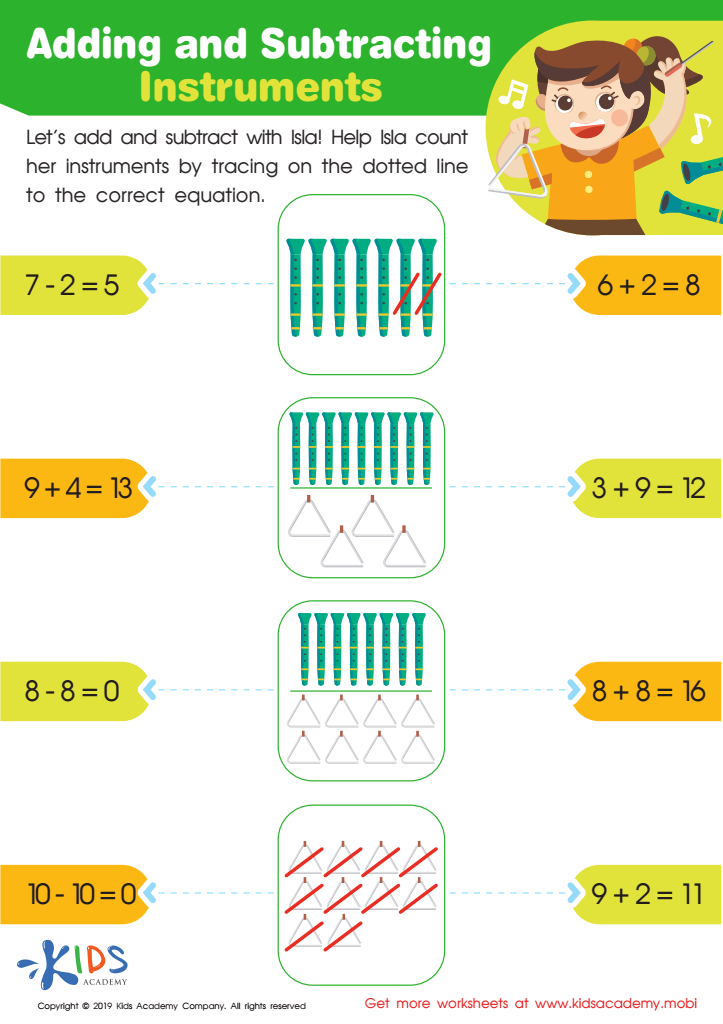
Adding and Subtracting: Instruments Worksheet
Children can help Isla count her musical instruments with this fun worksheet. The downloadable PDF gives them a chance to practice addition and subtraction by connecting pictures to equations. It's also a great way to learn the order of operations.
 Assign to My Students
Adding and Subtracting: Instruments Worksheet
Worksheet
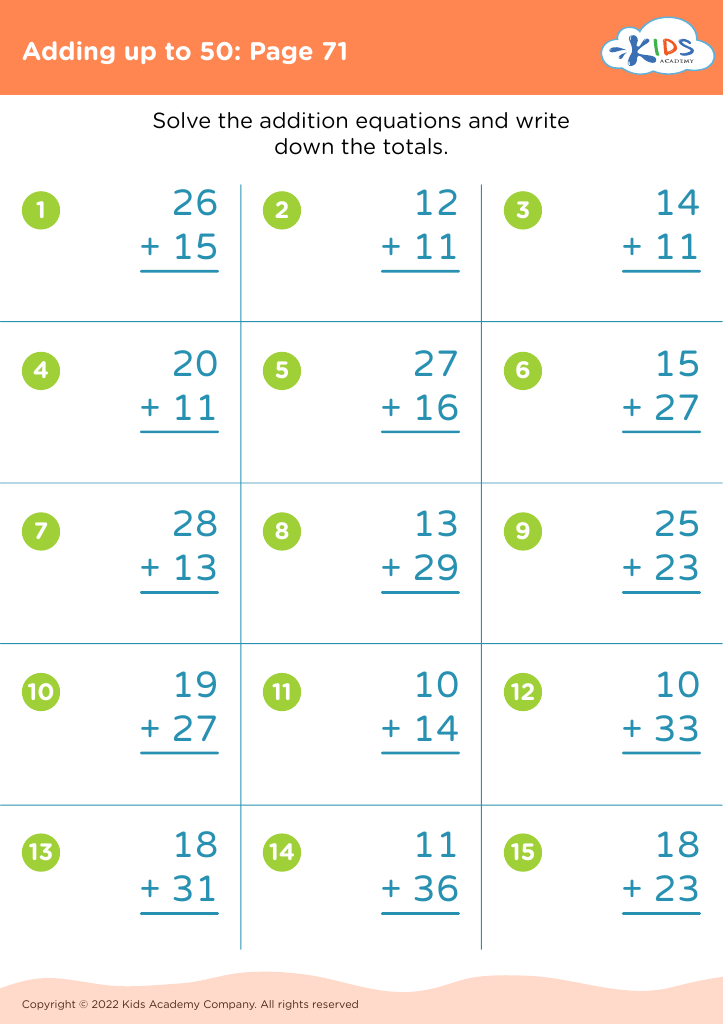
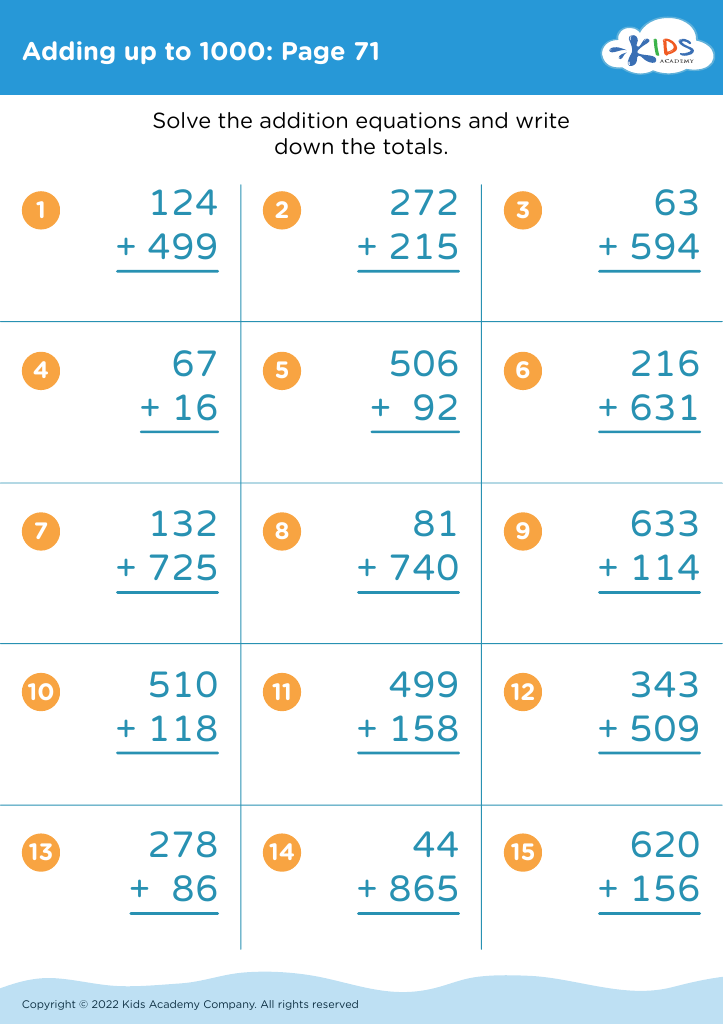
Join Kids Academy for Free
Who is primarily going to use this learning content?








Mathematical skills, particularly addition and subtraction, are crucial for children aged 4-7 as they lay the foundation for future learning and daily life applications. During these early years, children's brains are highly receptive to developing new cognitive skills, making it an ideal period to introduce basic math concepts. Proficient skills in addition and subtraction help foster numerical literacy, enabling children to understand number relationships and the principles of calculation, both of which are vital for tackling more complex mathematical problems later on.
Moreover, early competency in these arithmetic operations promotes logical thinking and problem-solving skills. As children learn to add and subtract, they start to recognize patterns, make predictions, and develop critical thinking abilities. This foundational knowledge is essential not just for math subjects but also for understanding concepts in science and coding, thereby opening doors to diverse academic and career opportunities.
Additionally, real-life situations often require quick and accurate calculations. Whether it's sharing toys, distributing snacks, or managing allowances, everyday scenarios help children practice these skills in a meaningful context, thus strengthening their abilities and boosting their confidence. Therefore, parents and teachers should invest time and resources in teaching these fundamental skills to ensure a well-rounded educational and personal development for young learners.








